Antara Harve February 28, 2023 No Comments

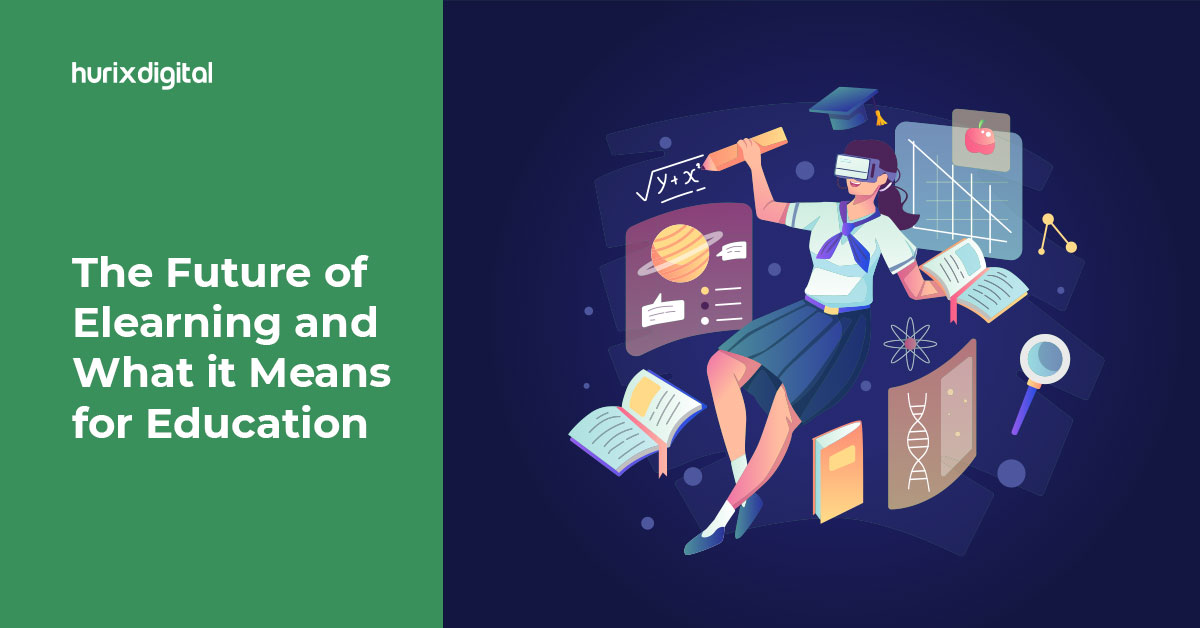
The Future of Elearning and What it Means for Education

[vc_row][vc_column][vc_column_text]E-learning has become the new normal, revolutionizing the way we learn and paving the way for a more efficient and effective educational experience. From virtual classrooms to interactive learning materials, e-learning is bringing a whole new level of convenience and engagement to education. It has opened up a world of opportunities, allowing students to learn at their own pace and in their own way. In this blog post, we’ll explore the future of e-learning in education by covering major trends reigning supreme in 2023.  1. Micro-learning Microlearning allows course designers to break down complex topics into small, easy-to-digest chunks, making it easier for learners to absorb the information.  It also allows them to focus on the specific topics they need to learn without getting overwhelmed by the entire subject. With microlearning, students can quickly review and retain the information they need without having to spend hours studying.  Research confirms that microlearning boosts long-term retention and focus by up to 80%. Moreover, it enables students to learn on their own time, making it a great option for busy professionals. A win-win for all! 2. Gamification Gamification is an engaging and interactive way to make learning fun and exciting for students. By introducing elements of gaming into the learning process, students are more engaged and motivated to complete their coursework.  Gamification also encourages learners to think critically and develop problem-solving skills as they have to figure out the best way to progress through the game. It provides students with a sense of accomplishment when they reach certain milestones.  Additionally, gamification can be used to personalize learning and make it more engrossing for students. No wonder 95% of learners favor a gamified work experience, according to a recent survey. 3. Adaptive Learning Adaptive learning is carving the future of e-learning in education. It is a personalized learning approach to education that uses technology to adjust teaching strategies and content based on the individual student’s needs.  This type of learning helps students engage with the material in a way that is tailored to their individual strengths and weaknesses, allowing them to learn more effectively and efficiently.  With the help of adaptive learning, students are able to learn at their own pace and according to their individual learning styles.  Additionally, adaptive learning can provide teachers with important data about student progress and understanding, which can be used to adjust the learning materials to better meet the needs of the students. 4. M-Learning M-learning, or mobile learning, is an exciting new way to learn that is becoming increasingly popular. It allows learners to access educational materials on mobile devices, such as smartphones and tablets, and offers an unprecedented level of convenience and flexibility.  With m-learning, learners can access educational content at any time and from any location, making it the perfect solution for busy people who need to learn on their own schedule.  Additionally, m-learning offers a way to distribute customized content tailored to individual needs, making it even easier to find the right material and quickly understand it.  With the added benefit of being able to contact other students and access help from teachers and other experts, m-learning is becoming increasingly mainstream. Therefore, it will continue to dominate the landscape of e-learning in education. 5. Video-Based Learning This is a type of online education that utilizes video content to teach students. Not only is video-based learning more compelling and interactive than traditional methods of learning, but it also has several other benefits.  With video-based learning, students can pause and rewind content, making it easier to absorb information and review concepts. This style of learning also allows for easier collaboration, as students can replay parts of lectures and videos to discuss topics with their peers.  Through this type of e-learning in education, students can watch lectures, tutorials, and demonstrations that can also be adapted to their unique learning needs. Undoubtedly, videos will continue to transform education in the future. 6. VR and AR in E-learning With the rise of virtual reality (VR) and augmented reality (AR) technology, e-learning in education has seen a dramatic shift in how students learn and interact with their environment. Through the use of VR and AR, students can explore virtual worlds and engage with their e-learning material in a more immersive and multisensory way. For example, they can explore a 3D representation of a historical event or learn a new language by engaging in a virtual environment. They can explore a virtual 3D model of a human heart to gain a better understanding of its anatomy. The possibilities are endless. It should come as no surprise that the use of VR in the global education market is anticipated to surpass USD 1.3 billion by 2026. In fact, VR training can be 52% more economical compared to classrooms when there is a large number of learners involved (3000+). 7. Artificial Intelligence (AI) AI-powered solutions are helping personalize the learning experience, providing students with tailored content, guidance, and feedback that can be adjusted in real-time.  AI systems can also be used to automate administrative tasks, such as tracking student progress and providing customized reports and summaries. Additionally, they can be used to identify patterns in student data that can help administrators and teachers identify trends and areas for improvement.  Artificial intelligence can also be used to provide automated feedback to students based on their performance, which can help them understand areas where they need to focus more effort and resources. Conclusion The future of e-learning in education is an exciting prospect for educators and learners alike. We can expect to see more interactive learning experiences, more personalized learning, and more options for remote learning in the future.  As technology continues to advance, e-learning will become even more accessible and user-friendly. We can also anticipate more collaboration between educators and learners, facilitating collaboration, communication, and feedback.  E-learning will continue to become part of the mainstream education system, offering more opportunities for customization and allowing learners to learn in their own way. Explore Hurix

Antara Harve February 27, 2023 No Comments

Integrating Mobile eLearning Into Corporate Training

[vc_row][vc_column][vc_column_text]In today’s highly competitive business landscape, organizations are constantly seeking ways to improve their operations to gain an edge over their competition. However, an organization’s most valuable asset is its employees; honing their skills and knowledge and improving their overall performance via corporate learning solutions is vital in achieving that goal.  Statistics show that the average American adult spends about 3 hours and 43 minutes on a smartphone daily. As this generation and smart devices are inseparable, it has become increasingly possible to incorporate mobile eLearning into corporate training programs.  In this blog, we will dive deeply into how organizations can leverage the power of mobile technology to create training programs that are more effective, efficient, and engaging, that help employees in reaching their full potential, and, as a result, support the growth and success of the organization. Mobile eLearning in Corporate Learning Solutions Here are the key benefits you as organizations can benefit from integrating mobile learning into your corporate learning solutions.  1. Access Training Solutions from Anywhere, at Anytime Employees carry smartphones with them all the time. With mobile e-learning, employees can access corporate learning solutions from anywhere and anytime, making it easier for employees to fit the required training into their busy schedules. Employees can utilize their downtime while traveling, waiting for food to be served at lunch, or even between calls to keep up with their required learning schedules. Let’s be honest; no one likes to stay back late after a hectic day to finish specific training assigned to them or have to extend their time at the office to catch up with work that couldn’t be done as there were training sessions held during work hours.  2. Improved Knowledge Retention Studies have shown that shorter learning sessions result in improved knowledge retention. Shorter learning sessions have a multitude of advantages; mobile e-learnings offer manageable bit-sized chunks of knowledge and information, which are easier to retain. In addition, employees can focus on the specific learning sessions that are most relevant to the current corporate learning needs as well as interests.  In addition, shorter mobile eLearning lessons can be accessed more frequently as and when employees need to re-enforce their command over a specific topic to keep them on top of their performance game.  3. It Gives Employees Control of Their Learning Unlike traditional corporate training sessions that are a one size fits all solution, with mobile eLearning, employees can receive personalized learning sessions with eLearning integrated into corporate learning solutions. In addition, customized learning sessions can be catered to each employee’s learning style and development goals.  This approach will not only improve employee participation but will also help motivate them further, leading to better learning outcomes. A secondary benefit to giving employees control over their learning is increased confidence, resulting in better job performance.  How can Mobile eLearning Benefit Organizations? Incorporating mobile eLearning into their corporate training solutions can offer a range of benefits to businesses, especially those with a growth-oriented mindset. Here are a few perks of mobile eLearning to keep in mind.  1. Increases Productivity Mobile eLearning has the potential to significantly enhance employee productivity when integrated into corporate learning solutions. Organizations can minimize employee downtime by eliminating the need for employees to travel to learning centers or stop work to attend specialized learning sessions, thus boosting productivity.  2. Mobile eLearning is Cost-Effective and Future-Proof Businesses can significantly reduce training costs by eliminating the need for expensive in-person training and the costs associated with travel expenses, materials, and hiring corporate trainers.  Mobile eLearning can also be easily updated to take advantage of new capabilities and trends as mobile devices and their associated technology evolve, ensuring that organizations are always up to date and prepared for the future. This can result in an improved ROI for businesses.  3. Mobile eLearning Can Help Organizations Keep Track of Employee Progress Incorporating mobile eLearning into corporate learning solutions can allow businesses to gather data on employees’ learning progress and performance. Mobile learning platforms often come equipped with tracking and reporting tools that can provide real-time progress data, which can also be used to identify areas where training can be improved or to assess the overall effectiveness of the training program. In addition, the above data can help organizations measure the ROI of their investment in the mobile eLearning program, which can help demonstrate the program’s effectiveness and secure funding for future initiatives. 4. Helps Standardize the Quality of Training Across the Organization Integrating mobile eLearning into corporate learning solutions can help deliver standardized training content to all employees at once, ensuring improved quality of training organization-wide which can also lead to enhanced training compliance.   Another benefit of mobile eLearning is that it can be translated easily into multiple languages. This can enable organizations to reach a large number of employees simultaneously, regardless of their geographical location or language. Providing quality training can also help organizations improve employee retention.  Summing It Up Integrating mobile eLearning into corporate learning solutions has the potential to benefit both employees and organizations significantly. Organizations can ensure that their employees receive the training and development they require for success by providing them with accessible, engaging, and personalized learning experiences while also reducing the time and resources needed for training and development.  Simultaneously, mobile eLearning can assist organizations in increasing employee engagement and motivation, resulting in improved performance and market competitiveness. The advantages of mobile eLearning are apparent, and organizations that adopt this technology will thrive in an increasingly fast-paced and competitive business environment. Hurix Digital’s Workforce Learning Solutions provide a comprehensive and effective way to manage your organization’s training and development needs. We focus on mobile-first technology that can provide personalized learning experiences and assist organizations in ensuring that their employees receive the highest standards of necessary training and development while reducing the time and resources required for developing and distributing new training solutions.  So, whether you want to improve employee engagement, increase knowledge retention, or support your employees in their career growth,

Antara Harve February 27, 2023 No Comments

Best cloud-based learning management system

[vc_row][vc_column][vc_column_text]With the rise of remote learning, the demand for cloud-based Learning Management Systems (LMS) has skyrocketed. A cloud-based Learning Management System enables trainers and teachers to design, manage, and deliver interactive e-learning experiences. According to a report by Forbes, the global e-learning market is expected to reach $325 billion by 2025, growing at a Compounded Annual Growth Rate (CAGR) of 9.5% from 2020 to 2025. The increasing adoption of cloud-based Learning Management Systems largely drives this growth. This article will discuss some of the best cloud-based Learning Management Systems available in 2023. Blackboard Blackboard is one of the most used cloud-based Learning Management Systems (LMS). It’s an all-in-one platform that provides institutions with a comprehensive set of tools and features for managing, delivering, and evaluating online and hybrid learning programs. Blackboard offers an easy-to-understand interface, customizable dashboards, and multiple tools to support the creation and management of online courses. Integration Capabilities and Analytics Features Blackboard can integrate with other systems, such as student information systems, content management systems, and other educational technologies, to provide a seamless experience for administrators and learners. Additionally, Blackboard offers robust analytics and reporting features that enable educators to track student progress, engagement, and outcomes and to make informed decisions about their courses and programs. Accessibility and Inclusiveness Another important aspect of Blackboard is its commitment to accessibility and inclusiveness, reflected in its accessibility features and compliance with international accessibility standards. Canvas Canvas is another popular cloud-based Learning Management System of 2023. It is known for its intuitive interface and flexible features, making it an ideal choice for schools and universities of all sizes. Robust Content Management System One of the standout features of Canvas is its robust content management system, which enables educators to easily create, manage, and deliver online content, including multimedia, assignments, assessments, and more. Additionally, Canvas provides many tools to support student collaboration, such as discussion forums, wikis, and peer review activities. Easy Access to Analytics Another important aspect of Canvas is its extensive analytics and reporting capabilities, which allow educators to track student progress, engagement, and outcomes in real time. This information can then inform course design and pedagogy and help identify areas for improvement. Canvas also provides a mobile-friendly interface, allowing students to access course content and engage with their peers from anywhere, on any device. Schoology Schoology is a cloud-based Learning Management System that has gained popularity among educators and institutions in 2023. It is designed to provide an integrated solution for managing the entire learning process, from content creation and delivery to assessment and collaboration. Flexible and Customizable User Interface One of the key features of Schoology is its flexible and customizable user interface, which allows educators to create and manage engaging and interactive online courses. The platform also provides many tools to support student collaboration and communication, including discussion forums, group projects, and peer review activities. Tools for Student Collaboration and Communication The platform seamlessly connects with other systems and tools, such as student information systems, content management systems, and educational technologies. This means that educators can access all the tools and resources they need to create, manage, and deliver online learning experiences in one place without switching between different platforms. Robust Integration Capabilities with Other Systems and Tools Schoology integrates with popular learning tools such as Turnitin and Google Drive. This allows educators to seamlessly create and grade assignments, check for plagiarism, and share resources with their students. The platform also integrates with SIS systems such as PowerSchool and Infinite Campus, allowing educators to manage student data and performance metrics easily. Open API Access for Custom Integrations In addition, Schoology provides open API access, allowing developers to build custom integrations with other platforms and tools. Educators can further tailor the platform to their needs by adding specific features and functionalities. Overall, Schoology is a comprehensive and user-friendly cloud-based Learning Management System that provides a wide range of features and tools to support online and hybrid learning. With its flexible interface, collaborative features, and analytics capabilities, Schoology is one of the top choices for educators and institutions looking for an effective and integrated solution for managing their online programs. Google Classroom Google Classroom is a free, cloud-based learning management system for K-12 schools and educational institutions. It provides educators with the tools and resources to create, manage, and deliver engaging and interactive learning experiences for their students. The platform is designed to simplify creating and managing online courses, making it easy for teachers and trainers to focus on delivering great learning experiences rather than worrying about technicalities. Here are some of the key features and benefits of Google Classroom: Course Creation and Management Google Classroom makes it easy for educators to create and manage their courses. They can add assignments, questions, and materials and track student progress. The platform provides a range of templates and tools that make it easy for educators to get started. The user-friendly interface allows teachers and trainers to focus on delivering great learning experiences rather than worrying about technicalities. Seamless Integration with Google Products Google Classroom integrates with other Google products such as Google Drive, Google Docs, and Google Forms. This makes it easy for educators to access and share resources and materials with their students. Assignment Management Google Classroom provides various tools and resources to help educators manage assignments and track student progress. Educators can set due dates, attach materials, and provide feedback to students. The platform also offers real-time analytics, so educators can see how their students progress and identify areas where they need extra support. Moodle Moodle is a widely used open-source cloud-based Learning Management System that has been developing for over two decades. As of 2023, it remains one of the most popular LMS options for educators and institutions worldwide. Flexibility and Customizability of Moodle One of the key strengths of Moodle is its flexibility and customizability, with a wide range of plugins, themes, and tools that allow educators to tailor the platform to their specific needs. 

Antara Harve February 27, 2023 No Comments

15 Best Online Learning Platforms

[vc_row][vc_column][vc_column_text]With the world shifting to an online mode of operations, it’s no surprise that higher education has also taken the digital route. From exclusive virtual classrooms to online lectures, more students are turning to online learning platforms for higher education. Top 15 Online Learning Platforms for Higher Education 1. Coursera This American online learning platform for higher education offers college-level courses from top universities worldwide. It collaborates with 275+ leading universities like Yale, Johns Hopkins University, and IIT Kharagpur for its courses. It provides 7000+ courses with the Coursera premium subscription in subjects such as Computer Science, Business, Public Health, Machine Learning, Data Science, and more. 2. Udemy Udemy provides over 8000+ courses with its plan and is one of the largest online education platforms for higher education. It’s also one of the most cost-effective online learning platforms, with courses on programming, design, marketing, and more. The platform also offers discounts on course bundles and certification programs. 3. edX edX is a nonprofit online learning platform for higher education and a collaborative effort of two of the world’s best universities – Harvard and MIT. It provides free courses from top universities, colleges, and organizations. Students can choose from thousands of courses ranging from data science and engineering to humanities and social science. 4. Unacademy Unacademy is one of the most popular online learning platforms for higher education in India. It offers free and paid courses in several subjects and provides mentorship by top educators. This platform provides over 30+ courses. It also offers competitive exam preparation courses, online workshops, and offline events. 5. NPTEL NPTEL stands for National Program on Technology Enhanced Learning. Launched in 2003, this platform is an initiative from the IITs and IISc funded by the Ministry of Education, Government of India, to provide free online courses to students. It offers nearly 600+ courses each semester in 22 disciplines, including engineering, science and technology, business, and humanities. Today anyone can access the online courses offered by NPTEL through its Massive Open Online Courses (MOOC) initiative. 6. Udacity This American online learning platform for higher education offers Nanodegrees for career advancement in the field of technology. It provides courses in programming, data science, artificial intelligence, and cloud computing. Udacity is a great platform for students who want to acquire job-ready digital skills with personalized support. The platform currently has more than 16.9 million registered users from more than 240 countries across the globe, with more than 2.6 million projects submitted so far. Also read: 7 best education tech companies for k-12 institutes 7. Khan Academy Created by Sal Khan in 2008, Khan Academy is an American nonprofit online education platform providing free courses to students of all ages. The platform offers lessons as short videos and provides free tools for parents and teachers. In addition, Khan Academy also provides practice exercises and course material for educators. With over 120 million learners from 190+ countries, 10,000 plus course videos, and more than 50,000 exercises in maths, biology, finance, and more, Khan Academy is one of the largest online education platforms. 8. Swayam Swayam is a Government of India initiative providing free online education to millions of students. It was designed to achieve three fundamental education principles- access, equity, and equality. Swayam offers courses taught in classrooms from class 9 till postgraduation. These courses are designed by some of the best teachers in the country and are provided in an interactive way to be accessed by anyone at any time, free of cost.  9. BYJU’S BYJU’S is a global ed-tech company that offers learning solutions to more than 150 million students across the globe. Its highly adaptive and engaging courses are designed to deliver highly effective learning solutions to students. In addition to providing K-12 education, it also offers various programs for students to prepare for competitive exams like IIT JEE, NEET, IAS, and CAT.  10. Great Learning Great Learning is a premier online learning platform for data science, AI, and analytics. Being a part of BYJU, it is also one of India’s largest professional learning companies. It offers courses ranging from introductory to advanced levels and provides industry-relevant programs in both online and offline modes. 11. UpGrad UpGrad is also one of the best online learning platforms for higher education. Founded in 2015, today UpGrad is South Asia’s largest online higher education platform. UpGrad offers courses in various fields, including law, marketing, finance, technology, and more. It has more than 2 million registered learners from over 100 countries across the globe. With its industry-relevant online courses, industry partners, and world-class faculty, it is revolutionizing higher education globally.  12. Simplilearn Simplilearn is one of the most popular online learning platforms for higher education available today. The platform provides learners with a wide range of courses, from basic to advanced levels, that they can take to gain knowledge and skills in their desired field. Simplilearn offers a variety of certifications and diplomas and has more than 1000 online courses in areas like Big Data, Machine Learning, Cyber Security, and more. 13. MasterClass MasterClass focuses on providing high-quality video tutorials and interactive learning experiences. The platform benefits learners who want to study new concepts in different fields or improve their existing skills. Learners can browse through a catalog of more than 180 classes and choose the one that best suits their needs. 14. Pluralsight Pluralsight is an online learning platform for higher education that provides a comprehensive library of courses and resources to help individuals and organizations stay ahead of the ever-changing technology landscape. With its extensive library, Pluralsight enables learners to gain the necessary skills to succeed in their chosen field. From software development and IT operations to data science and creative design, Pluralsight has something for everyone. 15. Eduonix With its wide range of courses covering various topics, Eduonix is the perfect platform for professionals looking to stay up-to-date with the latest industry trends. With its easy-to-use interface, intuitive navigation system, and interactive elements such as workshops and training,

Antara Harve February 5, 2023 No Comments

6 Higher Education Learning Challenges that Could be Solved with eLearning

[vc_row][vc_column][vc_column_text]The modern workforce today is evolving in the way it hires recruits. There is an increasing shift towards hiring for skills, not degrees. Recruiters seek a mix of domain, cognitive and interpersonal skills in a potential hire. Unfortunately, the higher education framework is yet to catch up with the needs of the evolving workplace.  With the growth of virtual education, some higher education providers are looking to upgrade their virtual education modules. Attempts are being made worldwide to raise the standard of virtual education with a mix of technology and creativity. Yet, many challenges to online learning remain unaddressed.    This is where the principles of elearning can revolutionize online education, and this shift is already happening. In 2020, the global eLearning market was valued at $197 billion. Moreover, it is expected to grow at a compound annual growth rate of 17.5% to reach an estimated market size of $840.11 billion by 2030.  In this blog, we look at the biggest challenges facing online education today and how elearning is emerging as a solution to address them.  The Six Key Challenges and Solutions A study by Learning House Inc. indicated that 37% of students who enrolled in both onsite and online courses felt their online experience was superior. Additionally, 87% felt it was either as good or better.  Going from there, let’s understand the challenges to online education and the eLearning solutions that can transform the learning experience.  Too Many Communication Channels When most universities in higher education institutes went online in 2020, one of the biggest challenges they faced was that educators were using multiple communication channels.  This included messaging apps and email and video conferences to host live sessions, send notifications, and share resources. In addition, they faced multiple challenges, such as limited bandwidth, the inability to communicate with a larger number of learners effectively at one time, and the inability to store resources in one place.  A solution to this problem is that higher education providers can now leverage a single unified platform, which makes it easy to store, categorize, and share sources. In addition, it offers a seamless, superior experience to all stakeholders, such as learners, parents, guest lecturers, and educators, who can be easily onboarded on one platform.  Understanding Tough Concepts is a Challenge   Learners need to master the fundamentals of each subject. Sometimes there is a need for enhanced interactive resources to supplement instructor-led lectures.  By leveraging mediums such as animated videos, 3D learning, augmented reality, and virtual reality, higher education experts can build an immersive experience for learners. This approach makes for a better understanding and retention of concepts.  Lack of Hands-On Understanding  Textbooks offer conceptual knowledge, theories, and information across all subjects. However, there is a need for learners also to invite skills and a deeper understanding.  E-learning enables them to get hands-on experience with simulated live projects. They can also work on the project as teams and build collaborative skills. A mix of domain, interpersonal, and communication skills is tested together.  For instance, students may be given a project where they need to apply a mathematics formula to solve a problem. They may need first to identify which mathematics formula to apply. They also need to use more than one formula at a time, thus making the experience both challenging and rewarding.  Lack of Revision  Learners need to continue practicing and revising to excel in their field. Many learners do invest enough time and effort in revisions. Hence, they end up getting what they have already learned. However, eLearning applies gamification to the learning process.  This approach makes revision extremely addictive and nudges learners to revise regularly. They will receive notifications reminding them to practice daily. As they practice more and more, they also receive rewards, which adds incentive to the journey.  The unaffordability of Physical Textbooks The price of physical textbooks is continually going up. As a result, learners often end up buying second-hand books or accessing pirated copies. These books are extremely heavy to transport and difficult to store.  However, in the last two or three years, more learners are adopting interactive eBooks, which deliver high value. In addition, learners can “listen” to the content of the books, thus reducing screen time.  They can highlight important pages, communicate with educators and fellow learners through comments, and instantly leverage the search function to locate information.  New-age eBooks come with interactive content in videos, audio presentations, and infographics. They also hyperlink to content outside of the eBook to enhance learning.  Lack of Data on Learner Engagement  Access to data offers educators insight into the habits of learners. Right from the early days, learning has always depended upon data insights as a guide to enhance the learning process.  Data enables educators to understand which learning resources are most useful, how they respond to gamification, which resources are least visited and need to be upgraded, what times of the day learners are logging in, and from which geography.  Educators can search from relevant data with customizable dashboards and receive insights within minutes.  Interactivity vs. Effectiveness Too often, education providers cram a lot of interactive modules to help enhance the quality of learning. However, an excess of interactivity does not translate to effective learning.  At times it can be distracting, confusing, and time-consuming. But it may not translate into the learning outcomes that an education provider is looking to drive.  The impact of eLearning ultimately lies in the ability of learners to absorb and retain knowledge and build ski lls. Hence, a thorough understanding of learning needs and outcomes must dictate the shift toward e-learning.  Conclusion  The sooner higher education providers address key challenges to online learning, the sooner they can offer a superior experience to learners that will give them a competitive edge in the world of work.  However, this shift requires a strong understanding of the eLearning space and how to make learning effective. This is where partnering with a digital software development specialist can empower higher education providers to transform

Antara Harve February 4, 2023 No Comments

Benefits of Higher Education Learning at Hurix Digital

[vc_row][vc_column][vc_column_text]High school education has experienced a digital transformation at an accelerated pace over the last two years. As a result, the needs of students and educators have changed immensely. Some of the key drivers of these shifts include the growing demand for high-quality learning resources, growing demand for virtual education, a need to lower the cost of textbooks and education, and making education accessible to larger demographics of learners.  Technology is playing a major role in delivering these shifts. Any education technology company looking to build a competitive edge in the higher education domain will need to upgrade its tech stack and embrace innovation. By partnering with a digital transformation specialist, they can leverage the benefits of e-learning in higher education.  In this blog, let us understand how innovative technology can elevate the standard of education delivered by an education technology company today.  Top 9 Benefits of Importance of Higher Education Learning Solutions at Hurix Digital Here is a snapshot of nine benefits e-learning in higher education can access by partnering with a digital specialist.  A Mobile-First Approach More and more learners are accessing online learning resources through their mobile phones. Hence, it is in the best interest of education technology companies to mirror this habit by offering platforms designed with a mobile-first approach.  Right from onboarding to taking an assessment, learners must be able to participate in all activities via their smartphones.  Building for Micro-Learning  Another growing trend is the concept of micro-learning.  Instead of spending several hours learning a concept, learners want to spend a few minutes watching videos, audio presentations, eBooks, visual presentations, infographics, or other online learning resources. In addition, they may want to spend a few minutes when traveling or waiting for an appointment to learn with high-quality learning resources.  Hence, educators are designing content that can be presented as bite-sized learning modules.  Interactive eBooks Replacing Physical Textbooks  Another growing trend is the replacement of physical textbooks with interactive eBooks.  Ebooks come with several advantages that are attractive to learners. First, they cost significantly less than physical textbooks. We do not way a ton as their physical counterparts can be stored on the cloud. Finally, learners can access them in several different ways. They can “listen” to the books being read out loud through audio representations. They can increase and decrease the font size, make notes, and highlight key learnings. Learning as a group with in-line communication between educators and students is possible.  Furthermore, Ebooks have interactive elements, such as videos, audio, presentations, and infographics, that engagingly simplify concepts.  Introducing Online Learning  The traditional classroom offers a lecture-based learning experience. Unfortunately, this can be a one-way street and discourage children from actively engaging.  By introducing some virtual learning programs and modules, educators can leverage the various advantages of online learning to benefit the classroom.  For instance, students can work on collaborative projects. They can ask questions while the teacher is teaching the subjects. Students can also revise lessons by referring to online resources shared by their teachers.  Access to Learner Insights   Another valuable contribution of technology is that educators can access detailed analytics to understand learner behaviors.  Education providers can get first-hand insights into how learners engage with various learning resources, what hours and days are most active, the geographies they are logging in from, and what types of content need to be revamped.  While higher education providers scale their operations and serve learners from several geographies, analytics will play an important role in determining the effectiveness of education.  Introduce Gamification  Statistics indicate that the introduction of gamification is a key strategy to engage learners. Introducing interactive modules and rewards draws learners in, making the process competitive and interactive.  The use of technologies like Artificial Intelligence and Machine Learning helps online platforms gauge a learner’s progress and proficiency level based on which relevant lessons are rolled out.  Another key outcome is that it makes practicing an addictive experience, thus enabling learners to stay committed to learning goals.   Geographically-Relevant Learning  With location-based technology, higher education providers can offer learners from various geographies relevant content.  For instance, it can offer content based on the curriculum of choice and the language relevant to that area.   Introducing Augmented Reality (AR) & Virtual Reality (VR) Certain concepts are tougher than others. However, some subjects also have great scope for a visual and immersive experience.  For instance, the Milky Way can be explained using technology such as AR and VR to create an immersive experience where students can closely see the planets and their moons instead of merely reading about them in their textbooks.  These technologies enable students to embark on a virtual learning tour that enhances the learning experience. They empower them to grasp tough concepts, retain information, and think innovatively.  Access to Online Libraries  It is challenging for educators to create content, especially video content, from scratch. However, today, online video libraries with a large number of videos of higher educational content are accessible.  By partnering with an innovative digital service provider, higher education providers can access readymade libraries with rich media content rather than developing such resources from scratch.  Conclusion  The importance of higher education learning and the benefits of implementing technology cannot be stressed enough. Therefore, any company providing services for implementing e-learning in higher education must continuously innovate to offer learners a superior learning experience. The key mission of any tech platform should be to deliver high-quality education and serve its learner base. Ultimately, providing education is to empower learners with knowledge and skills.  This is where partnering with a digital software solutions specialist can help free up bandwidth to deliver on this mission. Your digital partner will focus on bringing continuous innovation to aid that mission and help you reap the benefits of technology in higher education.   Suppose you are an education technology company that needs support. In that case, Hurix Digital offers customized services to build and deliver innovative learning solutions that expedite learning and make it a rewarding experience for learners. Connect