Blended learning vs Traditional learning: What’s the Difference?

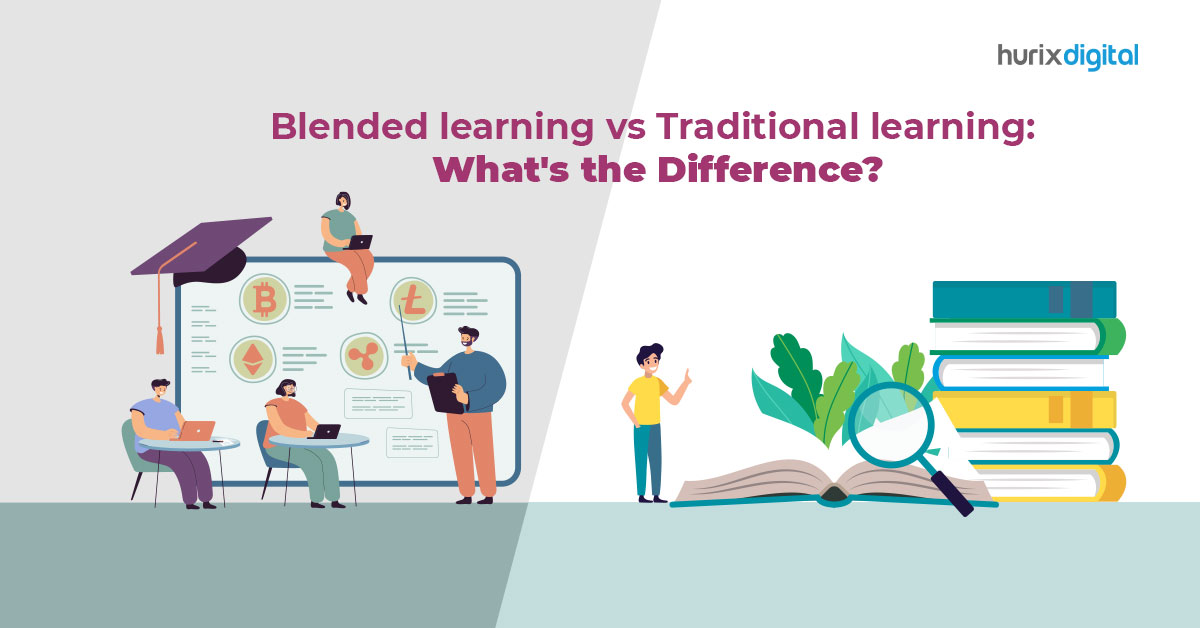
[vc_row][vc_column][vc_column_text]In the post-pandemic era, a mixed approach to schooling has emerged as the new standard. The landscape of education is rapidly evolving.  Education has seen a significant transformation in the last few years as a result of the 21st century’s technological advancements, the widespread adoption of digital technology in our educational ecosystem, and easy access to the internet.  The way that knowledge was previously taught to students has been fundamentally revolutionized through blended learning. Blended learning accelerates, simplifies, and expedites learning in contrast to the conventional method of teaching using a chalkboard.  60% of educators say that blended learning enhances students’ academic performance. Despite such advancements in learning, the debate of blended learning vs. traditional learning stays on.  This article is going to settle this debate by discussing both topics extensively.  The ABCs of Blended Learning: Concept, Importance, and More  As the name suggests, blended learning is a mixture of virtual and traditional methods of learning.  Virtual learning, or eLearning, allows students to complete their work at their own pace and in their own time. In contrast, traditional classroom learning takes place in a dedicated space with the student and teacher present.  Blended learning merges the two and creates a strategy that benefits both the learners and the educators. With blended learning, the emphasis is more on how teachers instruct their students, including the resources they employ and how they incorporate them into their lesson plans, as opposed to the situation or scenario. It enables learners to gain knowledge independently and in their own time. ‘ Furthermore, it provides instant feedback through evaluations and knowledge checks. Learners can easily assess the information they require at any time and location. It also offers content standardization and enables adaptive learning.  The blended learning method, just like the other learning methods, is utilized to achieve learning goals. This makes the impossible possible by offering functionalities that enable learning in ways that are hard to pull off in traditional classrooms.  Blended learning allows learners to understand what style of learning works best for them; it makes learning a fun experience for all kinds of learners with its interactive elements.  Blended Learning Vs. Traditional Learning: Which One Is Better? In the battle between traditional and blended modes of learning, the blended mode has acquired a lot of points so far for obvious reasons.  Blended learning is the perfect mix between traditional learning and eLearning and ensures that nothing comes in the way of a smooth learning experience for learners.  Here are more aspects that will settle the debate of ‘Blended Learning vs. Traditional Learning‘ for you. 1. Effectiveness and Flexibility Traditional learning follows the old ways of educating students, which are not always effective for the entire classroom because not all students learn at the same pace.  It’s hard for educators to keep track of the progress of every student in their classroom.  These issues don’t exist in blended learning; its curriculum is well-crafted and flexible for all kinds of students so that they can learn in their own space without any pressure.  As a result, learners make the most of their learning sessions and understand the concepts in depth.  2. Motivation Unlike traditional learning, blended learning provides instant feedback to learners regarding their progress.  This gives the learners sufficient time to work on the problematic areas and motivates them to push beyond their limits.  3. Personalized Education Not all learners have the same learning style and pace, and it’s hard for conventional learning methods to take good care of them all.  In blended learning, all kinds of learners get equal attention. The belief that there cannot be a training experience that syncs with the requirements of different students is strongly refuted by blended learning.  Moreover, while focusing on the study session, students can freely ask questions to the educators directly. When students do not feel pressurized by their teachers to perform well in every task they undertake in class, they give it their all. 4. Cost Efficiency Blended learning allows for significant financial savings for organizations. It eliminates the need for travel expenses while also allowing employees to continue with their regular work schedules, unlike traditional learning.  Students can learn everything their online tutor is teaching while sitting comfortably at their workstations. Ways You Can Incorporate Blended Learning in the Classroom Gone are the days when the concept of ‘one-size-fits-all’ was prevalent in the education sector. Educators nowadays focus heavily on making concepts clear to learners by incorporating blended learning methods, even inside traditional classrooms.  Here are four strategies you can follow to carry out study sessions effortlessly. 1. Utilize The Tools You Have You don’t need to spend a fortune on eLearning materials on day one; for starters, work with what you have, and the rest will fall into place. Try out new teaching techniques and find short videos related to your topic on the web.  Such small changes will make a big difference in the long run, and you will see the outcome in the student’s performance afterward.  2. Switch On The Smartphones If your traditional classroom has an anti-cell phone policy, it’s time to change that. If you use them wisely, you can easily eliminate distractions and make learning a fun activity.  You will see an increased amount of engagement from the majority of students present in class this way.  To take this further, you can ask your students to post tweets using their Twitter accounts based on the topics you have discussed in your class. Such activities will make them concentrate actively throughout to come up with the best results.  3. Assign Interesting Homework With the right actions, you can also make doing homework a fun activity for students. Start by assigning videos to watch at home or creating an online question set for them to solve before the next class.  In the next class, don’t forget to discuss the homework you’ve assigned. The students will be even more eager to get their work done if you stay consistent

How to Convert PDF to ePUB3? A Detailed Guide (2023)

[vc_row][vc_column][vc_column_text]Interactive storytelling is a growing need in the publishing world today. Consumers want to “listen” to books, engage through interactive multimedia content, and enjoy an immersive experience. eBooks are an important pillar in this journey. eBook revenues are expected to hit $14.21 billion by 2023. They are also expected to grow at a compound annual growth rate of 2.01 % to reach projected revenues of $15.39 billion by 2027.  In the early days, PDFs were used to produce eBooks, which essentially comprised text, static images, and hyperlinks that connected to related content on the Internet. However, PDF-based eBooks have limitations and may no longer serve the needs of a wide demographic of users.  Publishers, brands, authors, and social influencers bringing out eBooks are looking to bring more interactivity and accessibility through interactive eBook storytelling. They want to cut through language, readability, and cost barriers. This is where the feature-rich ePUB3 file format makes a difference. The use of ePUB3 instead of PDF is revolutionizing the world of eBooks as we know them.   In this blog, we delve into the growing relevance of ePUB3 and how businesses and influencers can convert PDF to ePUB3 seamlessly using an affordable, state-of-the-art digital publishing platform.  What is the Challenge Faced by Publishers, Authors, and Brands? Large-scale Conversion from PDF to ePUB3  One challenge faced by publishers, authors, and brands is that a large amount of existing content was produced in PDF format. Businesses may wish to produce newer editions of these eBooks. They may want to upgrade them, enhance them with multimedia content, and create access to a wider, more inclusive demographic.  For instance, they might wish to republish an eBook in a different language, add a read-aloud functionality, embed fresh multimedia content, and improve the readability of an eBook across multiple devices. With the arrival of ePUB3, all of these upgrades a possible. In addition, the arrival of digital publishing platforms makes it easy to convert PDF to ePUB3 eBooks seamlessly and distribute them at scale. But first, let’s understand the unique benefits of the ePUB3 file format.  What is an ePUB3 File? An ePUB file is an innovative format that enables reflowable text, unlike a PDF file. This means that the format of the content automatically adapts based on the screen resolution of the device used. PDFs also tend to be heavier files as compared to ePUB because ePUB extensions or files are stored in a zip file, using HTML to proceed.  ePUB3 is the latest version of ePUB. A key advantage is that it enables files to be embedded with videos, audio, and interactive multimedia elements. This innovation means that any content piece, such as an eBook produced with ePUB3, can be made more engaging.  This is great news for publishers, businesses, and content creators, who aim to produce high-quality, accessible content. ePUB3 has the potential to revolutionize the way we present eBooks, from books on food, and science textbooks, to children’s books. It helps publishers bring creativity to their storytelling while consumers get access to highly user-friendly eBooks.  ePUB3 Also Comes With Some High-Value and 3 Unique Features as Follows:  Consumers can leverage a spectrum of fonts and text styles, thus enabling more power over how they consume content.  It removes language barriers by enabling compatibility for multiple languages. It also allows for books to be written in languages like Arabic, which are traditionally written from right to left.   K-12 publishers especially can leverage the ePUB3’s capabilities for directly embedding MathML, or Mathematical Markup Language, an XML-based language used to describe mathematical notation. This is a useful feature when creating science, math, and engineering textbooks.  How to Convert eBooks from the PDF to ePUB3 Format  Today, a wide range of tools are available to convert PDF to ePUB3 files easily and cost-effectively. However, the most secure approach for businesses is to do it through credible digital publishing software, which enables files to stay secure, safe, and confidential. 6 Simple Step-By-Step Guide to ePUB3 Conversion: Step 1 – The first step is to register and create your account on the platform. Step 2 – The next step is to import your PDF file. Click on the “Import PDF” option, and select the relevant PDF document, which needs to be converted, when the PDF dialogue appears. Step 3 –  Select the fixed layout ePUB3 template or reflowable layout template per your needs. If you want the format to stay intact, then go for the fixed layout template so you have more control over the outcome.  Step 4 – You will need to choose the font of the text. You can either stick to the existing font, choose a similar font, or use fonts from a specific URL. However, the default choice is the font used in the PDF document.  Step 5 – You will now need to preview and edit the new file. Look out for the preview and edit buttons, and continue the process until you are satisfied with the results. You can add relevant links, videos, and images to enhance the storytelling. Step 6 – Once you are satisfied with the final PDF to ePUB3 copy, you are ready to publish the upgraded version. Click on the “Publish” button, and your eBook is ready to be distributed to your audience.  A professional digital publishing platform also comes with digital rights management, which enables the secure distribution of the eBook to authorized audiences. Hence, make sure that your PDF to ePUB3 conversion is done professionally, especially if you run a business and want to keep the content secure.   The Takeaway  The launch of ePUB3 has changed the game for publishers, who can leverage its features to redefine the eBooks of the future. This is an incredible marketing opportunity waiting to be tapped. However, the opportunity is not restricted to publishers. A growing number of brands and social influencers are also leveraging eBooks to build visibility and brand loyalty.  The usage of ePUB3 is expected to drive up the demand for

How Can Video-Based Training Technologies Be Used To Provide Interesting Training Videos?

[vc_row][vc_column][vc_column_text]Training and updating your staff on new skills is crucial in today’s fast-paced business world. But how can you make this process more exciting and effective? Enter video-based training technologies, the ultimate training tools for employees. We’ll explore the benefits of video-based training, how to create engaging training videos, and the best practices involved. You’ll also learn how to measure the success of your training programs and take employee development to the next level.  Let’s dive in! The Importance of Training Tools For Employees The importance of employee training is critical to the success of any business. A company would want to invest in employee training for many reasons, but most importantly, it helps increase employee productivity and motivation.  Employee training should be ongoing throughout the year, not just once or twice yearly. You might be wondering how video-based training technologies can engage employees. Here are some ideas: Use video as a coaching tool during live training sessions Use microlearning techniques Create interactive games or quizzes requiring learners to answer questions before progressing through the course material. Types of Video-Based Training Technologies There are different types of video-based training technologies. They include: Animated videos are animated images or graphics that can be used to explain concepts and processes. These can be created using different software programs such as Adobe Photoshop or SketchUp Pro. Live-action videos are recordings of real people taking tutorials in real time. They can also be captured with unique cameras that record at high speeds. When played back at an average rate, it looks like the person is moving slowly or standing still while speaking in slow motion or pausing between sentences/words/phrases to create emphasis in training materials. Interactive videos allow users to click on certain parts of the screen where they want more information about something specific before continuing their learning journey. Virtual reality (VR) videos give viewers an immersive experience by allowing them to see what it would be like if they were physically present in a specific place/environment–for example, employees in simulations of a scenario using tools at work and attending meetings/conferences without leaving the comfort of your homes. Benefits of Video-Based Training Technologies Video-based training technologies provide extensive toolkits for creating engaging training videos that can be used for various purposes, such as improving productivity, increasing retention rates, and creating marketing materials for promoting an organization’s products or services, among others. Here are some of the benefits that video-based training solutions can offer: Improved employee engagement Video-based training solutions allow you to deliver content more engagingly than traditional learning methods like text or audio files. Employees will be more likely to retain information from their training sessions if they’ve been captivated by visually striking graphics/animations in the video or seen the event in real-time rather than read about it in an ebook or listen to audio recordings. Cost-effective and efficient They allow you to train employees on the job rather than sending them to a classroom or paying for outside trainers. This saves time and reduces costs associated with travel and other expenses related to learning new skills. Video-based training technologies allow you to create engaging and interactive videos that can be viewed anytime, anywhere in the world. They allow employees to train themselves with little to no help from others, thus saving your company money on employee training costs. Customizable and accessible You can add text, images, and other visual elements to help explain complex concepts more clearly. Video-based training technologies enable users to access their content anywhere with an internet connection or mobile device such as a tablet or smartphone. You can easily access YouTube or similar platforms where videos can be downloaded onto devices. You can also create courses that include multiple types of media such as text, audio, images, and video clips and other interactive features such as quizzes or polls that allow participants to take action right away after viewing a particular topic or concept covered in the course material. Creating Interesting Training Videos using Video-Based Training Technologies Video-based training technologies are a great way to provide interesting training videos. They allow you to convey complex information engagingly and memorably, but creating such videos is not always easy. Here are the steps on how to make your video training content more engaging: Setting clear objectives and defining the target audience This will help you determine what information needs to be conveyed and how best to do it. You need to find out what goals your audience wants to achieve and what challenges they face when trying to achieve these goals. By understanding these objectives, you can create a more engaging video training program that helps people reach their goals faster. Scriptwriting and storyboarding The purpose of this exercise is not just about conveying information — it should also engage learners so they not only broaden their skill sets by engaging in new learnings and reduce the gaps in understanding through learning and development initiatives. This means using persuasive language and phrases that capture attention and providing humor where appropriate (such as during transitions). Incorporating engaging visuals and sound effects Combining text with images makes the information easier to understand than if you were just reading what you need to know. You can also include sound effects in your video so that it feels more like a movie than just a series of slides or still images on your computer screen. In addition, if you have access to royalty-free music, you can incorporate music into your video for added interest for learners. Using gamification and interactivity to enhance the learning experience Gamification and interactivity help build engagement with learners, which is essential for effective learning. You can incorporate elements like badges and leaderboards into your video-based training by adding interactive questions at various points in your content to entice participants to stay attentive. You can also encourage participants to respond to what they’ve learned by sharing their thoughts and feedback on social media platforms such as Twitter or

Infographic: How to Use Microlearning in Sales Training

[vc_row][vc_column][vc_custom_heading text=”Microlearning in Sales Training” font_container=”tag:h1|font_size:16|text_align:left” use_theme_fonts=”yes”][vc_single_image image=”98416″ img_size=”full” alignment=”center”][vc_column_text] For more insights write to us at marketing@hurix.com [/vc_column_text][/vc_column][/vc_row]

What are E-commerce Solutions? Benefits, Types, Best Practices and More

[vc_row][vc_column][vc_column_text]E-commerce solutions are becoming increasingly important for businesses to grow and thrive in the digital age. With the gradual growth of online shopping, it’s crucial for businesses to have a proven e-commerce strategy to reach and acquire customers and sell products. In this article, we’ll cover everything you need to know about e-commerce solutions and how they can benefit your business. What are E-commerce Solutions? E-commerce solutions refer to a set of software and technology tools that help businesses sell products and services online. These solutions typically include a website or online storefront, a shopping cart, payment processing systems, and inventory management tools.  These solutions also often offer marketing and customer relationship management (CRM) capabilities, enabling businesses to promote their products and manage customer interactions effectively. The purpose is to streamline the online sales process and make it easier to sell products and services to customers through the internet. Top 6 Benefits of E-commerce Solutions E-commerce solutions offer several benefits for businesses looking to sell products and services online. Increased Reach: They allow businesses to reach a global audience, expanding their customer base beyond geographical limitations. Convenient Shopping Experience: They provide customers with a seamless shopping experience, allowing them to shop from anywhere at any time. Improved Sales and Revenue: They make it easier for businesses to sell products and services, leading to increased sales and revenue. Cost-Effective: They can help businesses reduce their costs by eliminating the need for physical storefronts and associated overhead costs. Better Customer Insights: They offer businesses access to valuable customer data and insights, allowing them to understand customer behavior and preferences better. Increased Product Visibility: They make it easy for businesses to display or showcase their products to a large audience, increasing their visibility and attracting new customers. Streamlined Operations: They automate many of the manual tasks involved in running an online store, freeing up time and resources for business owners to focus on growth and innovation. Overall, they offer a comprehensive suite of tools and capabilities designed to help businesses succeed in the digital age. 4 Types of E-commerce Solutions Several types of solutions are available, each designed to meet the specific needs of different types of businesses. B2B (Business-to-Business) E-commerce Solutions: These solutions are designed specifically for businesses that sell products and services to other businesses. B2B e-commerce solutions typically offer features such as bulk ordering, custom pricing, and account management. B2C (Business-to-Consumer) E-commerce Solutions: These solutions are designed for businesses that sell products and services directly to consumers. B2C e-commerce solutions typically offer features such as a user-friendly shopping cart, payment processing, and order tracking. Marketplace E-commerce Solutions: These solutions allow businesses to sell their products and services on a centralized platform, such as Amazon or Etsy. Marketplace e-commerce solutions typically handle all aspects of the sales process, from payment processing to order fulfillment. Mobile E-commerce Solutions: These solutions are designed for businesses that want to sell products and services to customers through mobile devices. Mobile e-commerce solutions typically offer features such as a mobile-responsive design and touch-friendly navigation. The type of e-commerce solution a business chooses will depend on several factors, including its target audience, the types of products and services it sells, and its overall business goals. Funding the Best E-commerce Solution for Your Business Below are some factors to consider while selecting an e-commerce solution. Business Needs: Consider your business’s specific needs, such as payment processing, shipping and handling, and customer management. Make sure the e-commerce solution you choose supports these requirements. Budget: Plan and fix a budget for the solution. Keep in mind that some solutions may offer a monthly fee, while others may charge a percentage of sales. User Experience: Consider the user experience for both your customers and your team. Make sure the e-commerce solution you choose is easy to use and offers a seamless shopping experience for your customers. Scalability: Choose an e-commerce solution that can scale with your business as it grows. Consider the solution’s ability to handle increased traffic and add new features and functionality as required. Integrations: Consider the integrations you need, such as accounting software, shipping carriers, and marketing platforms. Make sure the e-commerce solution you choose integrates with the tools you need to run your business efficiently. Security: Ensure that the e-commerce solution you choose meets industry security standards, such as PCI compliance. This is important to protect your customers’ sensitive information and your business’s reputation. Customer Support: Choose an e-commerce solution that offers reliable customer support, such as 24/7 phone and email support and a robust knowledge base. By considering these factors and evaluating your options, you can select an e-commerce solution that fits your business’s specific needs and helps you reach your goals. 5 Best Practices for Implementing E-commerce Solutions Below are some best practices for a successful e-commerce solution implementation. Plan Ahead: Plan your e-commerce solution implementation, including the budget, timeline, and resources required. Determine the goals you want to achieve and the metrics you’ll use to measure success. Choose the Right Solution: Select an e-commerce solution that fits your business needs and budget and aligns with your goals. Make sure it has the features you need and integrates with your existing systems and tools. Engage Stakeholders: Engage stakeholders, including your team, customers, and partners, in the implementation process. Keep them informed of changes, and seek their feedback to make sure that the solution meets their needs. Test and Validate: Test the e-commerce solution thoroughly before launching to ensure it meets your requirements and provides a seamless customer experience. Validate the solution’s security and performance. Launch and Monitor: Launch the e-commerce solution and monitor its performance. Track the metrics you identified in your planning process, and make adjustments as needed. Implementing the right solution can help your business increase sales, improve the customer experience, and streamline operations. By understanding the benefits, types, and best practices of e-commerce solutions to boost sales, businesses can make informed decisions when choosing one. Conclusion E-commerce solutions are a crucial

10 Trends in Education Technology That Will Have A Major Impact in 2023

[vc_row][vc_column][vc_column_text]Technology has always been a major driver of change in the education sector. From the introduction of the printing press to the rise of online learning, technology has always had a profound impact on how we learn. And as we move into the future, it’s clear that technology will continue to shape the education landscape in a variety of ways. In this article, we’ll explore some of the major emerging trends in education technology that are expected to impact the education sector in 2023. We’ll discuss the rise of artificial intelligence, the increasing use of digital resources, and how technology is changing how we learn. 10 Emerging Trends in Education Technology in 2023 Education technology is changing the way students, teachers, and entire educational institutions interact with each other. More powerful and useful trends in the education technology space will inevitably emerge in the coming years, leading to more comprehensive and effective learning environments. Here are the top 10 emerging trends in education technology in 2023.  Mobile Learning and Digital Content Platforms AI-powered Learning Environments Augmented Reality (AR) and Virtual Reality (VR) Gamification of Learning Wearable Technology Automated Assessments Adaptive Learning Cloud Computing Social Media in Learning Mobile Learning 1. Mobile Learning and Digital Content Platforms E-learning platforms have become more popular after the Covid-19 pandemic hit the world. The platforms provide students access to high-quality educational content and instructors from anywhere in the world. Furthermore, digital content platforms offer an immense array of learning resources for students and teachers alike. As the popularity of digital content platforms continues to grow, the impact on how people learn and interact with educational content will no doubt increase.  2. AI-powered Learning Environments AI-enabled technologies such as facial recognition, natural language processing, and machine learning are increasingly used in classrooms, making learning easier and more engaging.  Furthermore, AI-powered learning environments can provide students with personalized learning experiences and enable teachers to tailor lessons to meet individual students’ needs. Hence, it would be safe to say that AI is rapidly being integrated into educational tools, and its impact will certainly be felt in the coming years.  3. Augmented Reality (AR) and Virtual Reality (VR) AR and VR can help to create immersive and engaging learning experiences, regardless of the environment. They will increasingly be used as a tool for immersive and experiential learning.  This allows students to explore virtual worlds, practice tasks, and engage in simulations tailored to their individual needs. As both technologies become more commonplace, their impact on education will be hard to ignore.  4. Gamification of Learning Gamification of learning is a trend already seen in many educational institutions. The primary goal of incorporating game design elements in an educational setting is to make learning more fun and engaging. Some examples of gamification in an education setting includes; earning virtual points for completing tasks, a virtual leaderboard to compete with peers, etc. By turning learning into an interactive and engaging experience, students are able to retain more information and build skills in a fun and engaging way.  5. Wearable Technology As wearable technologies become more widespread and customizable, their impact on learning spaces will be prolific. Wearable technology can help track progress, provide performance feedback, and offer real-time personalized guidance. Furthermore, students can listen to audio lectures, receive class notifications, make voice notes, and more with wearable technology such as smartwatches and VR headsets. This would make learning more accessible and effective and benefit teachers and parents.  6. Automated Assessments The power of automation in the education field cannot be understated. Automated assessment tools will be increasingly used to evaluate students’ progress. This gives teachers and administrators better insights into student performance and areas that need improvement. Automated assessment tools can also provide analytical data to help students identify weak areas and work on them. In addition, automated grading tools allow teachers to quickly and accurately grade assignments, reducing the time needed for this task.   7. Adaptive Learning Adaptive learning will become a major emerging trend in education technology, allowing courses to be tailored to the individual needs of each student. More and more educational institutions are incorporating this innovative data-driven approach to facilitate customized learning experiences. This will help teachers meet the needs of a diverse student population and maximize student learning outcomes. It would also help teachers to customize individual learning paths and learning paces. 8. Cloud Computing Cloud computing will continue to be an important tool for educators, allowing them to access and store data more effectively. It also allows students to save money on expensive books as cloud-based books can be accessed easily anywhere.  As an emerging trend in education technology, cloud computing offers strong authentication facilities to ensure data security. It also facilitates easy collaborations among students and teachers. 9. Social Media in Learning Social media impacts the way we learn. It has created new opportunities for learners to connect with each other and access and share knowledge. Social media has also had a significant impact on the way educators teach. It has given educators new tools to reach and engage learners.  The use of social media in learning is still in its early stages, but it has left a significant impact on the way we learn. In the years to come, social media will continue to have a big impact on how we learn and teach. 10. Mobile Learning Mobile devices are becoming increasingly popular for educational purposes, allowing students to stay connected with their learning wherever they go.  And that is why more and more educational content is being optimized for mobile learners today. Portable devices like mobile phones and tablets are replacing traditional learning mediums because with mobile e-learning solutions, learning never stops. The End Note Education technology has come a long way in the last decade, and its influence on classrooms, curriculum, and teaching methods has dramatically increased. In 2023, these trends will have an even greater impact on the educational landscape, ushering in an era of innovation and improved teaching and

10 Best Online Teaching Platforms to Start Your Teaching Career

[vc_row][vc_column][vc_column_text]The world of online teaching is rapidly growing in today’s digital era, and it is projected to reach a new level of sophistication in 2023. With more people looking for more ways to access education and resources, many companies are offering a variety of platforms to meet the needs of learners around the world. From peer-to-peer learning platforms to full-fledged online classrooms, here are the seven best online teaching platforms to look out for in 2023. The Rise of Online Teaching Platforms in 2023 As online teaching platforms continue to grow in popularity, more and more schools and universities are beginning to use them as a mainstay of their curriculum. There are several reasons for the rise of online teaching platforms. First, they provide a convenient and flexible way for students to learn. Second, they are often more affordable than traditional methods of instruction. Finally, online teaching platforms allow institutions to reach a wider audience of potential students. As online teaching platforms continue to grow in popularity, it is important for institutions to be aware of the trend and to consider how they can use these platforms to their advantage. Also Read: 6 Proven Benefits of Online Teaching Platforms for Higher Education Institutions 10 Best Online Teaching Platforms in 2023  Let’s look at seven of the best online teaching platforms for 2023. 1. Hurix  Hurix e-learning solutions are designed to provide the best possible learning experience for learners. With state-of-the-art technology, Hurix provides digital learning solutions that are tailored to meet each learner’s individual needs, making them one of the best online teaching platforms. Hurix also offers customized learning paths and content that can be tailored according to the specific requirements of each organization or individual. The comprehensive suite of e-learning solutions helps learners gain knowledge, develop skills, and stay up-to-date with the latest trends in their field. Also Read: Top 10 Online Teaching platform in the USA 2. UpGrad Being South Asia’s largest higher education technology company, UpGrad is a popular online teaching platform. Online courses in a wide variety of domains, including science, technology, business, marketing, finance, and more, are available on this platform.  UpGrad is also a great platform for teachers as they get comprehensive growth opportunities and dedicated career support. 3. Udemy Udemy is a great platform for teaching and selling courses. Teachers create courses, share them with students, and get paid for the courses they create. This online learning platform provides video courses on a range of topics, such as technology, design, photography, and business. Furthermore, they also collaborate with many renowned universities from all across the globe to curate courses that are industry-relevant and engaging. Also Read: 5 Online Teaching Strategies That Improve Student Learning 4. Coursera Coursera is a massive open online course (MOOC) platform and one of the most popular teachings and online learning platforms out there. Over 7000+ courses in various subjects, including computer science, engineering, and business, are available on this platform. Coursera provides teachers with all the necessary tools and resources they need to start their online teaching journey from anywhere in the world and achieve their teaching goals. Furthermore, they also provide certifications, which can help boost a teacher’s credentials.  5. Edureka Edureka is an online teaching platform that helps teachers deliver lectures and courses to students all over the world. Edureka offers a variety of features and tools to help teachers deliver their courses effectively and efficiently. The platform offers a wide range of courses, from introductory to advanced, in a variety of subjects. Teachers can also create their own courses and publish them on the Edureka platform. In addition, Edureka provides a variety of tools and resources to help teachers deliver their courses effectively, including lecture notes, PowerPoint slides, and video lectures. 6. edX edX is an online platform for teaching courses from leading universities. Teachers get to create courses and share them with students personally. edX is a great online teaching platform for teachers who want to deliver lectures and courses to students all over the world. It doesn’t matter if you’re a highly experienced teacher or just starting your online teaching journey – edX has options for everyone. 7. Udacity Udacity is a platform for teaching computer science, engineering, and other technical subjects. Course materials, tutorials, and project-based learning are available on this platform. The platform also provides instructors with various tools to help them enhance their teaching experience. The onboarding process is quite simple and straightforward, and you can still apply even if you have no experience in teaching. 8. Learn World Learn World allows teachers to create courses and share their knowledge with students from all over the world. They offer a variety of features to help teachers build and deliver their courses, including video hosting, course outlines, student management, and more. Learn World also provides a community of teachers and students who can connect and collaborate on projects. 9. Skillshare  Skillshare offers a variety of courses, ranging from business to design to education. They also provide a teacher certification program, which allows teachers to become certified in their chosen fields.  On Skillshare, a wide range of creative courses is available, making it a great platform for teachers of all varied subjects. The courses are well-designed and easy to follow. The teacher certification program is also rigorous and provides a great way for teachers to earn an online teaching credential. 10. Teachable Teachable is an online teaching platform that offers courses for educators, including classroom teachers, adjunct professors, and curriculum specialists. With Teachable, teachers can keep their finger on the pulse of their students’ learning, monitor their grades and assignments, and cultivate a personal learning community. Furthermore, teachers are given all the assessment tools and resources required to make class content engaging and interactive. The feedback option lets the teacher know how effective their class is and what they can do to make it even better. Also Read: Best Software Tools and Tips for Online Teaching Conclusion In 2023, online teaching

Julia Suk April 18, 2023 No Comments

Training Evaluation – 10 Best Ways to Evaluate Training Effectiveness and Impact

[vc_row][vc_column][vc_column_text]The impact and effectiveness of training solutions signify how helpful a specific training module is in facilitating employee learning. In simpler words, the effectiveness of a training program measures the extent to which employee performance can improve by the content and design of training imparted. When it comes to training effectiveness evaluation, there are several proven methods and strategies to do it. In this post, we will discuss a few strategies you can use for your employee training evaluation. 1. Kirkpatrick’s Levels of Evaluation Kirkpatrick’s model is one of the most preferred assessment models that can be used to evaluate both formal and informal training. This training evaluation tool works by analyzing the training against four main levels of criteria, which are Reaction – i.e., to understand learner satisfaction  Learning – i.e., to assess the understanding of a topic and skill development  Behavior – i.e., to evaluate if employees are able to apply their learnings in day-to-day tasks Results – i.e., to check if the business objectives are fulfilled 2. CIPP or Context, Input, Process, and Product Evaluation Model The CIPP or Stufflebeam model is another popular model for the evaluation of training. As the name suggests, the model assesses four different aspects of a training program, including context, input, process, and product, and helps to determine its efficacy in meeting business objectives. The method focuses on: Context evaluation – the evaluation of overall goals or mission  Input evaluation – the evaluation of plans and resources  Process evaluation – the evaluation of activities or components  Product evaluation – the evaluation of outcomes or objectives 3. Kaufman’s Evaluation Method Kaufman’s model is mainly a response or reaction to Kirkpatrick’s model and takes it one level up. The model is built on the below parameters. Input – evaluation of resources is done Output – assesses delivery of instruction Acquisition – assesses if the learners retained the knowledge  Application – assesses how well the learners utilize the skills and knowledge learned Organizational Payoffs – assesses the impact of learning in the organization. 4. Summative vs. Formative Evaluation A formative assessment is a method of assessment that focuses on employee learning during or at the time of their training. It offers trainers real-time feedback so they can work on and improve learning outcomes. Examples of formative assessment are games, quizzes, assessments, and instructor observation. A summative evaluation, on the contrary, is a type of assessment that takes place after the completion of training. Some examples of summative assessments are reports, presentations,  tests, examinations, and projects highlighting the employee’s knowledge gained throughout their training. 5. Anderson’s Model of Evaluation   This is yet another preferred method or method for the evaluation of training. The three key stages of Anderson’s Model are mentioned below. Stage 1: This is the stage where the evaluation of the current training program takes place against the strategic priorities of the business. Stage 2: At this stage, trainers measure the contribution of the overall training program towards strategic business results. Stage 3: This stage aims to determine the relevant approaches to decide whether the ROI is worthwhile. If not, the training approach is changed. 6. Feedback and Survey Considered to be the most basic forms of evaluating the impact and effectiveness of training solutions, feedback and surveys are crucial to determine the success of any training program. The best approach is to gather real-time feedback from the learners to measure the effectiveness as well as the impact of the training and accordingly make required changes to the program. Expert L&D professionals should curate the survey and feedback questions to collect valuable feedback on both company-wide and role-specific training imparted to the learners.  7. Measuring Training Effectiveness While ‘Doing’ Today, various new-age tools are available to measure the impact and effectiveness of training programs. Among these are the microlearning platforms that empower you to collect the finer details on how your employees engage with the overall structure and content of the training while continuing to work at the same time. This is also why an increasing number of companies are converting their traditionally designed training programs into microlearning-based bite-sized learning content. 8. The Phillips ROI Model The Phillips ROI model is another popular training evaluation method that evaluates the return on investment (ROI) of a training solution. This model is quite similar to the scope and sequence of Kirkpatrick’s Model with an additional level which is the measuring of ROI. Here is the procedure to calculate the ROI of a training solution as per this method. Pre-training data collection for comparing metrics before and after the training Post-training data collection from sources such as supervisors, performance charts, peer groups, etc Gauging training effects and factors contributing to performance improvement Converting data to monetary values Calculating return as ROI (%) = (Net Training Benefits/Total Training Cost) * 100 9. The CIRO model  The CIRO Model is a popular training evaluation method that evaluates the effectiveness of management training solutions. CIRO here is an acronym that stands for the following: Context – Primarily assesses the operational condition of the organization to be able to identify and evaluate the training needs and objectives  Input –  Analyzes available resources for determining the best possible training method to achieve respective training goals or objectives. Reaction – Takes feedback from training participants through evaluation forms to evaluate the reactions against learning  Outcome – Evaluate training outcomes to overcome any training gaps 10. Visual Authentication of Training Effectiveness  The visual authentication of training effectiveness is an approach that measures the impact of training via visual confirmation of employees completing the tasks in real life. The employees, in this method, upload images, audio, or images as proof of task completion, which helps managers gauge the success of training and customize future training sessions accordingly. In Conclusion  Evaluation of training programs is an important aspect that helps companies cut costs and save a great deal of time, which they can use for other strategic priorities of the business. If done using

Julia Suk April 17, 2023 No Comments

How to Ensure Compliance Training Is Effective for USA Employees

[vc_row][vc_column][vc_column_text]Compliance training is legally mandated enterprise training for employees, and every organization has its own compliance training program. However, not all compliance training programs are the same when it comes to effectiveness. It is not enough to implement a generic training program for your employees. It is important to design and develop compliance and training solutions that are tailored to meet the unique needs of your organization. Let us understand compliance training and enterprise training in detail. What is Compliance Training? Compliance training is a kind of employee training that is mandated by legislation and employment policies. It entails educating the employees on the laws and regulations applicable to their work responsibilities and the industry the company operates in. Corporate and regulatory laws are primarily meant to maintain safety in the workplace and protect the dignity of the diverse employees working in the organization.  According to Verizon’s 2022 Data Breaches Investigations Report, 82% of data breaches involve a human element. Violation of laws, regulatory policies, accreditation requirements, and corporate regulations can negatively impact your business and lead to fines, penalties, and even lawsuits. It is important to have an effective compliance training program in place to avoid these issues.  Why is Compliance Training Important? Effective compliance training is of extreme significance to the long-term health of the organization. Here are some of the most important reasons.  1. Mitigate the Risk of Non-Compliance  Compliance training helps reduce the risk of non-compliance. Often, legal violations that happen in organizations are preventable. Employees who have received training are more likely to work in accordance with the policies and legal regulations. A well-planned compliance training program can help your business save unnecessary legal expenses in the future. 2. Build a Safe Work Environment Compliance and enterprise training go a long way in building a safe and inclusive work environment. Employees learn how to handle compliance issues and where to report serious grievances. Trained employees make fewer errors and are likely to have higher productivity than untrained ones. Compliance training also helps enhance a company’s reputation in the industry.  3. Define Organizational Policies  Compliance training for employees helps define high-level organizational policies. It provides structures that are mandatory for keeping the workplace safe and secure. Having clearly defined policies in place makes it easier for everyone to follow the company procedures. 4. Optimize Ethics and Priorities  Compliance training can help employees learn how to achieve their work responsibilities ethically. They receive training on using multiple systems at work and perform in a way that adheres to both internal and external rules and regulations.  5. Promote Company Image  Implementing effective compliance and training solutions can help boost the company’s image in the long run. Such training has a high return on investment (ROI) and can save the business thousands of dollars in penalties and non-compliance. Employees become more efficient at handling conflicts and get better at decision-making, thereby adding more value to the organization. Seven Elements of Effective Compliance Training in the USA An effective compliance program is crucial for a company’s risk management and long-term success. Different countries have different compliance requirements according to their laws and regulations. Here are seven elements of effective compliance training for employees in the USA. 1. Policies and Procedures  The compliance training modules should list all the relevant policies, standards of conduct, and procedures in a structured manner. The employees should be able to understand the procedures relevant to their specific job functions so that compliance can be maintained. The policies should be reviewed and updated regularly. 2. Compliance Officer  One of the major steps in implementing compliance training in your business is the appointment of a compliance officer and compliance committee. Designating them will help to detect and correct non-compliance at the earliest and support the business’s compliance program with adequate resources. The compliance committee will set standards of conduct and establish a safe and clear route of communication for reporting non-compliance. 3. Training Modules  Effective compliance training needs to be provided to employees at all levels of the organizational hierarchy. Compliance training programs should be revamped and repeated at regular intervals, ideally at least annually, as the legislation, rules, and policies are subject to change. It is important to stay current and relevant on compliance issues. 4. Effective Communication  Effective communication is a prerequisite for a great compliance training program that successfully delivers its goals. It is imperative to develop effective lines of communication for reporting occurrences of potential non-compliance. The top management needs to be visible and approachable so that everyone in the hierarchy feels safe to report anything of concern. Providing methods for anonymous reporting, such as anonymous hotlines or surveys, will encourage more open communication. 5. Monitoring and Auditing For your compliance and training solutions to be highly effective, your business needs a stringent internal monitoring and auditing system in place. Determine an annual work plan, identify the potential areas of risk, conduct regular audits, and regularly monitor the operations. This will ensure that any issue of non-compliance is caught and corrected at the earliest. The compliance program needs to be reviewed periodically, ideally annually. 6. Disciplinary Guidelines  While implementing compliance training for employees, it is important to establish clearly defined disciplinary guidelines to ensure that the set standards are followed throughout the organization. Everyone in the organizational hierarchy, irrespective of their position and title, is expected to adhere to the predetermined norms of compliance. Disciplinary guidelines need to be strictly enforced to make certain that the compliance training for employees is effective.   7. Identifying Non-Compliance and Corrective Action    A bullet-proof method for tracking and reporting non-compliance issues is necessary to ensure the effective implementation of compliance training. All the potential non-compliance issues that come up should be thoroughly documented and investigated. If any deviation from the set standards is found, then corrective action should be enforced immediately. The offenses should be dealt with and resolved promptly before any further complications arise. Undertaking appropriate corrective action is key to maintaining effective compliance within

Julia Suk April 17, 2023 No Comments

7 Best Ebook Conversion Tools that are Compatible with Multiple Formats?

[vc_row][vc_column][vc_column_text]When it comes to eBooks, one of the most frustrating things for readers is the inability to view a certain ebook on their chosen e-reading device. This occurs even when you choose the best possible eReading device. Have you ever wondered why? Well, the main reason behind the issue here is not with the ebook or the e-reader but the format of the eBook. All ebooks aren’t similar in terms of format or layout, making them incompatible with the specific eReader you are using to read them. This is where eBook conversion software comes in. Ebook conversion tools or eBook converters refer to the software systems you can use to convert your ebooks into specific e-reader-compatible file formats. The importance of an ebook conversion tool here is huge, as there are multiple ebook formats available, and it is not feasible for any device to read them all. In this post, we are going to look at some of the top ebook conversion tools compatible with multiple formats to facilitate a better and more enjoyable reading experience. Top 7 eBook Conversion Tools Compatible With Multiple Formats Hurix Digital Zamzar Online-Convert PDF Mate To ePUB Epubor Ultimate Hamster eBook Converter Here are seven ebook conversion tools compatible with multiple formats that you should consider. 1. Hurix Digital Hurix is one of the most preferred ebook conversion tools compatible with multiple formats. The other highlight of the tool is that it helps with transforming your books into a fixed-layout ePUB that you can access from any platform. Further, it takes into account the clients’/publishers’ requirements based on their customized e-readers. Among the other features of Hurix are the following: The platform makes the eBooks available on various operating systems such as iOS, Android, and Windows post-conversion  It offers a range of features such as read-aloud, text highlight, glossary pop-up, search functionality, and more The platform makes your ebooks available in fixed layout and reflowable formats 2. Zamzar Zamzar is a platform that is well-designed and easy to use. It offers high-quality eBook conversion for multiple file formats. Among the highlights of Zamzar are the following: The free plan of the software allows you to convert up to two ebook files which are up to 50MB  The paid version of the Zamzar ebook converter allows you to convert unlimited files on a daily basis up to a maximum of 100 files  The software supports a range of different formats, including AZW, AZW3, CBC, CHM, EPUB, FB2, CBZ, CBR, LIT, LRF, PDB, MOBI, PRC, PML, RB, TCR, and many more 3. Online-Convert  Online-Convert is another well-known ebook converter that allows you to convert everything from images to video files. Among the other highlights of the online converter are the following:  It is free to use and supports multiple formats, including ePub, HTML, PDF, LIT, Mobi, and more The free eBook conversion version of the platform lets you convert up to 20 files at one go The paid version of the platform allows you to convert up to 200 files in one go The tool also gives you the advantage of audio, video, and image converter, document converter, and more 4. PDF Mate  PDF Mate is a professional ebook converter that helps to convert PDF to Word and allows users to manage eBooks and documents much more conveniently. Among other highlights of PDFMate are the following: It is compatible with multiple formats, including PDF, EPUB, Mobi, TXT, AZW3, KFX, DOCX, HTMLZ, PRC, and many more All converted eBooks on PDFMate are compatible with over 200 devices, including different tablets, e-Readers, and smartphones  It allows batch conversion for the entire eBook collection 5. To ePUB To ePUB is another good choice of ebook conversion tool compatible with multiple formats. The tool is available as a web app that operates on Windows and Android and supports more than 30 input formats. Among the other highlights of To ePUB are the following: It is a simple and easy-to-use eBook converter  To ePUB software supports a range of different eBook file formats, including AZW, AZW3, CBC, CHM, EPUB, FB2, CBZ, CBR, LIT, LRF, PDB, MOBI, PRC, PML, RB, and TCR, and many more The tool supports batch conversion and can convert various popular eBook formats 6. Epubor Ultimate Epubor is another good Book converter software for PC and is compatible with multiple eBook formats. The tool allows you to convert your files in the preferred ebook format and read them anywhere. Among the other highlights of the platform are the following: The tool comes with a very intuitive and a user-friendly interface  It does not require any external addons or software for file viewing The platform converts DRM-free and DRM-signed ebooks as well  Supports a wide list of formats, including AZW, CBC, CHM, EPUB, FB2, CBR, LIT, LRF, PDB, MOBI, CBZ, PRC, PML, RB, and more It provides a batch eBook conversion option 7. Hamster eBook Converter  The last on this list is Hamster eBook Converter – a tool that is completely free to download and supports multiple formats.  Among the other highlights of Hamster eBook converter are the following: The tool allows you to convert your eBook files in proprietary formats for Sony, Amazon, and other eBook readers into a version that can be read by any other reader  Compatible with multiple formats, including  PDF, TXT, FB2, HTMLZ, LIT, LRF,  and PDB Hamster eBook Converter is available for users in more than 40 languages and is considered one of the best format converters for eBooks To Wrap Up When it comes to picking the right format for your eBook, there are a number of different factors to consider. The availability of similar eBook conversion tools online makes it even more difficult for users to pick the one compatible with multiple formats. In this post, we have shared some top options for looking for an eBook converter. Check them out and choose the one that best suits your need. A good quality eBook conversion tool such as Hurix Digital