Blog

Explore The Top 20 Learning Experience Platforms(LXP) Of 2023

[vc_row][vc_column][vc_column_text]If you are looking for a comprehensive guide to the top learning experience platforms of 2023, you’re in the right place. In this blog, we’ll embark on a journey to explore the top 20 LXP platforms that are transforming the way we learn and grow. From interactive content and personalized learning paths to gamification and data-driven analytics, these platforms take employee training and development to new heights.  Read ahead to learn more about the top 20 LXP platforms! Top 20 Learning Experience Platforms (LXP) Of 2023 According to market research by Facts & Factors, the global learning experience platform (LXP) market was worth 508.5 million USD in 2020. And it’s predicted that it will skyrocket to a whopping 2.18 billion dollars by 2026, with a growth rate of 25.3% CAGR. Thus, as an organization, you might not want to miss out on this latest digital resource that has been transforming employee learning and training. Following are the top 20 LXP platforms of 2023: 1. Lessonly Founded in 2012, Lessonly is a learning experience training platform by Seismic Software Inc. It is designed to streamline sales coaching and learning. Lessonly offers a huge array of tools to facilitate effective employee training and development. Furthermore, its user-friendly interface allows organizations to create, manage, and deliver various types of learning content, such as interactive courses, quizzes, videos, and assessments. 2. Udemy Business Udemy Business has all the tools and resources that are needed from a learning experience platform. According to Business Insider, there was a massive growth in course consumption on the platform between 2020 and 2021. Talking about its features, the best part about Udemy Business is its customized learning paths. Thus, organizations can create personalized learning paths to cater to the unique needs and goals of individual learners. This personalized approach ensures that employees receive targeted training that addresses their specific skill gaps. 3. 360Learning Being a Learning Experience Platform, 360Learning helps organizations create collaborative learning experiences. This is achieved through group discussions, sharing content, and providing relevant feedback through in-app forums. In addition, 360Learning integrates with other learning platforms such as Coursera, content creation tools like Canva, and HR Management Systems to provide a complete solution for all business needs. 4. Docebo Docebo is an exceptional AI-powered learning experience platform that is changing the way organizations train their employees. What truly sets Docebo apart is its ability to harness the power of AI to provide valuable insights and recommendations. It utilizes AI and human-centered design to create assessment exercises and customized learning paths. 5. Cornerstone Learning In Santa Monica, Cornerstone Learning was founded in 1999 by Adam Miller, Perry Wallack, and Steven Seymour. As one of the top LXP platforms, Cornerstone Learning provides robust analytics and performance-tracking capabilities. This enables organizations to measure the impact and effectiveness of their training programs. The platform also offers data and insights into learners’ progress, completion rates, and performance metrics. 6. EdApp EdApp is an all-in-one employee training platform integrated with features such as Canva-integration and cloud-based translation. One of the biggest advantages of using the EdApp Learning Experience platform is that it is a mobile-first learning platform. Thus, enabling learners to learn anywhere and anytime according. Other in-built features include a template library, PowerPoint converter, course review and reporting, and analytics for performance measurement.  7. Axonify With its intelligent learning and personalized education plans, Axonify is an excellent employee training and education platform. Its employee analytics tools help the employees to know their shortcomings. Furthermore, with Axonify’s personalized learning pathways, employees can narrow these skill gaps and enhance performance. 8. Skills Caravan LXP Skills Caravan is an all-in-one learning experience platform that utilizes generative artificial intelligence. Furthermore, this platform integrates top-notch content libraries and gamification tools to enhance the learning experience. The user interface is interactive and easy to navigate. At the same time, the real-time analytics tool helps learners track their course progress. 9. Tovuti LMS Founded by Troy McClain, Tovuti LMS enables organizations to create personalized courses and train teams easily and efficiently. It is a cloud-based LXP platform that offers organizations all the tools to train their employees and track the effectiveness of the course effectively. The integration of virtual classrooms enables employers to connect and train employees virtually. 10. Learn Amp With Learn AMP’s learning management and learning experience platforms, organizations can drive engagement and improve their overall performance. Just like Tovuti LMS, it is also a cloud-based platform that integrates learning, employment, and talent development tools all in one place.  11. Auzmor Auzmor LXP platform is the one-stop solution for creating highly interactive training courses and modules for your employees. The platform utilizes social-media-like communications features to keep the learners engaged. Organizations can create, launch, modify, and track courses very easily. Furthermore, the courses can be accessed through any device due to the availability of the Auzmor mobile app. 12. Whatfix Whether you want to create training courses or highly interactive how-to guides, Whatfix LXP allows users to create and launch their courses easily. The highly interactive activity dashboard, activity tracking, and asynchronous learning mode make Whatfix a top learning experience platform choice globally.  13. Wormhole Like its counterparts, Whatfix and Auzmor, Wormhole is also integrated with course authoring, performance tracking tools, and asynchronous learning mode. With Wormhole, organizations can curate personalized learning paths for their employees to reduce their skills gap and enhance their overall performance. 14. Rallyware Rallyware LXP is a cutting-edge Learning Experience Platform that revolutionizes employee training and development. With its intuitive interface and robust features, it offers personalized learning paths, interactive content creation, gamification elements, and data-driven analytics. Organizations can utilize Rallyware to create performance-driven courses and enhance the teams’ performance. 15. OpenSesame OpenSesame is widely used for employees’ professional development through e-learning and online courses. OpenSesame has a huge library of online courses covering multiple industries and topics. These courses can be directly accessed through OpenSesame. The platform also provides users with a dashboard, performance-tracking tools, and certificates to enhance the

Hurix May 25, 2023 No Comments

How we keep up our Social Media Marketing game?

[vc_row][vc_column][vc_column_text]Kami Huyse, the Oprah Winfrey in the world of public relations, says, “The first rule of social media is that everything changes all the time. What won’t change is the community’s desire to network.” The world is becoming smaller, thanks to the magnitude of information available on social media platforms alone. It is interesting, appealing, offbeat and whatnot! Sounds so much fun, right? And then comes along a sector that is data-driven, rule-heavy and some regulation lurking around the corner to stop you from unleashing your creativity, Rambo. A BFSI sector client advertising on social media has to navigate a veritable minefield of rules, regulations and norms. And that is the biggest challenge we had to face when mapping out their social media strategy. So, what did we do? How did we crack this tough nut?[/vc_column_text][vc_custom_heading text=”Unraveling the Social Media Strategy” font_container=”tag:h1|font_size:18|text_align:left” google_fonts=”font_family:Lato%3A100%2C100italic%2C300%2C300italic%2Cregular%2Citalic%2C700%2C700italic%2C900%2C900italic|font_style:900%20bold%20regular%3A900%3Anormal” css=”.vc_custom_1551875477040{margin-top: 0px !important;margin-bottom: 0px !important;border-top-width: 0px !important;border-bottom-width: 0px !important;padding-top: 0px !important;padding-bottom: 5px !important;}”][vc_column_text]The audience is anywhere and everywhere which worked in our favour. But there was a gap here too! While some are well aware of the risks and ready to venture, many are eluded by the volatility of the trade. This meant that we had to scratch the surface of every platform to see where the social media strategy could find the solace that our client was looking for. From Instagram to LinkedIn, we put out a variety of posts specific to each platform to validate their potential. While Instagram demanded mindful posts and easy to grasp information, Twitter needed us to tap the right nerve of trends and hashtags! The requirement was to tie almost everything to the crux of the matter – Investment! Be it a movie or the 10-year challenge, they wanted their content to be read by their potential users on all these days![/vc_column_text][vc_custom_heading text=”Client’s Perspective is Everything” font_container=”tag:h2|font_size:18|text_align:left” google_fonts=”font_family:Lato%3A100%2C100italic%2C300%2C300italic%2Cregular%2Citalic%2C700%2C700italic%2C900%2C900italic|font_style:900%20bold%20regular%3A900%3Anormal” css=”.vc_custom_1551875471192{margin-top: 0px !important;margin-bottom: 0px !important;border-top-width: 0px !important;border-bottom-width: 0px !important;padding-top: 0px !important;padding-bottom: 5px !important;}”][vc_column_text]Even though promoting products was the first thing we had on our minds, compliance regulations suggested that we had to stay away from promoting them. This is despite the historically high CTRs! Ahh the heartache! Going with the current flow of imparting knowledge, our client’s approach was to educate the audience and encourage individuals from all age groups and backgrounds to come and invest in their services. Their main agenda was to open the bird-box and make people see the beauty. Their audience could be anyone- a college student or a senior citizen. They wanted their buyer’s journey to start by landing at a point on the website and move on by exploring their other reading materials, products and services. This would then generate leads and these viewers would eventually convert into customers. The aim was to educate them first about the stock market and then their products, which would attract them to opt for their services on the backing of well-written articles and knowledge centers. So our primary objective was to drive traffic to their website through social media posts. And the secondary objective was to increase their brand presence and page followers.[/vc_column_text][vc_custom_heading text=”Our Touchstone” font_container=”tag:h2|font_size:18|text_align:left” google_fonts=”font_family:Lato%3A100%2C100italic%2C300%2C300italic%2Cregular%2Citalic%2C700%2C700italic%2C900%2C900italic|font_style:900%20bold%20regular%3A900%3Anormal” css=”.vc_custom_1551875384432{margin-top: 0px !important;margin-bottom: 0px !important;border-top-width: 0px !important;border-bottom-width: 0px !important;padding-top: 0px !important;padding-bottom: 5px !important;}”][vc_column_text]Since driving traffic to their website was the objective, we were not focused on the traction for each post. With oodles of information and research papers put up on the website to be referred by their target audience, they were looking for an agency that was aware of their market and their perspective of marketing. The user was expected to land at their website and it was our job to guide them to the information on what is the company extending towards its buyers. Right from its products to blogs on the latest events, the website was well-equipped with all data and information. Being recognised as a top Social Media Marketing Company on DesignRush, we had a reputation to live up to and we did not shy from the challenge! To extend their reach, they were more focused on browser push notifications (BPN) for their user lists. When we stepped into the account, the aim was to grasp not only their target audience’s requirements but also the language and specific terms of the sector. We sensed the mood of the room for a few weeks to evaluate the performance of each of the activities they had going on to bring traffic to their website. Our analytics, content and design teams closely studied the competitors to understand what kind of posts would work best with the audience they were looking at before coming up with a social media strategy.[/vc_column_text][vc_custom_heading text=”Changes” font_container=”tag:h2|font_size:18|text_align:left” google_fonts=”font_family:Lato%3A100%2C100italic%2C300%2C300italic%2Cregular%2Citalic%2C700%2C700italic%2C900%2C900italic|font_style:900%20bold%20regular%3A900%3Anormal” css=”.vc_custom_1551875395682{margin-top: 0px !important;margin-bottom: 0px !important;border-top-width: 0px !important;border-bottom-width: 0px !important;padding-top: 0px !important;padding-bottom: 5px !important;}”][vc_column_text]Pushing up to 8-10 BPNs in a day, they were bombarding their users with information which drew very few CTRs. What did you do when an app on your phone starts sending you a notification every 2 hours? The client was fantastic! Very receptive to suggestions and agreeable to experimentation. It was a perfect match for our creative juices to flow unchecked. We started with a two-week long test where we reduced the number of BPNs to half the previous number. Along with a renewed approach at the content to make it more clickbaity, the test proved to be successful with an increased CTR to show for it. As our analytics team pitched in with their evaluations, we started introducing new social media properties. The company also organized educational and informative webinars for their TG. Before our intervention, these used to be a last minute promotion activities. However, we also aligned this process into a framework by creating a calendar and social media posts for it in advance. This gave us a chance to promote the webinars well in advance to boost the registrations and views. Apart from these changes to their existing promotions, we drew up a more holistic social media strategy to encompass the various channels.[/vc_column_text][vc_custom_heading text=”What was new?” font_container=”tag:h2|font_size:18|text_align:left” google_fonts=”font_family:Lato%3A100%2C100italic%2C300%2C300italic%2Cregular%2Citalic%2C700%2C700italic%2C900%2C900italic|font_style:900%20bold%20regular%3A900%3Anormal” css=”.vc_custom_1551875408904{margin-top: 0px !important;margin-bottom:

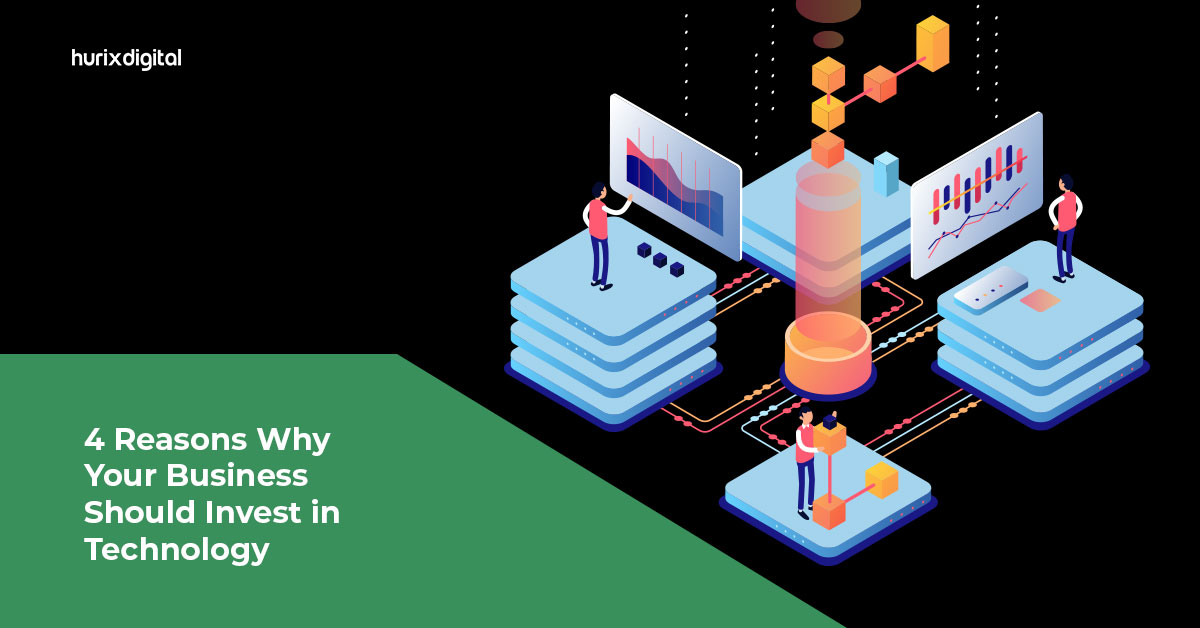
4 Reasons Why Your Business Should Invest in Technology

[vc_row][vc_column][vc_column_text]The world is experiencing the magic of the evolution of technology, and technology is shaping up to be an integral part of today’s business landscape. Investing in technology for your business has become the backbone for many. For smooth business operations, every business requires technical support. If you are not using technology. Before investing in technology, you should have the right people to recommend technologies and the benefits of technology in business. Knowing the importance of technology in business and incorporating technology into your business helps to reach your goals and experience digital transformation faster than their competitors. An example of this is – Chatbots are very popular with the young crowd, and more millennials interact with a chatbot for faster communication and response to queries. This blog answers why invest in digital marketing, digital transformation technologies, and the benefits of technology in business. Let’s take a look at the reasons why you need to make an investment in digital transformation: 1. Achieve a Competitive Edge To deliver customer excellence, technology is considered the main aspect of your business. It can be implemented for internal workflow efficiency to customer-facing activities. Before implementing technology, you should check technological updates in your industry and how these technology updates can improve your current business performance. Straightforward ideas on these points will help you to identify the problems in your existing systems that can be enhanced through technology 2. Gain Agility in Business Technology is changing quickly nowadays. Technology plays a pivotal role in helping companies survive the evolving business requirements and market trends. So you must realize the upgradation of the existing technology or adapt new technologies as and when required. 3. Improve Organizational Data Security Your legacy IT infrastructure might become vulnerable to ever-increasing digital attacks and data breaches. Companies have to understand these threats and increase their technology involvement to improve security protocols for their organization’s data security. 4. Improved Operational Productivity Process automation technologies improve workflow productivity so CXO can utilize those time in critical thinking and decision-making. Technology solutions are innovating the core of businesses across every industry. Therefore, it is an intelligent step to invest in technology to be ahead of the competition. Hurix.com helps you to grow your business with the latest technology solutions. Pioneering in digital transformation in business, Hurix has experienced IT teams working on various technologies like web/mobile technologies, process automation, database development, Integration solutions, and so on.[/vc_column_text][/vc_column][/vc_row]

Why Tech-as-a-Service (TaaS) is Gaining Popularity over the Traditional Approach?

[vc_row][vc_column][vc_column_text]In today’s rapidly changing world of technology, it becomes crucial to have a flexible and robust system and process in place. The line between hardware and software is constantly blurring. The traditional services approach finds it difficult to keep up with the evolving demands of technology and customers. They have limitations on innovations, costs, and storage. TaaS is a new and dynamic digital transformation to software services delivering value to customers and businesses. Today, successful companies like Google, Amazon, and Netflix have adopted the TaaS model.  Table of Contents: What is TaaS Key characteristics that differentiate TaaS from traditional technology services Proprietary and Ownership Ease of customization Privacy is Guaranteed Subscription and On-demand Cost-saving Sustainability In Conclusion What is TaaS? What is TaaS? TaaS stands for “Technology as a Service.” It is a cloud-based testing strategy in which businesses contract out their software testing requirements to an outside service provider. Functional testing, performance testing, security testing, and other testing services are all available through TaaS. Employing TaaS software enables businesses to access a specialized team of testing specialists, cutting-edge testing tools, and infrastructure without using significant internal resources. With the help of this on-demand testing strategy, businesses may scale their testing efforts in accordance with their unique needs, cut expenses, and shorten the total software development lifecycle.  Key characteristics that differentiate TaaS from traditional technology services 1. Proprietary and Ownership In the TaaS model, the ownership of proprietary technologies remains with the provider and is not transferred to the customer. 2. Ease of customization Traditional technology services have limitations concerning customizations. However, TaaS allows flexibility in the customization of services to suit the customer’s needs. 3. Privacy is Guaranteed In traditional methods, the technology is shared among multiple users which can compromise security. With TaaS customers can enjoy complete privacy of their assets without having to worry about sharing with others.  4. Subscription and On-demand TaaS follows a subscription-based model which enables customers to pay for the services as per usage. Also, the technology resources can be scaled up or down on demand. 5. Cost-saving The cost of ownership of hardware and software is significantly reduced with TaaS. This can prove to be a good proposition, especially for small companies and startups with tight budgets. 6. Sustainability By adopting the Taas model, companies can promote sustainability and reduce their carbon footprint caused by frequent upgrades. Companies can minimize their environmental impact by incorporating sustainable products and assets in TaaS.  In Conclusion: TaaS is the future of the technology industry, as more companies and customers are making the move to proprietary technologies. Choosing a company like Hurix.com provides TaaS service makes your business future-proof.  Contact us today to book a call with us.[/vc_column_text][/vc_column][/vc_row]

5 Reasons Why IT Companies Require Technology Roadmap

[vc_row][vc_column][vc_column_text]In today’s fast-paced and rapidly evolving technology landscape, IT companies need a clear and well-defined technology roadmap to navigate the complexities of the industry. A technology roadmap serves as a strategic plan that outlines the organization’s technology strategy, including current technologies in use and future implementations. In this blog, we will highlight why technology roadmap is important and why IT companies require a technology roadmap to drive their success and stay ahead of the competition. Table of Contents: Ensuring Consistent Growth Identifying Areas for Investment Supporting Innovation Improving Customer Experience Enhancing Collaboration and Communication Conclusion    1. Ensuring Consistent Growth A technology roadmap provides a structured approach to ensure consistent growth for IT companies. By identifying emerging technologies and industry trends, organizations can adapt and evolve their technology strategies accordingly. Technology planning helps IT companies stay competitive and relevant in a rapidly changing market, fostering long-term growth and success.          2. Identifying Areas for Investment A technology roadmap assists IT companies in identifying areas where they should allocate resources and investments. By prioritizing initiatives based on their potential impact on the business, organizations can make informed decisions about resource allocation. This ensures that assets are directed towards projects aligning with the company’s objectives, maximizing returns, and minimizing risks.          3. Supporting Innovation Innovation is essential for IT companies to stay ahead of the competition. A technology roadmap is vital in supporting innovation by identifying new technologies and approaches that can be explored. By staying informed about emerging trends, IT companies can proactively experiment with technology implementation, products, and services, giving them a competitive edge and driving continuous improvement.           4. Improving Customer Experience Delivering an exceptional customer experience is paramount for IT companies. A technology roadmap development helps identify technologies that can enhance the customer experience. By leveraging the right tools and solutions, organizations can streamline processes, improve efficiency, and deliver superior services to their customers. This leads to increased customer satisfaction, loyalty, and ultimately, business growth.           5. Enhancing Collaboration and Communication A technology roadmap template promotes collaboration and communication within IT companies. By providing a clear picture of technology initiatives and their alignment with business goals, a roadmap helps different teams work cohesively towards a common objective. It facilitates cross-functional collaboration, ensures that teams are well-informed, and creates a shared understanding of the company’s technological direction. Conclusion: In the highly-competitive IT industry, having a well-defined technology roadmap is crucial for digital transformation planning and success. Technology roadmap development enables IT companies to consistent growth, identify areas for investment, support innovation, improve customer experience, and enhance collaboration and communication. By developing and implementing a technology roadmap, IT companies can effectively leverage technology to drive their business objectives, stay ahead of the competition, and embrace digital transformation.  Finding a company that knows how to create a technology roadmap helps your business to maximize the potential of its IT investments and drive success. As a software development company, Hurix helps in IT strategy planning for clients to make the most out of their technology.[/vc_column_text][/vc_column][/vc_row]

When to use Microservices Architecture for Application Development

[vc_row][vc_column][vc_column_text]Microservices are also known as microservice architecture in which a large application is built from a set of services. It is an approach to developing software systems. Each service performs a unique business function, while those services are connected via a well-defined interface.  Before microservices, applications were developed with a monolithic architecture. It was always microservices vs monolithic architecture. But, many companies moved from the traditional approach to the modern microservices architecture.  While this approach still works well for smaller and easy projects; however, Microservices architecture is suitable for bigger and more complex application development. It separates functionality and business operations into micro and more manageable components. Each service may have its database and interacts with other services via API endpoints. This blog explores when to use Microservices Architecture, its challenges, its benefits to organizations, and the constraints around its implementation.  Table of Contents:       Introduction       When to Use Microservices Architecture?       Complex and Scalable Applications     Polyglot Development       Rapid Innovation and Deployment       Challenges around Microservices Architecture       Increased Complexity     Distributed System Management       Operational Overhead       Microservices Architecture Benefits to the Organization       Scalability and Agility     Enhanced Resilience and Fault Isolation       Technology Flexibility       Constraints around Implementing Microservices Architecture       Development and Maintenance Overhead     Communication Complexity       Organizational Impact       Conclusion When to Use Microservices Architecture?  Microservices Architecture is suitable in the following scenarios: 1. Complex and Scalable Applications: When developing complex applications with multiple modules or functionalities that need to scale independently, Microservices Architecture offers flexibility. It allows different microservices to be developed, deployed, and scaled individually based on their specific needs.  2. Polyglot Development: If an organization prefers to use different programming languages or frameworks for different parts of an application, Microservices Architecture can accommodate this polyglot development approach. Each microservice can be developed using the most appropriate microservices technology stack. 3. Rapid Innovation and Deployment: Microservices Architecture supports agile development practices, enabling organizations to quickly innovate, iterate, and deploy new features or updates. The independent nature of microservices facilitates faster development cycles and reduces the risk of impacting the entire application during updates. Challenges around Microservices Architecture: While Microservices Architecture offers numerous benefits, it also presents some challenges: 1. Increased Complexity: Breaking down an application into smaller microservices introduces additional complexity regarding inter-service communication, data consistency, and service orchestration. Proper design, implementation, and management strategies are crucial to address this complexity effectively. 2. Distributed System Management: As microservices are distributed across different systems and environments, managing and monitoring the entire system can be challenging. Organizations need to invest in robust monitoring and management tools to ensure visibility and stability. 3. Operational Overhead: With multiple services to deploy, monitor and scale, there is an increased operational overhead. Organizations must invest in automated deployment and management processes to handle the complexity efficiently. Microservices Architecture Benefits to the Organization: Here are the microservices benefits organizations can use: 1. Scalability and Agility: Microservices allow for the independent scaling of services, enabling organizations to respond to changing demands quickly, and offering agility in microservices. Scalability in microservices offers the flexibility to scale only the required services, ensuring optimal resource utilization. 2. Enhanced Resilience and Fault Isolation: In a microservices environment, if one service fails, it doesn’t bring down the entire system. The fault is isolated, and the rest of the services can continue to function, improving overall system resilience. 3. Technology Flexibility: Microservices Architecture allows organizations to adopt the most suitable technology stack for each service. It promotes innovation and flexibility by leveraging the strengths of various technologies and frameworks.  Constraints around Implementing Microservices Architecture: Implementing Microservices Architecture may come with certain constraints: 1. Development and Maintenance Overhead: Breaking down an application into multiple Microservices designs requires additional effort in development, testing, and deployment. Organizations must carefully consider the trade-off between the benefits and the increased development and maintenance overhead. 2. Communication Complexity: Microservices rely heavily on inter-service communication, which introduces additional complexity. Organizations must design robust communication protocols and mechanisms to effectively handle service interactions. 3. Organizational Impact: Adopting Microservices Architecture often requires a shift in organizational structure and processes. It may involve changes in team composition, collaboration patterns, and DevOps practices to align with the microservices paradigm. Conclusion: Microservices Architecture offers numerous benefits, but evaluating its suitability for your application development needs is essential. It is well-suited for complex and scalable applications, polyglot development requirements, and scenarios that demand rapid innovation and deployment. However, organizations should be aware of the challenges surrounding increased complexity, distributed system management, and operational overhead. By understanding the constraints and properly addressing them, organizations can harness the benefits of Microservices Architecture to build robust, scalable, and agile applications. At Hurix, our robust technical team designs and develops applications using microservices that assure the success of the project in terms of scalability and the use of the latest technologies.[/vc_column_text][/vc_column][/vc_row]

6 Expert Tips for Creating a Unique and Successful Mobile App

[vc_row][vc_column][vc_column_text]Creating a distinctive and profitable mobile app is a key concern for businesses in today’s mobile-driven environment. With millions of apps accessible across numerous app stores, it can be difficult to stand out from the crowd. Using mobile app development services is one efficient way to increase your app’s visibility and audience. Your app’s discoverability can be improved, and you can increase organic traffic by optimizing it with pertinent keywords. Mobile app companies know how to make mobile applications that stand out, making for a very lucrative proposition for businesses. In this blog, we’ll look at 6 professional tips for mobile application development. Table of Contents: Research the audience Research competitors Create a great marketing strategy SEO User experience Get Feedback from users Conclusion Here are six tips that will be helpful to make your mobile app stand out: 1. Research the audience Understand the user base and target audience for your app. Analyze their requirements and demands before creating the product. This research will assist in developing an app that can stand out in the market. 2. Research competitors To perform better than the competitors, you can research and analyze your competition. Find out what other mobile application companies are doing, and find out their app features and functions, strategy, and tricks responsible for the success of the app. 3. Create a great marketing strategy For the mobile app to reach a wider audience, a good marketing strategy is important. You can make use of various marketing techniques such as promotional advertisements, social media campaigns, and events. 4. SEO Having good search engine optimization will get your app among the top apps. When users search, your app should be viewed in the search results to encourage users to view and download the app. 5. User experience The app should be easy to use and provide the best user experience. This can be achieved by focusing on the aesthetics of the app, easy navigation, accessibility, and clear language. 6. Get Feedback from users User feedback is always valuable to improve any app upgrades. The suggestions and reviews of customers can help to make the required enhancements in the app.  Conclusion: It takes a deliberate approach combining app development knowledge and SEO strategies to create a distinctive and effective mobile app. You may improve your app’s exposure, draw organic traffic, and achieve long-term success by implementing app indexing, completing thorough keyword research, improving app metadata, prioritizing user experience, promoting user reviews, and utilizing social media and content marketing. While mobile app development is crucial, keep in mind that the main focus of your efforts should still be on providing value and a top-notch user experience. Hurix is one such mobile app development company that provides solutions for all your mobile application development needs. Get in touch with us and join the bandwagon of superior mobile applications![/vc_column_text][/vc_column][/vc_row]

Test Automation and DevOps: What You Need to Know

[vc_row][vc_column][vc_column_text]In today’s fast-paced software development landscape, organizations are constantly seeking ways to enhance their efficiency and productivity. Two concepts that have gained significant popularity in recent years are test automation and DevOps. Recently, there has been a lot of talk about the importance of DevOps test automation. And rightly so, since “automation testing” and “DevOps” have increased in the industry. Why not combine both and understand them in detail? This blog will explore test automation and DevOps, and why they are crucial for successful software development. Table of Contents: What is Test Automation What is DevOps? Top 5 Benefits of Test Automation in DevOps Deliver products quickly Software stability Simplifies the testing process Collaboration across teams Improved Quality In Conclusion What is Test automation? Test automation uses automation frameworks and tools to verify the software or product’s functionality. The importance of test automation has risen over the years as this reduces the manual effort to a large extent and also saves time, which means a quicker release of high-quality products in the market. These test automation frameworks ensure continuous delivery within the DevOps framework. What is DevOps? DevOps, short for Development and Operations, combines practices and philosophies to deliver applications and services faster than the traditional approach. DevOps focuses on agility which can be achieved through the integration of various processes and automation in software development and operations to deliver reliable software with a shorter lead time. DevOps promotes a continuous delivery approach, where software changes can be released quickly and frequently. Top 5 Benefits of Test Automation in DevOps Listed below are some of the top benefits of test automation and performance testing in DevOps: 1. Deliver products quickly In today’s fast-paced world, where consumer aspirations are constantly evolving, software companies need to keep up with the changes. Automated testing and DevOps go hand-in-hand as they incorporate the philosophy of quicker release in a shorter time. This will enable reliable and bug-free products to be delivered to the market quickly. 2. Software stability With constant upgrades to products and releasing newer versions, it becomes all the more imperative to ensure stable software. Continuous testing in DevOps is important to ensure products are glitch-free and function smoothly after undergoing software upgrades. 3. Simplifies the testing process By using the right test automation tools and frameworks in DevOps, many repetitive tasks that are time-consuming and cumbersome can be automated. Automation testing in DevOps will increase efficiency while reducing human errors. 4. Collaboration across teams Collaboration of the test automation team with the development and operations teams is crucial for the test effectiveness within the release pipeline. 5. Improved Quality By automating tests, organizations can achieve consistent and reliable results. This leads to higher product quality as critical bugs are caught early, reducing the risk of releasing flawed software. In Conclusion: Considering these benefits, several enterprises are now incorporating test automation in DevOps to improve efficiency and business value. By combining the power of test automation and DevOps, organizations can achieve shorter development cycles, enhanced product quality, and ultimately, greater customer satisfaction. Embracing these practices is crucial for staying competitive in today’s rapidly evolving digital landscape. Hurix.com helps you with your test automation framework and other requirements. Get in touch with us to know more![/vc_column_text][/vc_column][/vc_row]

webadmin May 24, 2023 No Comments

How Digital Accessibility Companies Help You Promote Accessibility

[vc_row][vc_column][vc_column_text]With the continuous rise of digital transformation, web accessibility, as a theoretical and practical concept, has gained great prominence. Not only has it become a harbinger of gradual, progressive change, but it has also turned into a mainstay of favorable opportunities that have allowed people of all castes, creeds, races, genders, and countries to access information, goods, data, services, and prospects – with the click of a single button!  However, the term web accessibility can have no true meaning unless it can provide equal latitude to both people with and without impairments. If a website, document, or brand does not include any form of assistive technology within its operating system, it can end up excluding a sizable population. As a result, its ROI can dwindle to a massive fall! And this is precisely what digital accessibility companies help prevent. What are Digital Accessibility Companies?  Digital accessibility companies, to put it simply, are businesses that aim to provide an excellent digital experience to people with visual, hearing, reading, or any other type of neurodiverse disabilities. These include individuals who have blindness, low vision, dyslexia, partial sight, or deafness. The primary aim of digital accessibility companies is to make each site or document available on the internet in such a manner that they are : Perceivable – Every bit of information can be easily and quickly made visible. Operable – It becomes easy for users to interact with the elements of a webpage. Understandable – The content of a website can be understood without any hassle. Robust – All forms of digital content can be compatible with different screens.  Although there are an immense variety of ways that digital accessibility companies can employ to accomplish these tasks, the five main things they do to improve your digital content are:                                                          1. Use HTML for Labeling  Each website or webpage consists of a variety of different elements. These elements can range from headers and footers to tags, hyperlinks, and audio-visual devices. While someone without impairment can easily scroll down a page and access all of these elements, someone with impairment can not. This is why it is important to use HTML to label and organize every little element on your page. Digital accessibility solutions help you structure your site in accordance with these requirements, thus enabling you to make your page more readable.  2. Choose High Contrast  High contrast is a simple but effective tactic that a lot of digital accessibility companies use for making digital content more inclusive. High contrast doesn’t just enhance the color scheme of your text but also makes the words clearly stand out. As a result, your text does not mingle with the background, and thereby, it becomes eligible to both partially sighted and color blind individuals. Some digital accessibility companies couple high contrast with a large font so that even if the contrast is missed, the font makes the text understandable.  3. Add Alt Text  When it comes to making your digital content more inclusive, readable, and accessible – images, quite often, prove to be a bone of contention. This is because screen readers simply bypass images and read them on – as ‘image’. However, with digital accessibility companies on your side, you can get rid of this major problem. These companies can help you write detailed alt text (alternative text) for all your images. This text carries a graphic account/description of what the image truly contains. When a screen reader deciphers it, alt text and closed captioning can help the visually challenged understand all your content without any hassle. [/vc_column_text][vc_column_text] 4. Structure Headers & Header Tags Digital accessibility companies are known to make good use of both page headers and header tags. Let us consider that a visually impaired person wants to scroll through your website. Without headers, they will have to listen to the entire document and then decide which section interests them the most. Nevertheless, when digital accessibility companies structure headers and make them readable, the visually challenged can easily navigate their way through the entire document and reach the section of their choice within a few seconds! Header tags, therefore, end up increasing their reading speed & flow while saving their time.  5. Add Input Labels Last but certainly not least, digital accessibility companies work wonders in equipping you to add input labels to your tabular structures. Input labels, when added with forms, can enable your enterprise to collect accurate and precise data within a specified time frame. This is because people with impairments can use a screen reader to understand tabular structures only when there is an input label attached to them. Nevertheless, while undertaking this task, you need to make sure that this input label is added to every single element of the table – right from checkboxes and drop-downs to radio buttons and column additions.                                                       Wrapping Up   92% of customers are likely to spend more money on accessible websites?    and 71% of individuals with disabilities would leave an inaccessible website. The figures mentioned above literally speak for themselves. And to be fair, these are just the tip of the iceberg! Any increase in web accessibility, with assistance from digital accessibility companies, can easily take your enterprise to great heights. This is because with digital accessibility companies working day in and day out for you, you don’t just enable your audience (with visual, neuro, hearing, or other forms of impairments) to enrich their overall browsing experience, but you also allow them to become a continuous and steady part of the mainstream. Consequently, your goodwill, as an organization that values equality, inclusivity, and compassion over inequity, indifference, and discrimination, increases manifold! [/vc_column_text][/vc_column][/vc_row]

Hurix May 24, 2023 No Comments

The 5-Step Prepress Checklist: Your Key to a Successful eBook Publication

[vc_row][vc_column][vc_column_text]Prepress plays a key role in making your final work ready for publishing, be it magazines, textbooks, or fiction novels. Nowadays, a lot of writers are taking the self-publishing route for their books and prepress plays an even more crucial role. An expert prepress service can make the job easier for you by reducing the turnaround time, while at the same time, making sure you get the design, typesetting, and proofreading services that put your work on par with the industry standards. Prepress is the most important bridge between a potent manuscript and an international bestseller. Today, creativity and talent are often not enough to guarantee success; execution and presentation play an equally important role, if not more. For those reasons, a lot of publishers consider outsourcing all this work to prepress experts. E-book publishing comprises of several stages, from high-quality digitization using the right tools and technology to image formatting, copy editing, and indexing. A team of prepress professionals manage the entire gamut of this publishing process, from fixing the layout, getting the typesetting right, pagination, to making sure the design and graphics are up to the standard.[/vc_column_text][vc_custom_heading text=”Therefore, it’s convenient to have a prepress checklist regardless of whether you are self-publishing your eBook or going through the traditional publishing route.” font_container=”tag:h2|font_size:18|text_align:left” google_fonts=”font_family:Lato%3A100%2C100italic%2C300%2C300italic%2Cregular%2Citalic%2C700%2C700italic%2C900%2C900italic|font_style:900%20bold%20regular%3A900%3Anormal” css=”.vc_custom_1684912384133{margin-top: 0px !important;margin-bottom: 0px !important;border-top-width: 0px !important;border-bottom-width: 0px !important;padding-top: 0px !important;padding-bottom: 10px !important;}”][vc_custom_heading text=”1. Typesetting” font_container=”tag:h3|font_size:18|text_align:left” google_fonts=”font_family:Lato%3A100%2C100italic%2C300%2C300italic%2Cregular%2Citalic%2C700%2C700italic%2C900%2C900italic|font_style:900%20bold%20regular%3A900%3Anormal” css=”.vc_custom_1684912392933{margin-top: 0px !important;margin-bottom: 0px !important;border-top-width: 0px !important;border-bottom-width: 0px !important;padding-top: 0px !important;padding-bottom: 10px !important;}”][vc_column_text]The last thing you need your eBook to have is clutter. You want your readers to have an enjoyable experience while reading, and not be lost in the clutter created by a confusing layout. A neat and tidy layout enriches the reading experience and makes sure your readers are in the mood you want them to be in when they read your e-book. Typesetting is the careful arrangement of text and images to create an appealing design that would enhance the reading experience. It is important to use industry-standard tools, techniques, software, and platforms available in the market at the prepress stage. Seasoned typesetting professionals use the latest software solutions, like InDesign, 32B, and Quark, to provide you with the page layouts that don’t just suit your work, but also make them ready for print or publishing. As far as composition is considered, using services like XML First Workflow is advised.[/vc_column_text][vc_custom_heading text=”2. Copy Editing” font_container=”tag:h3|font_size:18|text_align:left” google_fonts=”font_family:Lato%3A100%2C100italic%2C300%2C300italic%2Cregular%2Citalic%2C700%2C700italic%2C900%2C900italic|font_style:900%20bold%20regular%3A900%3Anormal” css=”.vc_custom_1684912403102{margin-top: 0px !important;margin-bottom: 0px !important;border-top-width: 0px !important;border-bottom-width: 0px !important;padding-top: 0px !important;padding-bottom: 10px !important;}”][vc_column_text]There is a critical difference between just plainly jotting ideas and bringing them to life. The latter requires immaculate perfection in terms of syntax, semantics, and grammar. And for those reasons, thorough and comprehensive copy editing is very important, to give your e-book a professional touch. Sometimes, there may just be a minor spelling mistake that’s barely noticeable, which is where a professional proofreader comes into play. Therefore, performing a spell check on every word is of the utmost importance at the prepress stage. The role of copy editing isn’t only limited to checking your e-book from a spelling and grammatical point of view. It extends to looking at your work from various other angles like research precision, color corrections, and positioning. For instance, if your writing is non-fiction, it is preferable to have your facts validated and cross-checked from other sources, and this job also comes under the purview of copy editing. Similarly, color correctness also plays a very important role in determining the final quality of your e-book.[/vc_column_text][vc_custom_heading text=”3. Illustration and Artwork” font_container=”tag:h3|font_size:18|text_align:left” google_fonts=”font_family:Lato%3A100%2C100italic%2C300%2C300italic%2Cregular%2Citalic%2C700%2C700italic%2C900%2C900italic|font_style:900%20bold%20regular%3A900%3Anormal” css=”.vc_custom_1684912412800{margin-top: 0px !important;margin-bottom: 0px !important;border-top-width: 0px !important;border-bottom-width: 0px !important;padding-top: 0px !important;padding-bottom: 10px !important;}”][vc_column_text]It is a known fact that a picture is worth a thousand words. And in the absence of the right graphic design, imagery, and illustration, your work may lack the impact it is capable of. Having a professional for the aforementioned needs is a must, more so in the case of storybooks for children, where pictures play a vital role in getting the message across. Generally, a trained graphic designer is enough to do this job, but in certain cases, you may need the assistance of an experienced illustrator as well. The technical skills involved in fixing the artwork of your e-book comprises image resizing, pixel management, image enhancement, retouching, reproduction, and graphics creation. Therefore, it is important to look for someone who has hands-on experience in Photoshop, Illustrator, InDesign, and CorelDraw. If your final output is not limited to an eBook, then it is also advisable to consult someone who understands the nuances of studio printing.[/vc_column_text][vc_custom_heading text=”4. Formatting and Compatibility” font_container=”tag:h3|font_size:18|text_align:left” google_fonts=”font_family:Lato%3A100%2C100italic%2C300%2C300italic%2Cregular%2Citalic%2C700%2C700italic%2C900%2C900italic|font_style:900%20bold%20regular%3A900%3Anormal” css=”.vc_custom_1684912423442{margin-top: 0px !important;margin-bottom: 0px !important;border-top-width: 0px !important;border-bottom-width: 0px !important;padding-top: 0px !important;padding-bottom: 10px !important;}”][vc_column_text]We live in a digital era where everyone has a different preference when it comes to gadgets. Therefore, it becomes important to focus on the format of your e-book. While there are different formats available for e-books like MOBI and EPUB, PDF is the most common format across all devices. As important as it is to make sure that your book is print-ready in PDF format, it is, however, also essential to ensure that your e-book is tailored to be compatible across all devices. When it comes to mailing high-resolution PDFs of your e-book, e-mail doesn’t cut it, because of the large file size. And it becomes a headache to send PDFs to different parties involved in the prepress process. Fortunately, sending these large files is possible through a web-based service provided by Adobe, which offers online storage to save high-resolution files. It also allows you to create a short URL for your PDF that can be shared on your website or blog.[/vc_column_text][vc_custom_heading text=”5. Indexing” font_container=”tag:h3|font_size:18|text_align:left” google_fonts=”font_family:Lato%3A100%2C100italic%2C300%2C300italic%2Cregular%2Citalic%2C700%2C700italic%2C900%2C900italic|font_style:900%20bold%20regular%3A900%3Anormal” css=”.vc_custom_1684912432199{margin-top: 0px !important;margin-bottom: 0px !important;border-top-width: 0px !important;border-bottom-width: 0px !important;padding-top: 0px !important;padding-bottom: 10px !important;}”][vc_column_text]Indexing in e-books is much simpler when compared to their printed versions. This is because e-books allow hyperlinking of the index to the corresponding pages and or chapters in the book. Therefore, it helps to design an intuitive and user-friendly index page for the reader. And at the prepress level, it becomes very important to distil