Blog

Understanding VPAT: The Key to Ensuring Accessibility Compliance

[vc_row][vc_column][vc_column_text] What is VPAT? How accessible is your ICT product? VPAT helps answer that question for you. Voluntary Product Accessibility Template (VPAT) is a document drawn up by the developer of a product or the vendor, which describes how well an information and communications technology (ICT) product or services such as hardware, software, electronic content and support documentation conforms to the accessibility standards of Section 508 of the U.S. Rehabilitation Act of 1973, as amended, for IT accessibility. It is a reporting format in which the conformance of accessibility of Information and Communication Technology (ICT) products and services is documented. VPAT can be used to evaluate accessibility standards compliance for mobile applications, websites, software, documentation or hardware. The Information Technology Industry Council (ITIC), as www.barrierbreak.com states, develops the VPAT and sees to it that it is up to date with all the latest developments of different ICT accessibility standards and guidelines.  VPAT consists of different Editions, WCAG, Section 508, EN 301 549 and International (Int), which include different accessibility standards and guidelines. All the 3 leading ICT accessibility standards are included in the INT Edition of VPAT. The current VPAT includes the U.S. Revised Section 508, European EN 301 549, and WCAG standards, which the regulations of many jurisdictions require. VPAT is available in four editions: WCAG edition – Compliance to the W3C Web Content Accessibility Guidelines 2.0 or 2.1. 508 edition – Compliance to the U.S. Revised Section 508 standards EU edition – The European edition which is used for reporting compliance to the EN 301 549 standard INT edition – For reporting compliance to all 3 standards, there is the international edition  Voluntary Product Accessibility Template  also points out that the rows of each table in the VPAT address each accessibility requirement for ICT products. The rows are grouped into sections to match the organization of the particular standard. In these standards, there are different sections for different technical aspects of a product such as software, hardware, web content, two-way voice communications, documentation, and product support services.  Each VPAT table has three columns: the first column identifies individual requirements the second column is where the degree of compliance to the requirement is to be documented and the third column contains remarks and explanations further describing the level of conformance Since section 508 was refreshed in 2017 and currently measures accessibility with the Web Content Accessibility Guidelines (WCAG) 2.0 criteria, one must ensure to get VPAT 2.0 (or higher). VPAT 2.4 which was revised in February 2020 became available for download on March 7, 2020.[/vc_column_text][vc_column_text] Who draws up the VPAT? Normally, vendors produce the VPAT; the vendor provides the details of each aspect of the requirements and how a particular product supports each criterion in the document.  Rationale for VPAT: Why VPAT? The aim of a VPAT is to enable and empower buyers of ICT products to make informed decisions about the accessibility and openness before making a purchase. As www.sonoma.edu points out, a VPAT helps in various ways. Understand the level of accessibility compliance of a product and the functional details before buying them. Compare with other similar products the degree of compliance. Choose a product that best suits the accessibility criteria besides the organization’s functional and legal requirements. Importantly, when an accessible product is not available, to plan for an equally effective and accessible one. VPAT provides accessibility and social inclusion for special groups of people like those who are disabled and living in developing countries, the aged, and those living in remote rural areas. VPAT provides a means for companies and organizations to show their accessibility compliance and their conformity to standards that have been put in place by the Information Technology Industry Council. VPAT enables government agencies to evaluate the conformity of a company’s products and services while also enabling organizations to self-report their competence and compliance levels in their services. How does one get a VPAT? Some vendors publish their VPATs on their website, while others provide it in response to requests raised through their sales or support contact. Is it compulsory to obtain a VPAT? According to Section 508 of the Rehabilitation Act, government agencies are required to make ICT accessible to people with disabilities. Section 508 is applied to the CSU by the State of California.  However, a VPAT is optional for vendors – they may choose not to create or provide a VPAT.  Conclusion VPAT is highly beneficial in the long run for all organizations. Through VPAT, not only are the government agencies able to evaluate and analyse the commitment to the conformity of the companies but also see growing transparency in the organizations as they self-report their compliance and competence levels in their services; this transparency positively impacts their goals.[/vc_column_text][/vc_column][/vc_row]


webadmin May 24, 2023 No Comments

Google Classroom or Moodle – Which is the Better Option for You?

[vc_row][vc_column][vc_column_text]Though these two platforms serve a similar purpose, Google classroom vs Moodle comparison helps us understand the different approaches towards online learning. In recent times, online learning has witnessed exponential growth. Following this, learning management systems have advanced in functionalities and become easier to access. The improved quality of LMS has encouraged a lot of K-12 schools and educational institutions to optimize their learning environment through an LMS. Google Classroom and Moodle are two such LMS platforms that aim at improving the learning experience in K-12 and higher education domains. Also Read: K-12 Education in the Post-COVID Era[/vc_column_text][vc_custom_heading text=”Through this article, we will draw a comparison of Google classroom vs Moodle and understand which can cater to your needs better.” font_container=”tag:h2|font_size:18|text_align:left” google_fonts=”font_family:Lato%3A100%2C100italic%2C300%2C300italic%2Cregular%2Citalic%2C700%2C700italic%2C900%2C900italic|font_style:900%20bold%20regular%3A900%3Anormal” css=”.vc_custom_1684911145836{margin-top: 0px !important;margin-bottom: 0px !important;border-top-width: 0px !important;border-bottom-width: 0px !important;padding-top: 0px !important;padding-bottom: 10px !important;}”][vc_custom_heading text=”1. Overview” font_container=”tag:h3|font_size:18|text_align:left” google_fonts=”font_family:Lato%3A100%2C100italic%2C300%2C300italic%2Cregular%2Citalic%2C700%2C700italic%2C900%2C900italic|font_style:900%20bold%20regular%3A900%3Anormal” css=”.vc_custom_1684911153486{margin-top: 0px !important;margin-bottom: 0px !important;border-top-width: 0px !important;border-bottom-width: 0px !important;padding-top: 0px !important;padding-bottom: 10px !important;}”][vc_column_text]Google Classroom is part of the G Suite for Education. It provides a simple and straightforward interface and is accessible via Google account. It encourages collaboration between students and teachers to foster better communication. Moodle provides educators around the world with an open-source solution for eLearning that is scalable, customizable, and secure with the largest selection of activities available. It is based on a modular design that allows educators to design their curriculum using plug-ins to serve various purposes. 2. Deployment Google Classroom is a cloud-based LMS while Moodle offers both, on-premise & cloud-based deployment. The cloud-based platform – MoodleCloud, comes in two packages: Moodle for Free and Moodle for School. 3. Features Though Google Classroom offers a simple interface, it is a well-equipped LMS. Following are some of its core features: · Platform branding for school logos · Ability to reuse tests, and assignments, for future classes · Share videos, links, or images with other students · Schedule posting of assignments · Export grades to a Google sheet · Set access permissions · Email and mobile notifications of due dates · Free access to Google Apps for Education · Guardian emails & calendar · Customized notifications Moodle promotes a conducive learning environment. Its general features are listed below: · Mobile app · Multi-lingual support · BigBlueButton for video conferencing · LevelUP, a gamification module including progressive checkpoints · Chemistry Editor for chemistry assignments · Content authoring tools · Attendance tracking · WordCount for writing assignments · Quizventure for gamification of quizzes and tests · Group Choice for group projects   4. Positives Google Classroom Moodle · Strong collaborative focus · Easy to set up classes & assignments · Integrates with other Google products · Integrates with other educational apps · Keeps guardians updated · Flexible deployment options · Teachers can design their curriculum · Dedicated Moodle mobile app · Highly customizable · Provides custom certificates    5. Negatives Google Classroom Moodle · Not available for businesses · Limited tech support is offered to the users · Accounts for parents aren’t offered · Ads displayed in free accounts · School plans can only accommodate up to 500 users · The interface is not always intuitive    6. Integration Easy integration with various education applications is one of the best features of Google Classroom. It provides smooth integration with applications like Squigi, Writable, Pearson Education, Activity Learn, Aeris, Google apps, and G Suite. Moodle has integrations that are paid add-ons to enhance your learning environment. Some of the certified integrations for Moodle are – BigBlueButton, Bongo, Intelliboard, SimCheck, GO1, JFusion, Joomdle, and Promoodle. 7. Pricing Google Classroom is a free service. Schools and colleges have to register for the free Google education package. The open-source platform of Moodle is free to download and install. However, Moodle Cloud offers its services with three paid plans. $250 AUD or $190 USD for up to 100 users $500 AUD or $380 USD for up to 200 users $1000 AUD or $760 USD for up to 500 users Also Read: Top Online Learning Development and Delivery Tools[/vc_column_text][vc_custom_heading text=”Takeaway” font_container=”tag:h2|font_size:18|text_align:left” google_fonts=”font_family:Lato%3A100%2C100italic%2C300%2C300italic%2Cregular%2Citalic%2C700%2C700italic%2C900%2C900italic|font_style:900%20bold%20regular%3A900%3Anormal” css=”.vc_custom_1593437709909{margin-top: 0px !important;margin-bottom: 0px !important;border-top-width: 0px !important;border-bottom-width: 0px !important;padding-top: 0px !important;padding-bottom: 10px !important;}”][vc_column_text]Google Classroom and Moodle differ in their approach to providing a compelling learning environment. Google Classroom’s simple structure suits new users who are unfamiliar to an LMS, and also for schools that have more than 500 students. Moodle LMS might serve better if you are equipped with advanced technical knowledge. If you don’t have to accommodate more than 500 students, Moodle can be a better choice. Listen to how Google Classroom helped teachers and students to enhance the learning experience. Here is a one-minute quick overview of the Moodle learning platform. Suggested Reads: 10 Benefits of Moodle-based Learning Management System (LMS) 8 Popular Features of Moodle LMS for Corporate Training You Should Know [/vc_column_text][/vc_column][/vc_row]

webadmin May 24, 2023 No Comments

Top 15 K-12 Curriculum Development Companies in 2023 for Online Learning

[vc_row][vc_column][vc_column_text]While online education has witnessed growth over the last decade, the recent COVID pandemic, and the subsequent lockdown, have accelerated its adoption by schools and higher educational institutions. However, online education isn’t just a replication of the traditional classroom. Online learning gives students greater control over their learning, enabling them to trace their own learning paths and progress through the interactive modules at their own pace. Related Read: Online Learning VS Traditional Learning The role of the teacher also changes from a knowledge giver to that of a facilitator. Besides, the various course delivery platforms also have powerful assessment and reporting tools, allowing teachers to focus more on students. Real-time tracking tools make it possible to track in real-time the progress of each individual student. Course administrators and developers can use this information to personalize learning for each student. Using various digital formats such as AI, VR and audio/video, students can actually interact with the course and learn by doing. All these factors together necessitate a different approach to teaching and designing the course curriculum. Accordingly, there are several K-12 curriculum development companies specializing in designing highly interactive content for schools. Also Read: How to Create and Deliver the Best K-12 Learning Solutions[/vc_column_text][vc_column_text] Here are some of the best K-12 curriculum development companies to consider- Hurix Digital Edmodo Schoology BenchPrep The BlocksCAD Lightspeed Systems ALEKS Corporation Newsela Instructre, Inc. Flocabulary Explain Everything BYJU’s Apex Learning, Inc. PowerMyLearning TuvaLabs [/vc_column_text][vc_column_text] 1. HurixDigital Hurix is an EdTech content solutions company with an impressive track record of creating and delivering best-in-class content for K-12 education. The company has built a rich content repository of over 6000 learning assets in the K-12 domain. Hurix’s flagship product KITABOO is used by leading K-12 publishers across the world to deliver their content. The platform currently has more than 10 million users in over 20 countries. Hurix also creates custom content for K-12 education. 2. Edmodo This curriculum development company offers a safe and easy-to-use platform for teachers and students to connect and share content, access homework, notices, and events. It also has collaboration and communication tools for resource sharing and networking. This cloud-based platform can be accessed from any internet-enabled device. Schools can set up their own URLs and also access additional management, reporting and analytical tools. The Edmodo platform is free for both teachers and students. 3. Schoology This educational technology company provides a centralized cloud-based repository to connect people, content and systems required to conduct educational classes. Schools can leverage the features of the software to personalize classes and improve students’ learning outcomes. It also has great collaboration tools, allowing smooth connect between teachers, students, and peers. 4. BenchPrep The company has partnered with leading publishers to convert flat content into interactive online courses for high school, college, professional certifications and more. The courses are delivered through the BenchPrep LMS. Students can study and also sync their learning across the web, mobile and tablet devices. 5. The BlocksCAD This 3D modelling software is ideal for K-12 school teachers as they can leverage its 3D features and virtual reality environment to teach coding fundamentals, mathematics and abstract concepts. The software is easy to use and has several interactive features to increase student engagement, resulting in improved interest in math, engineering, and computational thinking. 6. Lightspeed Systems The company has partnered with several sectors including K-12 and higher education to provide highly interactive courses. Their content delivery platform, Relay, includes tools for collaboration and assessment, and is highly scalable and extensible by design. Besides, it also provides features such as management, integrated filtering, monitoring, and protection for schools. 7. ALEKS Corporation This curriculum development company specializes in creating web-based content. According to the company, its educational software is founded on “groundbreaking research in mathematical cognitive science known as Knowledge Space Theory”. The software can accurately assess students’ knowledge proficiency and accordingly deliver targeted instruction on the topics they most need to learn. 8. Newsela The company offers engaging content integrated with assessment and insights. Content is instructionalized to meet the unique learning needs of each student. Leveraging its interactive tools, AI, and analytics, this educational tool deciphers students’ needs and then leads them on their learning path. 9. Instructure, Inc. This software-as-a-service (SaaS) technology company uses its cloud-based Canvas learning management system (LMS) to impart learning. The company does not end the learning experience with schools and higher education. Rather it extends it to corporate organizations, enabling them to engage with their employees. 10. Flocabulary This web-based learning program for all K-12 subjects uses educational hip-hop songs, videos and additional materials to engage students and improve their learning outcomes. As of 2015, more than 35,000 schools had used Flocabulary to supplement their teaching. 11. Explain Everything What sets this K-12 curriculum development company apart is its unique interactive screencasting online and mobile whiteboard app. It enables collaboration between the teachers and learners, who can work together using a complete range of interactive tools including videos, sketches and PDF. 12. BYJU’s BYJU’s is a product of an Indian edtech company, which runs on a freemium model. Schools have free access to content for 15 days. The main delivery platform is a mobile app. Besides providing educational content to all school students from class 1 to 12, the company also trains students for competitive exams in India such as CAT, IAS, IIT-JEE, as also international exams such as GRE and GMAT. 13. Apex Learning, Inc. This K-12 curriculum development company offers online courses in English, mathematics, science, social studies, the fine arts, health and physical education, and Advanced Placement. Instruction and lectures are delivered ‘anytime, anywhere’ via live interactive video using the latest in pedagogical practices combined with powerful reporting. 14. PowerMyLearning This K-12 curriculum development company partners with various schools and higher education institutions to deliver custom learning programs through their award-winning digital learning platform, PowerMyLearning Connect. Rather than using only technology to deliver classroom sessions in a virtual environment, the company is focused on delivering interactive courses

How to Create Accessible ePUB Files

[vc_row][vc_column][vc_column_text]If you wish to provide a more flexible and personalized reading experience for all users, ePUB is one of the best formats for content creation. This blog explores more about this format and how you can create accessible ePUB files with ease.[/vc_column_text][vc_custom_heading text=”What is an ePUB format?” font_container=”tag:h1|font_size:18|text_align:left” google_fonts=”font_family:Lato%3A100%2C100italic%2C300%2C300italic%2Cregular%2Citalic%2C700%2C700italic%2C900%2C900italic|font_style:900%20bold%20regular%3A900%3Anormal” css=”.vc_custom_1631467867836{margin-top: 0px !important;margin-bottom: 0px !important;border-top-width: 0px !important;border-bottom-width: 0px !important;padding-top: 0px !important;padding-bottom: 10px !important;}”][vc_column_text]An ePUB or electronic publication is essentially a file format that is the existing industry-standard in digital publishing. It is considered a standard format that can seamlessly support the digitization of traditionally printed books. It enables digital content to reflow according to the screen size and enhances the content with multimedia and HTML interactivities. This makes ePUB an ideal format for displaying your digital publications on smartphones and other smart devices with different screen sizes.[/vc_column_text][vc_custom_heading text=”Why should ePUB files be accessible?” font_container=”tag:h2|font_size:18|text_align:left” google_fonts=”font_family:Lato%3A100%2C100italic%2C300%2C300italic%2Cregular%2Citalic%2C700%2C700italic%2C900%2C900italic|font_style:900%20bold%20regular%3A900%3Anormal” css=”.vc_custom_1631468589385{margin-top: 0px !important;margin-bottom: 0px !important;border-top-width: 0px !important;border-bottom-width: 0px !important;padding-top: 0px !important;padding-bottom: 10px !important;}”][vc_column_text]Accessibility in the digital world refers to the process of ensuring that the products, devices, and services are accessible, usable, and comprehensible to everyone, including people with disabilities. In simple words, ePUB accessibility primarily defines parameters such as discovery and content accessibility requirements for various ePUB publications. The key advantage of this approach is that it keeps your ePUB files aligned with the standards set for web content accessibility.[/vc_column_text][vc_custom_heading text=”How to create accessible ePUB files” font_container=”tag:h3|font_size:18|text_align:left” google_fonts=”font_family:Lato%3A100%2C100italic%2C300%2C300italic%2Cregular%2Citalic%2C700%2C700italic%2C900%2C900italic|font_style:900%20bold%20regular%3A900%3Anormal” css=”.vc_custom_1631468264345{margin-top: 0px !important;margin-bottom: 0px !important;border-top-width: 0px !important;border-bottom-width: 0px !important;padding-top: 0px !important;padding-bottom: 10px !important;}”][vc_column_text]The process of creating an accessible ePUB involves multiple steps based on the type of content authoring tools you are using and the features you want to include. In this post, we outline the most frequently utilized techniques for authoring accessible ePUB files. Here is the stepwise procedure to create an accessible ePUB file- 1. Setting up the software and tools To be able to create an accessible ePUB, you can use various free software and tools available. The choice of this software will primarily depend on the type of content to be authored, the technical skills of your employees, access to resources, and the final output you desire. For instance, while some ePUB authoring tools require detailed knowledge of languages such as HTML or CSS, others emphasize simplicity over versatility. 2. Defining the content adaptations When creating accessible ePUB content, another important thing to think about is how the content will be adapted to make perfect use of the accessible format. Also, pay attention to modifying the traditional ways text is presented so that they are easily accessible to people with various types of disabilities/ learning styles. 3. Working on compatibility  Without compatibility with various screen readers and text to speech (TTS) devices, an ePUB file is of little to no use for the visually impaired. An accessible ePUB file should allow users to listen to all text and view the text with simultaneous narration. Narration can either be done by synthetic or human voices based on the text-to-speech device. However, the end outcome should be the same; it should allow a user who cannot read the file to access the material and the information presented in it. 4. Digitizing and converting Digitizing your content is another important aspect when you are preparing your content for conversion to ePUB. In the case of ePUB, there is a wide range of processes and tools that you can use to convert your printed text to the digital format, which you may then embed in the ePUB file. 5. Setting up a template There are several templates available online that you may download as a beginning point for your accessible ePUB.  Alternatively, you can also use an authoring tool for generating a complete ePUB package. However, it is essential to remember that authoring tools must be used carefully; they are likely to generate a lot of superfluous code in the overall ePUB package and take more time to convert the publication to an accessible file.  6. Authoring  After the setting up process is done to create your accessible ePUB, there are multiple authoring/ editing tools available which you can use. Among these include Calibre, Sigil, Sublime Text, and more. The benefit of the authoring process is that it is suitable for reflowable files where either the images/videos are embedded inline within the flow of text and headings are left-aligned. 7. Adding standard accessibility to the file Once your content has been authored, you need to use the chosen authoring tool to add various accessibility features, including- Metadata info– To indicate the publication is accessible and features accessibility components such as the title of the publication, language used, date of ePUB creation, author, etc. Alt text description for images Navigation– For instance, Use <section> and <aside> tags in the content along with <itemref linear=”no”> tag in the manifest file to ensure a logical reading order. This is especially important for educational and academic texts. Semantic HTML markups  Accessible fonts The idea here is to author your content according to accessibility best practices, including descriptive hyperlinks and properly nested headings, apart from the things mentioned above. 8. Packaging your ePUB file Once the ePUB authoring process is complete, you need to ensure that you package the ePUB file by following the ePUB packaging guidelines, especially if you are setting up your ePUB as a text package. 9. Validating your ePUB file In the last step, you must check whether your ePUB conforms to all the standard accessibility requirements. To do this, you can use an ePUB checker that will help you identify issues, if any, and correct them before distribution.  Alternatively, you can also test your ePUB file through a program called a validator, which uses internationally approved processes to ensure that eBook stores only accept valid digital publications.[/vc_column_text][vc_custom_heading text=”To conclude” font_container=”tag:h4|font_size:18|text_align:left” google_fonts=”font_family:Lato%3A100%2C100italic%2C300%2C300italic%2Cregular%2Citalic%2C700%2C700italic%2C900%2C900italic|font_style:900%20bold%20regular%3A900%3Anormal” css=”.vc_custom_1631468381685{margin-top: 0px !important;margin-bottom: 0px !important;border-top-width: 0px !important;border-bottom-width: 0px !important;padding-top: 0px !important;padding-bottom: 10px !important;}”][vc_column_text]We have outlined here the complete process of creating an accessible ePUB file. However, the work does not end just here. An equally

Top 5 Factors to Consider While Choosing the eBook Conversion Service Provider

[vc_row][vc_column][vc_column_text]With the demand for eBooks reaching an all-time high owing to rapid technological advancements, wide adoption of smartphones, and availability of sophisticated reading devices, the need for eBook conversion service providers is also increasing. This is simply because creating, designing and formatting an eBook to make it publication-ready is a very technical and time-consuming process that requires professional expertise.  Availing eBook conversion services is one of the best ways for publishers as well as authors to convert their digital manuscripts into professionally designed eBooks compatible with popular eReaders, tablets, smartphones, and other similar devices. This blog aims to discuss eBook conversion services, including their key benefits and top factors you need to consider while choosing the best service provider. Benefits of Outsourcing eBook Conversion Services While there is always an option for publishers/authors to create eBooks using free and paid software tools that support various file formats, it is ideal to use professional eBook conversion services if you are looking for a top-quality and hassle-free conversion. The main benefits of outsourcing eBook conversion services include- Easy Access The eBook conversion service providers can work on a range of different formats. They have a team of dedicated professionals with the required expertise and coming-age technologies to manage formats like PDF, XML, Word, etc. They also ensure that all these formats are compatible across various platforms like smartphones, kindle and tablets. Interactivity The professional eBook conversion service providers include various interactive elements such as audios, videos, links, graphs and more in the development of eBooks, thus enhancing the readers’ engagement levels.  Low-cost  In most cases, the outsourced eBook conversion service providers render the best conversion solutions at very affordable rates. Further, these eBook conversion service providers will also enable the publishers and authors to update any section of the book at any time.  Factors to Consider While Choosing an eBook Conversion Service Provider There are several ways that publishers can benefit from eBook conversion. However, it is important to consider the following factors while choosing an eBook conversion service provider.  1. Quality of Conversion Quality of eBook conversion is the foremost thing you should look for when hiring a service provider.  It is best to hire a professional eBook conversion company specializing in varied and complex eBook conversion projects and multimedia conversion, fixed-layout ePUB conversion, eBook formats and more. Further, a professional eBook conversion company will also give you the advantage of validating your eBooks on trusted tools such as ePUB check and ePUBPreflight.  2. Security Security is one of the major factors to consider when looking for a service provider to convert eBooks into any desired formats like PDF, ePUB, KF8 and many others. It is of paramount importance to go with a service provider that assures complete security of your data, thus eliminating the risk of theft or damage. [/vc_column_text][vc_column_text] 3. Design Excellence Design excellence is another important criterion to look after when picking your eBook conversion service. This is primarily because, unlike the flat text versions of physical books, eBooks need to be designed professionally so that they can be read conveniently and should function properly on all the important platforms. The advantage of hiring a professional company is quality eBook conversion services with a range of features such as- Detailed table of content in eBook text Accurate embedding and resizing of the cover image  Effective and accurate conversions for some specific and compatible formats Formatting of paragraph alignments and indents similar to the source file 4. Layouts – Fixed or Reflowable Most of the eBooks are available in two different layouts- fixed and reflowable. You can choose the layout based on your eBook content. While the fixed layout is mostly used for eBooks with a lot of illustrations and graphics, the reflowable layout is primarily used for text-heavy books. Among the examples of books that use fixed layout formatting are coffee table books, children’s picture books and recipe books. On the contrary, when creating eBooks for K-12 and higher-ed students, some of the books might contain a lot of graphs, charts and tables. It is, therefore, important to choose a conversion service provider that can design a fixed as well as a reflowable eBook layout.   5. Interactive eBook Conversion Another important criterion when choosing an eBook conversion service is the ability to add various kinds of interactivities. The service provider should take care of the entire process of creating interactive eBooks along with seamlessly adding the following features to your interactive eBooks- a. Interactive elements The conversion service providers should be able to add interactive elements such as assessments, exercises, quizzes, matrix completion, yes/no answers, fill in the blanks, match the following and dictionary pop-ups. b. Audio, video and animation They should embed audio, video and animation effects into your eBooks to deliver a complete content experience.  c. Content linking They should link content to various external references or internally to cross-references, annotations, footnotes, indexes, etc. d. Collapsible table of content (ToC) For smoother navigation, the conversion service providers should make your table of content (ToC) collapsible. In Conclusion Various service providers offer eBook conversion services. While the exact kind of conversion services provided may vary from one service provider to another, the process would primarily entail converting a physical manuscript to an eBook. However, eBook conversion services aren’t just about getting a physical book into a digital one, but also about multiple other aspects such as the font type, charts, size, bullets, tables, and other similar things, which enhances the overall outlook of the eBook. To ensure the success of an eBook, it is, therefore, important to choose the eBook conversion services wisely. Following the above guide helps you choose the right type of eBook conversion service and enhance your eBook in the best possible way.[/vc_column_text][/vc_column][/vc_row]

Harness The Power Of ELearning: Benefits & Factors To Consider

[vc_row][vc_column][vc_column_text]eLearning, also known as electronic learning, is a form of learning that involves the use of electronic devices and digital technologies to deliver educational content. With the rise of technology, eLearning has become increasingly popular in recent years, and individuals, educational institutions, and corporations worldwide now use it. As a fact, by 2025, the global eLearning market is expected to be worth $325 Billion. eLearning solutions offer many benefits, including convenience, flexibility, cost-effectiveness, and personalized learning, among others. In this article, we’ll take a closer look at eLearning along with its benefits and factors to consider when implementing an eLearning solution. Different Types Of eLearning Solutions Various types of eLearning solutions are available, each with its unique features and benefits. Here are some different types of eLearning solutions Asynchronous eLearning:- Self-paced learning where learners can access materials anytime, anywhere. Synchronous eLearning:- Live, instructor-led training delivered online in real-time. Mobile Learning (mLearning):- eLearning is designed specifically for mobile devices, such as smartphones and tablets. Microlearning:- Short, focused eLearning modules that can be completed in a few minutes. Virtual Classroom:- An online environment where learners can interact with instructors and classmates in real time. Webinars:- Live online seminars that can be attended from anywhere worldwide. Game-based Learning:- Gaming-based learning is eLearning that uses gaming aspects to make the subject matter more interesting and fun. Simulation-based Learning:- Simulation-based learning is online instruction that mimics real-world situations to let learners exercise their abilities and make decisions. Adaptive Learning:- Adaptive learning is online education that customizes the learning process based on the requirements and abilities of the student. Social Learning:- Social learning is eLearning that encourages participants to work together and share knowledge through online forums and communities. Benefits Of eLearning Convenience And Flexibility One of the primary advantages of eLearning is the ease and flexibility it offers. Learners can access content through eLearning from any location, at any time, and on any device. This means that students may learn at their speed and on their schedule, which is very useful for individuals who have hectic schedules or reside in remote places. Cost-Effective eLearning is frequently a less expensive option than conventional classroom training. There are no charges related to travel, lodging, or venue rental with eLearning. Furthermore, because all knowledge is given online, the cost of resources such as textbooks and workbooks is also minimized. Increased Access To Expertise eLearning solutions can be used to provide access to subject matter experts who may not be available locally. This means that learners can benefit from the expertise of professionals from all over the world. Improved Retention And Engagement It is possible to create dynamic and engaging eLearning solutions that can increase learner retention. Videos, animations, and games are just a few examples of multimedia components that may be used in eLearning to keep students interested and motivated. Personalized Learning eLearning solutions can be designed to cater to the individual needs and learning styles of each learner. Learners can progress through content at their own pace, and content can be delivered in a variety of formats to suit different learning preferences. Factors To Consider When Implementing An eLearning Solution Content:- The success of an eLearning solution depends on the caliber and relevancy of the content. The content should be well-organized, interesting, and pertinent to the needs and interests of the learners. Instructional Design:- Instructional design is the process of creating effective eLearning content. Instructional design should take into account the needs and preferences of the learners, as well as the objectives of the training. Technical needs:- When establishing an eLearning system, technical needs such as internet access, bandwidth, and hardware should be taken into account. It is crucial to guarantee that students have wangle to the technology they need to take part in the eLearning program. LMS, or learning management system:- The software platform that provides students with eLearning content is tabbed a learning management system (LMS). It’s crucial to take into worth aspects like usability, scalability, and system integration while selecting an LMS. Support and Training:- Support and training are essential for an eLearning solution’s success. Learners should have access to technical assistance and assistance from instructors or mentors as needed. Additionally, teachers and administrators should be trained on how to use the eLearning platform and successfully support learners. Trends In eLearning Several trends are influencing the future of the eLearning industry, which is an ever-changing field. Virtual reality (VR) and artificial intelligence (AI) are two of the most crucial eLearning developments. VR is also becoming increasingly popular in eLearning, allowing students to immerse themselves in virtual surroundings that mimic real-world circumstances. This technology is especially effective for training in high-risk sectors like healthcare or manufacturing, where errors may be costly or hazardous. VR has the potential to open up new avenues for collaborative learning and distant education by allowing students to connect with instructors and classmates in virtual environments. Other eLearning trends include using gamification components to make learning more engaging and fun and the usage of microlearning, which offers brief, targeted material in bite-sized portions. As technology advances, it is expected that eLearning will develop and adapt to new trends and breakthroughs. Best Practices For Implementing eLearning Solutions The process of implementing eLearning solutions can be difficult, but several best practices can assist in making the process effective.  The eLearning program’s aims and objectives must first be clearly stated. This will aid in determining the program’s scope, target audience, and resource requirements.  Next, it’s essential to choose the right eLearning solution that meets the organization’s needs, taking into account factors such as the type of content to be delivered, the level of interactivity required, and the technical requirements.  Once the eLearning solution is chosen, creating high-quality content that is engaging, interactive, and relevant to the learner’s needs is vital. A constructive learning management system (LMS) should be chosen to track progress and provide feedback to learners. It’s also important to provide ongoing support and training to ensure learners and instructors are comfortable

Bespoke eLearning: What It Is And How It Can Benefit Your Organization

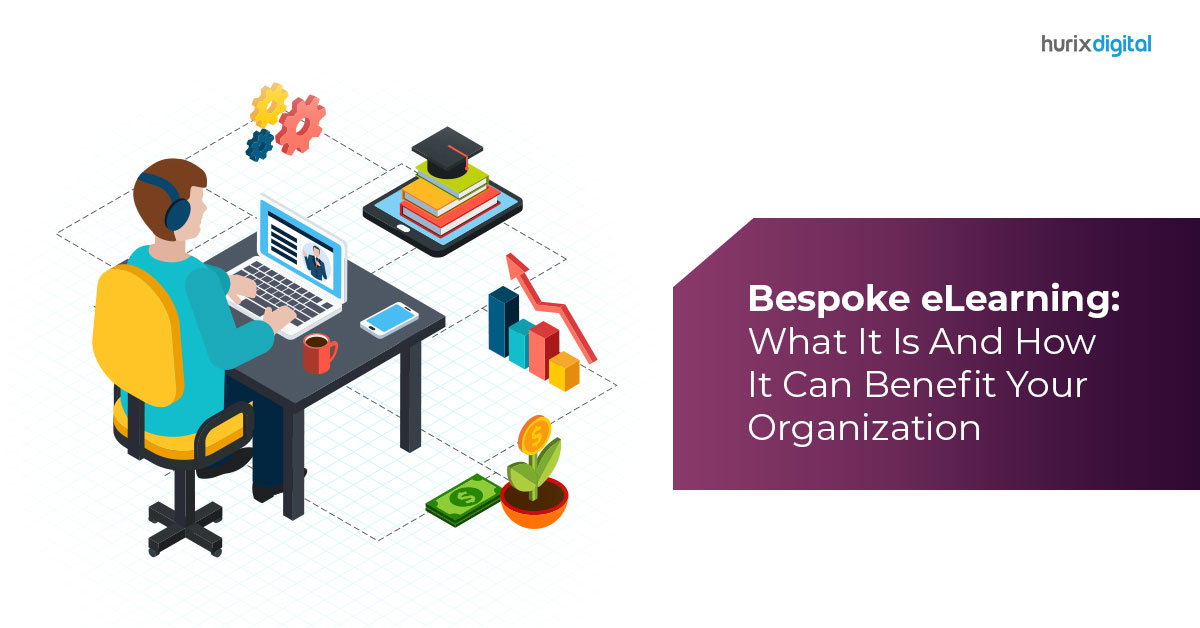
[vc_row][vc_column][vc_column_text]With the rise of eLearning, businesses, and education institutes are using the online medium to deliver exceptional learning experiences more efficiently and cost-effectively. Bespoke eLearning is one such trend that is now taking the eLearning opportunity to the next level. Instead of off-the-shelf, one-size-fits-all courses that were being offered till now, bespoke eLearning courses are slowly garnering attention for their ability to be customized based on the specific needs of the learners. In this blog post, we will discuss what bespoke elearning is, ways to implement it, and how it can benefit your organization. What Is Bespoke ELearning? Bespoke eLearning refers to personalized digital learning content designed for a specific organization. Unlike generic off-the-shelf eLearning, bespoke eLearning is tailored to meet the organization’s specific requirements, including its culture, objectives, and workforce. The content can be delivered in different formats, such as interactive modules, videos, quizzes, and simulations. It can cover a wide range of topics, from compliance and safety training to leadership and professional development. Bespoke eLearning is a growing need not just for educational institutions but also for workplace learning and development. The global learning industry is estimated to grow at a CAGR of 12.19% between 2022-2027 and is expected to increase by USD 4.4 billion this year. Thus, bespoke content will majorly affect how eLearning content is created and consumed. What Are The Types Of Bespoke ELearning? When it comes to bespoke eLearning, there are various types of approaches to it that you can explore. Each type is tailored for specific learning experiences and can be combined or standalone. The types of bespoke eLearning include the following: Self-paced Learning: In this approach, the student is provided with all the tools and resources they need to learn and progress along the course. These include video lessons, assignments, documents, and resources that students can consume at their pace. Instructor-led Learning: This type of learning focuses on having an instructor or teacher provide live classes or coaching to students, and they determine the pace of the entire course. Since the learners are in a classroom-like space, they can interact with other learners, get real-time feedback, and get the benefit of learning from an expert. Blended Learning: This approach brings the best of both worlds. The course allows learners to explore topics using the self-paced method to teach the basic concepts and explore the topic in-depth. Meanwhile, instructor-led classes help to review assignments, answer questions from the learner, and help to ensure the steady progress of the learner. Benefits Of Bespoke eLearning Bespoke eLearning content may take longer to implement compared to off-the-shelf courses that are a direct plug-and-play. However, Bespoke eLearning comes with inherent benefits, which include the following: Greater Flexibility Bespoke eLearning courses are built specifically to the learner’s demand, often using a combination of self-paced and instructor-led learning materials. This helps the learner get a comprehensive learning experience, and they can choose the topics that are most relevant to their interests. Plus, the course can be accessed anytime, from anywhere, and on any device, making it a convenient option for several learners. This helps make the course apt for a wide range of learners, be it students, full-time workers, or others. Easy To Update The problem with most off-the-shelf courses is that they are very hard to update with the latest mandate and information. Since the entire course system is designed only once, including updates or new information may require the old course to be scrapped and a new one to be designed. Bespoke eLearning solves this issue by ensuring that each module is designed per the learner’s demands. This makes it easier for the module to be updated and included/excluded in the course that is offered to the learner, making it highly scalable and ideal for the long run. Personalized Content Bespoke eLearning courses can be tailored to the specific needs of the organization and its employees. This means that the content is personalized, relevant, and engaging, which can lead to better learning outcomes and higher retention rates. Plus, the company can add its branding and take complete ownership of the course contents. Leverage Existing Content To Design New Courses Bespoke elearning programs allow trainers to choose existing content and design the course based on the need and type of learner. This can completely transform employee training and teaching mechanisms, which is ideal for industries with multiple stakeholders and departments. For example, a company can have marked-tailored training and tech-focused training. While this is apt for the marketing and tech teams respectively, a salesperson will need the combination of both to efficiently perform their role. This is where the training teams can take relevant sections of both courses. Thus, the salesperson knows the basics of technology to sell the product and also gets the marketing expertise to know what to say. Cost-Effective While Bespoke eLearning may require a high initial investment, it is cost-effective in the long run. By creating customized content, organizations can reduce the time and resources spent on training and the frequency of in-person training sessions. Closing Words In summary, Bespoke eLearning ensures that: Content is crafted and designed per the organization’s branding, featuring imagery that helps the learner relate and connect with the content better. Content is specific to the learner’s needs, enabling them to get a tailor-made course that is relevant and engaging. The learner’s experience is customized to suit the required learning mandate of the organization or the learning body. Thus, bespoke eLearning offers personalized, cost-effective, and ideal for use by educational institutions and organizations. Enterprises can use this approach to create tailored content for the organization’s specific needs, which can lead to better learning outcomes and higher retention rates, and helps solve critical business problems. If you want to implement bespoke eLearning in your organization, consider working with an experienced eLearning provider to create customized content that meets your specific needs. Hurix Digital offers Learning Management Systems that help organizations track and create content for their employees. Plus, it is

Uncovering The Most Innovative eLearning Companies In The USA

[vc_row][vc_column][vc_column_text]The eLearning industry in the United States is experiencing a boom. The industry is expected to reach US $120.67 Billion by 2027, from the current market size of US $59.52 Billion in 2021. The main reasons behind the tremendous popularity of eLearning are the accessibility, convenience, flexibility, and engagement they provide to learners. Modern eLearning platforms offer adaptive learning, where learners receive personalized content and tailored feedback to ensure quick progress. Today, eLearning is essential for individuals and organizations to meet their learning goals and succeed in the modern world. Thankfully, there are many eLearning companies in the USA that offer innovative learning solutions for learners worldwide. Here’s a list of the top eLearning companies in the USA you can trust to meet your learning needs. 8 Most Innovative eLearning Companies In The USA In 2023 Hurix Digital Coursera iSpring Solutions Udemy Skillsoft LinkedIn Learning Duolingo Khan Academy 1. Hurix Digital Featuring the top of our list is Hurix Digital Solution, a prominent eLearning company that has gained wide recognition for its innovative learning solutions. Hurix offers a comprehensive suite of eLearning services and platforms to its users. They include custom content development, learning management solutions (LMS), enterprise training platforms, mobile learning solutions, etc. These products cater to various industries, including educational institutions(K12 and higher education), enterprises, and publishers. What makes Hurix the number one eLearning company is its intuitive interface and use of best-in-class technology to provide an interactive learning experience for modern-day learners. It goes beyond normal pedagogy to incorporate elements like scenario-based learning, micro-learning, and gamification to enhance the learning experience. No wonder Hurix features top names in its list of clients- Deloitte, FedEx, Ikea, Cambridge University Press, Global Green Growth Institutes, and more. You can only expect the highest quality from Hurix’s digital products. 2. Coursera Here’s a name that most learning enthusiasts are familiar with. Coursera is one of the large eLearning platforms in the US, with over 35 million registered users. It offers a wide range of courses(both self-paced and scheduled) and programs from top universities and institutions. Besides its massive open online courses, Coursera offers specialization courses, MasterTrack certificates, and degree programs to individual learners and businesses. You can also incorporate its high-quality content into your corporate training programs. The biggest advantage of this platform is its reasonable price points. By offering quality content at affordable prices (some even for free), Coursera is on its way to democratizing education. 3. iSpring Solutions iSpring is another long-time player that has been in the eLearning industry for over 20 years. The eLearning company is mainly known for its two flagship products- iSpring Suite Max and iSpring Learn. The iSpring suite is a comprehensive authoring toolkit that you can use to create interactive eLearning content in PowerPoint. The innovative solution even allows you to add quizzes, assessments, simulations, and other multimedia elements to your content. On the other hand, iSpring Learn is a cloud LMS platform that organizations can use to manage their eLearning content. It offers an intuitive interface, a customizable platform, and robust features for an excellent reading experience. These products aim to make eLarning content creation and delivery accessible to a wide range of users, even if they do not have extensive technical skills. 4. Udemy Founded in 2010, Udemy has grown into one of the largest eLearning marketplaces. Thanks to its open platform, you will find an array of courses taught by expert instructors worldwide here. Anyone can create and sell courses on this platform. As a result, the platform can boast an extensive course catalog covering topics in business, technology, personal development, arts, and much more. For businesses, Udemy has a special offering called Udemy for Business. The corporate training solution offers organizations a curated library of courses for employee development. Companies can make use of this offering to upskill their workforce. 5. Skillsoft Skillsoft is another US-based eLearning company that leverages cutting-edge technology to deliver eLearning solutions. The company is best known for its enterprise-focused solutions, Skillsoft Percipio and Skillsoft Aspire, that offer LXP (AI-driven peer learning experience platform) for immersive learning. Skillsoft has pioneered the concept of microlearning by delivering educational content in bite-sized modules that can be consumed anywhere, anytime. The platform supports various learning formats (videos, simulations, assessments, etc.) and keeps learners motivated by awarding batches on completing each assignment. Through its comprehensive learning paths and numerous professional certification programs, Skillsoft has also made significant strides in addressing the skill gaps prevalent in today’s workforce. 6. LinkedIn Learning Another innovative eLearning solution, LinkedIn Learning, provides access to some of the best professional development and educational content taught by industry experts. Leveraging the vast professional network of LinkedIn, the platform offers specialist courses on topics ranging from business and technology to creative skills. What sets LinkedIn Learning apart is its integration with LinkedIn profiles. Once learners complete a course, they can showcase their certificates directly on their professional profiles. This integration enhances networking opportunities, making LinkedIn Learning a valuable resource for professionals looking to upskill and advance their careers. 7. Duolingo Duolingo is a language learning company that provides free language education supported by optional premium features. With its unique gamified learning approach, the eLearning company has made language learning accessible, engaging, and effective for learners worldwide. Duolingo lessons are usually bite-sized, followed by interactive exercises, making learning a new language enjoyable. Its unique algorithm adapts to each learner’s proficiency level and personalizes their learning experience for quick progress. Further, Duolingo even has a mobile app, making it convenient to access their content from anywhere, even on the go. 8. Khan Academy Khan Academy is another eLearning company that has revolutionized the way students learn and access educational content. Founded in 2008, Khan Academy is popular for its vast collection of free, high-quality video lessons. They cover subjects ranging from maths, science, history, economics, and more. What makes the platform innovative is its adaptive practice exercises that dynamically adjust to a student’s skill level, providing individual feedback

Unlock The Power Of Learning With 15 Top Online Learning Platforms

[vc_row][vc_column][vc_column_text]Online platforms for education are transforming the way we learn and teach. They offer unparalleled flexibility, convenience, and affordability in today’s increasingly busy and expensive world. And with everyone jumping on the bandwagon, the eLearning platform market is growing at a tremendous rate across the world. It’s not surprising that the global eLearning market is estimated to reach $686.9 Billion by 2030 at a CAGR (Compound Annual Growth Rate) of 9.5%. What’s more, the revenue in the eLearning market is expected to reach $166.60 Billion in 2023.   Given the availability of infinite options with multiple features, selecting the best online training platform can be quite challenging. But worry not! Whether you’re from the academic sector aiming to learn new skills or the business sector looking to train employees, here is a list of the best eLearning platforms you can sign up for. 15 Top eLearning Platforms Of 2023  1. Coursera With 275+ affiliated companies and leading universities, and 7,000+ courses, Coursera is one of the best online learning platforms for higher education. It offers a variety of online certifications, degree programs, and specializations that support multimedia elements, so instructors can upload videos, grade homework assignments, and quizzes, and have community discussion forums. Price – The Coursera Plus monthly subscription costs $59/month.    2. LinkedIn Learning Specializing in business, technology, and creative courses, LinkedIn Learning offers 16,000+ courses with top-notch educational content. Its instructors are experienced SMEs (Subject Matter Experts) with excellent presentation/teaching skills. The eLearning platform partners with several top organizations to offer the most in-demand professional certifications.  Price – While the monthly plan starts at $40/month, the annual plan is priced at $27/month.    3. Udemy Specializing in skills-based learning courses, Udemy offers over 210,000 courses on various topics, including arts, fitness, programming and IT, teaching, and more. It not only makes course creation easy for all but also offers a variety of online learning materials, including PowerPoint, Video content, text, PDF documents, and more. The platform supports multimedia lectures with video, text, and audio elements. Price – Lifetime access to individual courses ranges from $12 to $200. 4. EdX Founded by Harvard and MIT, edX offers 4000+ courses from 250+ premium institutions like Berkley, IBM, and MIT. The platform offers “micro” degree programs at the master’s and bachelor’s levels, allowing you to advance your career from home. It mainly specializes in engineering, data science, computer science, management, and humanities. Price – While edX offers various free courses, the subscription to the starter plan for higher education begins at $349/year per learner.   5. Skillshare Specializing in creative skills-based courses, Skillshare offers 34,000+ courses on creative arts, business, technology, and lifestyle. With over 1 million learners, the platform is known for courses in creative fields such as graphic design, videography, photography, animation, and more.  Price – The Skillshare for Teams plan begins at $159/year per user billed annually. 6. Udacity Known for its Nanodegree Programs, Udacity partners with tech giants like Microsoft and Google and industry leaders that have an understanding of the skills that are high in demand in the job marketplace. Being a project and skill-based learning program, each Nanodegree comprises a series of courses on various topics such as Coding, Artificial Intelligence, and Business. Price – Most Nanodegree Programs are available at $399/month.   7. Pluralsight Pluralsight is a high-quality eLearning platform designed for working professionals to develop business-critical skills in domains like IT operations, cloud computing, info & cyber security, and AI/machine learning. Its library features 7,000+ courses on in-demand topics that can help you build deep expertise.  Price – The starter plan for skills team membership costs $399/year per user.   8. Masterclass MasterClass partners with celebrity figures like Annie Leibovitz, Frank Gehry, Bill Clinton, and more to provide online courses in food, tech, arts, entertainment, etc. The platform allows you to learn directly from celebrity experts who have made it big in their careers. It offers 180+ courses with no deadlines so you can learn at your own pace. Price – The individual membership to access the MasterClass platform starts at $15/month (billed annually).   9. iSpring Learn If you’re looking for the best online training platform, iSpring Learn is a great option. It is an LMS packed with important and sophisticated features that can be integrated with the corporate training course of any company. Boasting a well-designed interface, iSpring Learn allows you to configure branding and your accounts and create multiple learning paths. Price – The basic subscription for organizations with 100 users or less starts at $2.87/month per user.    10. Canvas Canvas is another eLearning platform that offers great flexibility in support of different training formats. From grade books and quizzes to integrations, and reporting tools, the platform provides everything you need for course development.  Price – Canvas offers both free and paid courses. Get in touch with the sales team for a custom quote.   11. LearnUpon LearnUpon is a famous name in the LMS industry intended for corporate training, educational purposes, partner training, and customer education. In addition to multilingual support, user-friendly interface, and functionalities, the platform allows you to create branded digital storefronts to market and sell your courses.  Price – The basic plan starts at $599/month (50 active users, 1 portal). 12. Moodle Moodle is a well-known name in the open-source LMS domain. The platform includes excellent learner-centric software, social learning environments, and teacher and student plug-ins. It supports gamification (like achievements and leaderboards) to improve user engagement. Moreover, it’s SCORM-compliant, enabling you to upload complex eLearning interactions.  Price – The starter plan starts at $120/year for 50 users and 250MB. 13. Litmos Litmos is a popular business LMS and a training platform with multiple library resources – sales, compliance, employee skills, and security training courses. Being a cloud-based solution, the platform interface is easy to use, and its user management tools help companies assign courses to distributed and in-house teams. Price – Get in touch with the sales team for a custom quote. 14. Blackboard Learn Being in the industry for

webadmin May 23, 2023 No Comments

7 Key Benefits of Game-Based Education in a Digital World

[vc_row][vc_column][vc_column_text]Traditionally, education has been quite linear. Taking the students from one academic content to another with the least possible deviation in teaching methods. However, times have changed now. The use of digital tools in education has been on the rise and this has made educators and students fall in love with game-based education.[/vc_column_text][vc_custom_heading text=”What is Game-Based Education?” font_container=”tag:h1|font_size:18|text_align:left” google_fonts=”font_family:Lato%3A100%2C100italic%2C300%2C300italic%2Cregular%2Citalic%2C700%2C700italic%2C900%2C900italic|font_style:900%20bold%20regular%3A900%3Anormal” css=”.vc_custom_1589981021155{margin-top: 0px !important;margin-bottom: 0px !important;border-top-width: 0px !important;border-bottom-width: 0px !important;padding-top: 0px !important;padding-bottom: 10px !important;}”][vc_column_text]Game-based education is a type of innovative teaching methodology that defines learning outcomes. It aims at balancing academic content with gameplay to promote retention and application amongst students. Game-based education primarily revolves around making academic curriculum more fun, engaging, and impactful by applying game design thinking. From a refreshing teaching approach to ensuring better learning outcomes and retention among students, game-based learning has begun to revolutionize higher education. Let’s glance at the key benefits of game-based education.[/vc_column_text][vc_custom_heading text=”Key Benefits of Game-Based Education” font_container=”tag:h2|font_size:18|text_align:left” google_fonts=”font_family:Lato%3A100%2C100italic%2C300%2C300italic%2Cregular%2Citalic%2C700%2C700italic%2C900%2C900italic|font_style:900%20bold%20regular%3A900%3Anormal” css=”.vc_custom_1589981109396{margin-top: 0px !important;margin-bottom: 0px !important;border-top-width: 0px !important;border-bottom-width: 0px !important;padding-top: 0px !important;padding-bottom: 10px !important;}”][vc_column_text]1. A Non-Authoritative Approach Traditional teaching methods don’t always offer students the opportunity to voice their opinions or ideas. Game-based education is an exception to this. Players are always required to give their inputs during games. So effectively, students are the co-pilots of the learning process. Through game-based education, students engage on a personal level with the content. 2. Driving Students to Mastery Game-based education calls for constant skill improvement. Students cannot proceed to higher levels in the game without mastering the required specific skills. Students learn from active application – learning by doing, thus, game-based education ensures skill mastery. 3. Increasing Engagement & Retention The theory of learning by doing states that students should interact with their learning environment to enhance their knowledge and skills. Games are the best engaging tools as they can transform students from passive participants to active ones. Game-based learning creates an immersive experience, making the students feel like a core part of the learning process. Through games, students are engaged at a multisensory level. The audio-visual elements are more likely to be retained, imparting life-long learnings. Game-based education not only promotes student engagement but also helps in information absorption and retention. 4. Stimulates Logical Reasoning Game-based education supports the visualization of 3-D models in real-time, making learning a lot more contextual and relevant to the students, which encourages them to interact more with the content and enjoy the learning process all along. A virtually-enhanced world in game-based education encourages students to use their imagination and innovatively facilitates logical reasoning. Students are encouraged to think about new possibilities and solutions. 5. Simplifying Difficult Concepts Game-based education functions as an excellent way to make abstract topics easy to understand. This allows students to approach any subject topic from a different perspective. The use of artificial intelligence and augmented reality simplifies the most complicated of concepts and helps students understand the dynamics much better. 6. Delivering an Enriched Learning Experience Game-based education brings your academic content to life. It makes learning fun and exciting. No matter how complex or simple the learning goal is, game-based education always delivers an enriched learning experience. Students feel less stress and boredom and look forward to absorbing more information. Game-based education makes students excited about learning and promotes a healthy learning environment. 7. Learning Through Familiar Devices Students are free to choose the devices they want to learn on. Game-based education runs smoothly through devices that students are already familiar with. This adds on to the comfort quotient and thus, transforms into improved productivity and knowledge retention. Also Read: Top 5 Online Course Platforms for Educational Institutions[/vc_column_text][vc_custom_heading text=”Examples of Game-Based Learning in Education” font_container=”tag:h2|font_size:18|text_align:left” google_fonts=”font_family:Lato%3A100%2C100italic%2C300%2C300italic%2Cregular%2Citalic%2C700%2C700italic%2C900%2C900italic|font_style:900%20bold%20regular%3A900%3Anormal” css=”.vc_custom_1589981502683{margin-top: 0px !important;margin-bottom: 0px !important;border-top-width: 0px !important;border-bottom-width: 0px !important;padding-top: 0px !important;padding-bottom: 10px !important;}”][vc_column_text]Incorporating game-based education in the system is quite a creative task. Let us look at some examples and understand how game-based learning is used to teach different subjects effectively. 1. Subject: Civics Education & City Building Game: OurCity OurCity is a free Facebook game for learning. This game aims at developing students with civic knowledge and help them become responsible citizens. The game allows students to build and develop the city with available resources. Thus, through game-based education, students develop the skillset required to meet the needs of the people who live with them. 2. Subject: Online Marketing Game: Plantville Plantville is an online game-based learning tool developed by Siemens. This game allows learners to run a complete virtual factory. They get to act as a factory manager and carry out all the required tasks to ensure the smooth operation of the factory with the additional responsibility of ensuring worker safety. Through this game, students will learn to improve their efficiency. 3. Subject: Biology Game: Bionigma Bionigma is a puzzle game for solving protein multiple sequence alignments (MSA). This game develops the student’s ability of natural pattern recognition by enabling them to identify and align similar objects accurately. Through this game, students can directly support biological research by solving protein MSA problems. 4. Subject: Fire Safety Game: Teso Compliance Board Game This game allows students to move around the board and complete all the challenges to make fire safety training interesting. Through this game, students will develop the knowledge and skills required to handle fire breakouts. 5. Learning Apps –  With Leaderboards & Badges There are a lot of K-12 Learning Apps that have built-in badges, assessments, quizzes and levels to cross complete with leaderboards. They effectively gamify the learning experience and ensure that the student engagement and retention rates are high. Also Read: K-12 Education in the Post-COVID Era[/vc_column_text][vc_custom_heading text=”In Conclusion:” font_container=”tag:h3|font_size:18|text_align:left” google_fonts=”font_family:Lato%3A100%2C100italic%2C300%2C300italic%2Cregular%2Citalic%2C700%2C700italic%2C900%2C900italic|font_style:900%20bold%20regular%3A900%3Anormal” css=”.vc_custom_1589982207147{margin-top: 0px !important;margin-bottom: 0px !important;border-top-width: 0px !important;border-bottom-width: 0px !important;padding-top: 0px !important;padding-bottom: 10px !important;}”][vc_column_text]With advancements in technology, the future of game-based education looks bright. Institutions are embracing game-based education to revitalize their teaching strategies. This kind of teaching technique helps students develop and improve their practical thinking skills. Thus, education and gaming certainly should go hand-in-hand. Game-based education is the way forward! Suggested Reads: Digital Solutions for Universities and