Blog

The Scope of Higher Education with e-Learning in the Digital Era

[vc_row][vc_column][vc_column_text]E-learning in higher education has become increasingly popular as technology has advanced, and online learning platforms have become more sophisticated and user-friendly.  With the ability to access educational resources from anywhere at any time, more and more students are opting for e-learning as a convenient and flexible way to pursue higher education.  In this article, we will explore the scope, latest trends, and solutions in e-learning for higher education, including the growth of e-learning, the role of online learning platforms for higher education, the benefits of e-learning, and the challenges and solutions that need to be addressed.  We will also examine the future of e-learning in higher education as technology continues to evolve and new advancements are made. The Growth of E-Learning in Higher Education The growth of e-learning in higher education has been significant in recent years. According to a report by Forbes, the e-learning market for higher education is expected to grow by 9.5% annually, reaching a market size of $325 billion by 2025.  The increasing demand for flexible and convenient learning options and the growing adoption of e-learning by universities and colleges worldwide drive this growth.  With the ability to access educational resources from anywhere at any time, e-learning is becoming an increasingly attractive option for students looking to pursue higher education.  Additionally, e-learning is becoming more affordable, as the cost of online programs is often lower than the cost of traditional on-campus programs.  The growth of e-learning in higher education is also supported by the increasing availability of online learning platforms, making it easier for students to access educational resources. The Impact of Higher Education Solutions Higher education solutions that leverage e-learning is becoming more prevalent and have a significant impact on the education landscape.  These solutions include virtual and augmented reality, gamification, and adaptive learning, which enhance the learning experience by making it more interactive and personalized. Virtual and augmented reality technology can make the learning experience more immersive and engaging, while gamification can make it more interactive and fun.  Adaptive learning, on the other hand, can personalize the learning experience based on a student’s individual needs and abilities, leading to better engagement and knowledge retention. Furthermore, these solutions can improve the effectiveness and efficiency of the educational process. For example, adaptive learning can help students identify areas where they need more support and provide targeted instruction, reducing the need for remediation.  Additionally, virtual and augmented reality can provide hands-on, experiential learning opportunities that can be difficult to replicate in a traditional classroom setting. These solutions can also be integrated with online learning platforms, making them even more accessible for students. These higher education solutions are expected to evolve and improve as technology advances. The Benefits of E-Learning in Higher Education E-learning in higher education provides several benefits for students, including flexibility, convenience, and access to a wider range of resources and instructors: Flexibility is one of the main benefits of e-learning in higher education. With e-learning, students can access educational resources from anywhere at any time, allowing them to balance their education with work or family commitments. This flexibility is particularly beneficial for working professionals, parents, or students living in remote areas who may not be able to attend traditional on-campus classes. E-learning also offers convenience, as students do not have to commute to a physical location to attend classes, which can save time and money. Additionally, e-learning often costs less than traditional on-campus programs, making it more accessible to a wider range of students. E-learning provides students access to a wider range of educational resources and instructors. With e-learning, students can access a variety of course offerings and gain diverse perspectives. This is particularly beneficial for students interested in studying a specific topic or field but who do not have access to it at their local college or university. Challenges and Solutions Despite the clear benefits of e-learning in higher education, there are also some challenges that need to be addressed. Below are some of the main challenges: Ensuring the Quality of Online Education: This includes ensuring students have access to the same resources and opportunities as those enrolled in traditional courses. Limited Interaction and Socialization: Online education may provide limited opportunities for interaction and socialization compared to traditional on-campus education. Technical Issues: Technical issues such as internet connectivity and computer problems can disrupt the learning process. To combat these challenges, several solutions can be implemented: Providing Support Systems: Universities and colleges can invest in support systems such as online tutoring, counseling, and academic advising to help students succeed in their online education. Incorporating Interactive and Collaborative Features: Online learning platforms can incorporate interactive and collaborative features such as discussion boards, group projects, and virtual office hours to provide opportunities for interaction and socialization. Providing Technical Support: Universities and colleges can provide students with technical support to help them troubleshoot any technical issues that may arise. Incorporating Engagement Strategies: Universities and colleges can incorporate engagement strategies such as gamification, adaptive learning, and personalized instruction to ensure student engagement and retention. The future of e-Learning in Higher education The future of e-learning in higher education looks promising as technology continues to evolve and new advancements are made. Some of the key trends that are expected to shape the future of e-learning include: Artificial Intelligence and Machine Learning: AI and machine learning are expected to play a bigger role in e-learning, allowing for more personalized and adaptive learning experiences. Virtual and Augmented Reality: VR and AR are expected to become more prevalent in e-learning, providing students with more immersive and engaging learning experiences. Mobile Learning: With the increasing use of mobile devices, mobile learning is expected to become more prevalent, making e-learning more accessible for students on the go. Blended and Hybrid Learning: Blended and hybrid learning, which combine online and on-campus education, are expected to become more popular, providing students with the best of both worlds. Microlearning: Microlearning, focused on small, targeted lessons, is expected to become more prevalent in e-learning as it
Five emerging technologies in higher education learning

[vc_row][vc_column][vc_column_text]Higher education technology companies are constantly looking for new and innovative ways to enhance the learning experience for students. With the advent of technology, the way we learn and teach constantly evolves.  Let’s look at 5 emerging technologies poised to significantly impact higher education learning in the near future. Virtual and Augmented Reality Virtual and augmented reality (VR/AR) technology has been gaining popularity in recent years as a tool to enhance the learning experience for students.  VR technology immerses users in a virtual environment, allowing them to interact with simulations, models, and other visual aids in an impossible way with traditional methods. AR technology, on the other hand, overlays digital information onto the user’s view of the real world. One of the key benefits of VR/AR technology in higher education is that it allows students to engage in hands-on learning, even when they are not physically in the same location.  For example, VR technology can create virtual field trips that let students explore natural landmarks, historical sites, and other locations from the comfort of their classrooms. This technology can also create virtual labs where students can conduct experiments and gather data in a controlled environment. However, it’s also important to note that VR/AR technology can be costly and require specialized equipment, which may be a barrier for some institutions. Further, it’s important to ensure that VR/AR technology is used effectively and meaningfully rather than just as a gimmick. Artificial Intelligence and Machine Learning Higher education technology companies are increasingly using artificial intelligence and machine learning to analyze student data and personalize the learning experience. Using data on student performance, these technologies can predict which students may be at risk of falling behind and provide them with additional resources and support. AI-enabled tutoring systems can also help students improve their understanding of a topic through personalized feedback and instruction. AI and ML can also automate repetitive and time-consuming tasks such as grading and assessment, freeing educators to focus on more important tasks such as providing personalized instruction and feedback to students. However, it is important to note that AI and ML are not a panacea, and the implementation of these technologies in higher education learning should be done thoughtfully. It’s crucial to consider factors such as data privacy, ethical considerations, and how to ensure that the technology is inclusive and accessible to all students. Overall, the incorporation of AI and ML in education can enhance students’ learning experience by providing them with personalized instruction, predicting student performance, and improving student outcomes. Adaptive Learning Adaptive learning technology is designed to adjust the content and pace of instruction to match the needs of individual students. This technology in higher education uses data on student performance to identify areas where students need additional support and provide them with targeted instruction.  The goal of adaptive learning is to create a personalized learning experience for each student, helping them to progress at their own pace and reach their full potential. One of the main benefits of adaptive learning technology is that it can improve student outcomes by providing targeted instruction. By identifying areas where students need additional support, adaptive learning systems can provide targeted instruction tailored to their specific needs.  This can lead to improved student performance and retention, as students can receive instruction tailored to their specific needs. Adaptive learning technology can also create personalized learning pathways for students, allowing them to progress through the material at their own pace. By providing students with the opportunity to work at their own pace, adaptive learning systems can help to increase student engagement and improve student outcomes. Learning Management Systems Learning Management Systems (LMS) are web-based platforms that provide a central location for students to access course materials, assignments, and other resources. These systems can also track student progress, provide feedback, and facilitate communication between students and instructors.  With more classes being offered online, LMS technology is becoming increasingly important in higher education. One of the main benefits of LMS technology is that it can provide students with easy access to course materials and resources, which can greatly enhance their learning experience. In addition, by providing students with a centralized location to access course materials, assignments, and other resources, LMS technology can help to increase student engagement and improve student outcomes. The use of LMS technology in higher education is becoming increasingly popular. According to a report by MarketsandMarkets, the global LMS market is expected to grow at a CAGR of 19.1% between 2020-2025. Gamification Gamification incorporates game elements, such as points, badges, and leaderboards, into non-game contexts. For example, gamification can motivate and engage students in higher education, making learning more interactive and fun.  By using game elements, educators can create a more engaging learning environment that encourages students to take an active role in their education. One of the main benefits of gamification in education is that it can increase student engagement and motivation. By incorporating game elements into the learning process, educators can make learning more interactive and fun, which can help keep students motivated and engaged in the learning process. This can lead to improved student outcomes, as students are more likely to retain information when they are engaged and motivated. Another benefit of gamification in education is that it can be used to create personalized learning experiences. By using game elements, educators can create customized learning paths that allow students to progress at their own pace. This can help increase student engagement and improve student outcomes. Gamification is still a relatively new concept in education, but it is expected to grow in popularity in the coming years. According to a report by MarketsandMarkets, the global gamification market is set to grow at a CAGR of 27.4% between 2020-2025. Conclusion Higher education technology companies are constantly innovating and developing new technologies to enhance the learning experience for students. From virtual and augmented reality to adaptive learning and gamification, these emerging technologies can potentially transform how we learn. As technology in higher education

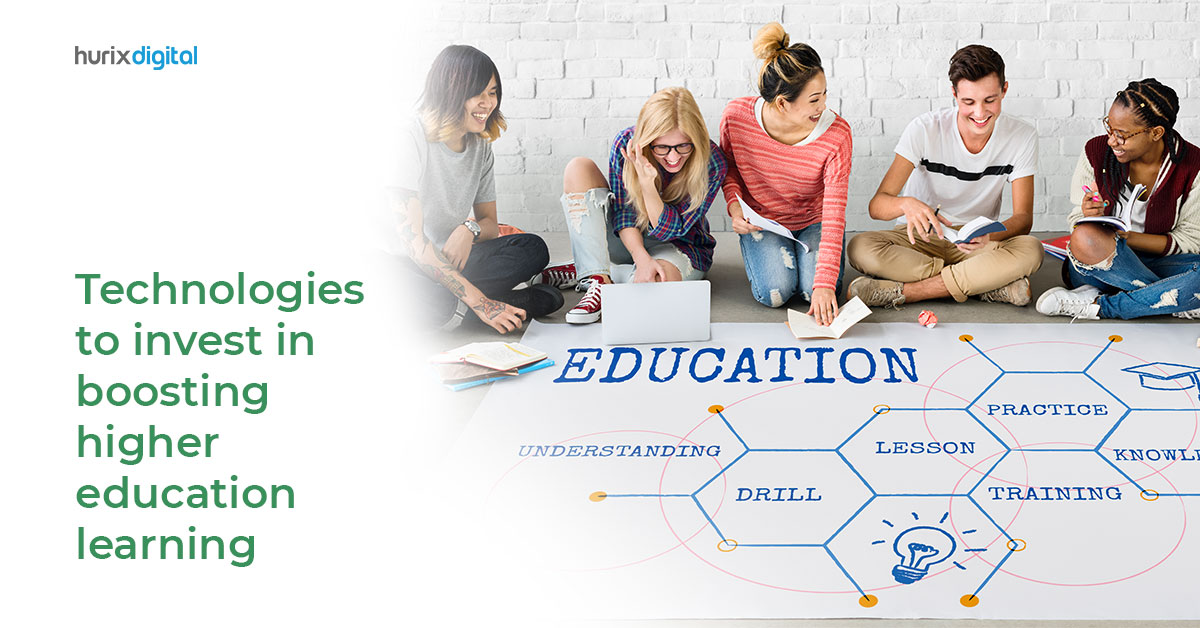
Technologies to invest in boosting higher education learning

[vc_row][vc_column][vc_column_text]The learning and education sector has seen drastic developments and unprecedented changes in the post-COVID-19 world. Online education is growing rapidly across the globe, and technological innovations are changing how education is imparted every day.  In such a dynamic environment, every education technology company must constantly update the technologies used to design, develop, and implement different educational programs.  According to a study by Holon IQ, education technology is slated to grow 2.5 times from 2019 to 2025 and is expected to reach $404B in total global expenditure. Therefore, investing in the right kind of higher education technology is pertinent for companies to reap the benefits of technology in higher education.  Ideal Technological Investments for an Education Technology Company  In the current educational landscape, utilizing learning technologies across different digital platforms is pretty much the norm and is a critical factor for e-learning modules.  As the various methods of imparting education continue to evolve, every education technology company needs to update itself continually. Here are some emerging technological practices that will support the growth of higher education in the near future. Digital Learning Technologies  Digital learning technologies are constantly evolving, and every education technology company needs to invest in newer avenues of digital learning and teaching solutions.  These investments may involve significant expenses in infrastructure to support emerging technologies. Here are some common digital learning technologies. Learning management system (LMS) An LMS integrates all course materials, learning modules, exercises, and activities. In addition, it allows for online discussions, group activities, grading assignments, etc.  Multimedia  Multimedia can include video, audio, and other kinds of interactive content. Some multimedia apps can also be embedded in the LMS for more convenient usage.  Collaborative Applications Cloud-based or online applications that allow students to collaborate with their instructors and peers are essential elements that every education technology company should invest in. Synchronized Technologies  Synchronization between different applications and media is necessary to conduct real-time online sessions. In addition, this synchronization helps maintain interactivity in online classes. Emerging Technologies  Emerging technologies, such as artificial intelligence (AI), augmented reality (AR), extended reality (XR), and virtual reality (VR), are expected to enable more engaging teaching methodologies in the coming years. Modes of Instruction  Online education and e-learning modules can be imparted through various instructional modalities. If a course is available in several modalities, students can choose whichever methodology suits them the best.  Classroom Teaching  In this method, the teaching occurs in a classroom, where in-person interaction between the students and the instructors is held. In addition, the use of technology enhances teaching. Online Teaching The entire teaching process occurs online in this modality and is imparted using various technologies.  Hybrid This is a blend of the classroom teaching method and online teaching. Students have the flexibility to choose either option. Sometimes, they may even have the option of choosing both.  Support Services  When an education technology company invests in technological innovations, it must also make additional investments in support services. Some support services are essential for the successful digital transformation of the educational landscape. Technology Support Staff  Additional technology support staff members must be hired whenever an institution updates its educational technologies. The increase in online education has made 24/7 technology support for students and instructors mandatory. Instructional Designers Every education technology company needs to hire instructional designers to support the instructors in effectively implementing e-learning modules. Student Support Services  Students need dedicated academic support to access online libraries and other resources. They also need support for registration, course advice, and consultations.  Instructor Development  Teachers and instructors must undergo regular training and development to keep up with the changing educational landscape.  When instructors had to quickly move to online teaching from classroom teaching during the pandemic, many didn’t have adequate training to make a smooth transition.  Providing adequate training opportunities and resources to the faculty is essential to help them improve their technological skills.  Learner Development  Students and learners across age groups and social classes have had to quickly adapt to the rapidly changing world of education in the past few years since the pandemic hit.  While contemporary learners have access to opportunities and resources that were inconceivable just a few years ago, they also face various challenges in a highly digitized world. Learners should ideally be trained in basic technology and life skills, including computer and internet skills, self-discipline, time management, teamwork and collaboration, stress management, self-motivation, community building, etc. It is also important to provide students with adequate mental health support.  Organizational Policies  More organizational policies must be developed and implemented to support online teaching and e-learning modules.  Responsibilities of teachers, teaching load, enrolment criteria for students, evaluation criteria, and many other factors must be considered while formulating new organizational policies.  Organizations should also examine the funding models for different instructional modalities. Another important issue to be considered is the inequalities in students’ ability to access technological resources. Benefits of Technology in Higher Education In the modern world, technology is indispensable in higher education. The use of technology has enhanced the education and learning processes in numerous ways. Here are a few benefits of technology in higher education. Personalized learning opportunities Increased collaboration among peers Improved levels of learner engagement Incorporates different learning styles Improved teacher productivity Access to unlimited resources Better accessibility and inclusion  Enhanced creativity in learners Automation and online assessment   How Can Hurix Help You? Do you own an education technology company and plan to invest in the latest technological innovations to boost higher education? There are numerous options for you to consider, each with its own pros and cons.  Working with a professional company to implement the best technological updates for your organization can make the process more effective. Hurix Digital has over 20 years of experience helping education technology companies choose the best e-learning practices for their students.  Contact our experts at Hurix to understand your needs better and implement the best higher education technologies to serve your students more effectively. [/vc_column_text][/vc_column][/vc_row]

Hurix April 27, 2023 No Comments

The Best eLearning Course to Fit Custom Requirements

[vc_row][vc_column][vc_column_text]In today’s fast-paced world, technology is evolving rapidly. Every professional needs to constantly keep reinventing themselves with the changing needs of their industry. eLearning courses allow employees to update their skills along with their routine work. It allows them to progress at their own pace without feeling pressurized. Many companies have skill-building programs for their employees. Today, a lot of enterprises have dedicated portals to support eLearning. Others have subscriptions to popular eLearning sites. A popular trend is companies hiring skilled professionals to build their own custom eLearning courses and contnet. Let us take a look at what makes custom eLearning courses stand out when compared to their off-the-shelf counterparts.[/vc_column_text][vc_custom_heading text=”Custom eLearning Courses vs Off-the-shelf Courses” font_container=”tag:h2|font_size:18|text_align:left” google_fonts=”font_family:Lato%3A100%2C100italic%2C300%2C300italic%2Cregular%2Citalic%2C700%2C700italic%2C900%2C900italic|font_style:900%20bold%20regular%3A900%3Anormal” css=”.vc_custom_1568641503660{margin-top: 0px !important;margin-bottom: 0px !important;border-top-width: 0px !important;border-bottom-width: 0px !important;padding-top: 0px !important;padding-bottom: 10px !important;}”][vc_column_text] Both custom and off-the-shelf courses come with their own set of pros and cons – The first complaint against any custom solution is the exaggerated cost. Any custom-designed course needs to be written and produced as per client requirement. And as a result, it costs significantly more than an off-the-shelf course. However, since a custom course is tailor-made for the employee related needsof an organization, the money is well spent. Although off-the-shelf courses do not need time and resources to be developed, this also means that employees struggle to find the right course. Custom courses are designed keeping employee needs and the organization’s values in mind. Often, employees themselves contribute to the course structure. As a result, the custom eLearning courses offered are of far greater value to them. Off-the-shelf courses are easy to deploy. However, they are designed for the training needs of many different organizations. Thus, the unique learning requirements of a particular business may not be met by them. This is where custom eLearning content comes to play. Custom courses can be changed or enhanced as per the training needs, quickly and easily. On the other hand, it may not be possible to alter off-the-shelf courses at all. Here’s more on can customized learning solutions solve critical business problems An organization has complete ownership of any custom course it develops. [/vc_column_text][vc_custom_heading text=”Why Choose Custom eLearning Courses for Employees?” font_container=”tag:h1|font_size:18|text_align:left” google_fonts=”font_family:Lato%3A100%2C100italic%2C300%2C300italic%2Cregular%2Citalic%2C700%2C700italic%2C900%2C900italic|font_style:900%20bold%20regular%3A900%3Anormal” css=”.vc_custom_1568640823294{margin-top: 0px !important;margin-bottom: 0px !important;border-top-width: 0px !important;border-bottom-width: 0px !important;padding-top: 0px !important;padding-bottom: 10px !important;}”][vc_column_text] There is no denying the fact that custom eLearning content development costs considerably higher than its alternatives. But it is important to note here that the cost is justified due to the benefits it brings to the table. Fully Customized Content– Vendors work with organizations to understand their needs, outline the desired objectives, and then create a course to fit their requirements. This way, what the employees get is a course tailor-made for them, instead of trying to make sense of something that is one-size-fits-all. Improved Effectiveness– One of the most significant benefits of custom eLearning content is that it can be structured around the day-to-day challenges employees face, and the skills they need to handle them. And due to the fact they can now use their learning to improve productivity, employee effectiveness goes up significantly. Easy to Enhance and Modify – As the vendors are directly in touch with the organization, any oncoming requirement can be met head-on. Even before the eLearning content is launched, organizations can plan ahead and make content that runs in parallel to their own future plans. Ownership and Reduced Maintenance Cost – Any customized content is owned by the organization. Moreover, as it is a one-time investment, outside of basic technical maintenance and enhancements, no other cost is involved. In the long run, however, the cost competes effectively with that of off-the-shelf courses. Increased Engagement from Employees – The content is tailor-made to increase the productivity of employees. Such custom content trains employees to handle day-to-day work problems more effectively. As a result, employees find the learning experience more useful and pay more attention. This leads to a more engaging learning experience. Here’s how interactive eLearning modules improve user engagement? Custom Budget – Custom eLearning course can be created to suit the budget of an organization. Such flexibility cannot be expected from off-the-shelf courses. Here are the benefits of investing in custom eLearning courses for your enterprise [/vc_column_text][vc_custom_heading text=”Handling Customer Pain Points with Custom eLearning” font_container=”tag:h3|font_size:18|text_align:left” google_fonts=”font_family:Lato%3A100%2C100italic%2C300%2C300italic%2Cregular%2Citalic%2C700%2C700italic%2C900%2C900italic|font_style:900%20bold%20regular%3A900%3Anormal” css=”.vc_custom_1568641664010{margin-top: 0px !important;margin-bottom: 0px !important;border-top-width: 0px !important;border-bottom-width: 0px !important;padding-top: 0px !important;padding-bottom: 10px !important;}”][vc_column_text] eLearning initiatives by organizations have proven to be very effective in the past. Companies like Shell, Toyota, and PayPal, all swear by well-modelled custom eLearning content. There are many different ways in which custom eLearning can provide relief to customer pain points. Here are a few different ways custom eLearning is making employee lives easier – Virtual to Real Transformation – Oftentimes, employees pass quantitative tests at the end of an eLearning training with flying colors. However, when it comes to the qualitative assessment of the real-life application of those same skills, their performance is not up to the mark. So, does this mean the time and resource the organization has spent on training its employees are not giving them enough returns? Indeed. Hence, the only way to ensure such issues do not keep coming up in the future is to create courses customized to guide employees towards solving the real-life problems they encounter during the course of their day-to-day work. Elevated Soft Skills – A company does not only run with the help of the proceeds from the products it creates or the people working on building those products. Human interactions are the bedrock of any successful organization. Whether it is the relations between employees or those between the representatives of the organization and its clients, soft skills are a major factor. Oftentimes, employees might be very skilled at their work but lack the soft skills required to ensure their work reaches the right strata. Here, custom built eLearning content can ensure that employees are trained in a healthy mix of job-related skills and the soft skills needed to better perform the job. Product Knowledge – Even after having worked on a product for several years, organizations

Gokulnath B April 26, 2023 No Comments

Prioritize Web Accessibility with Website Redesign & Corporate Rebrand

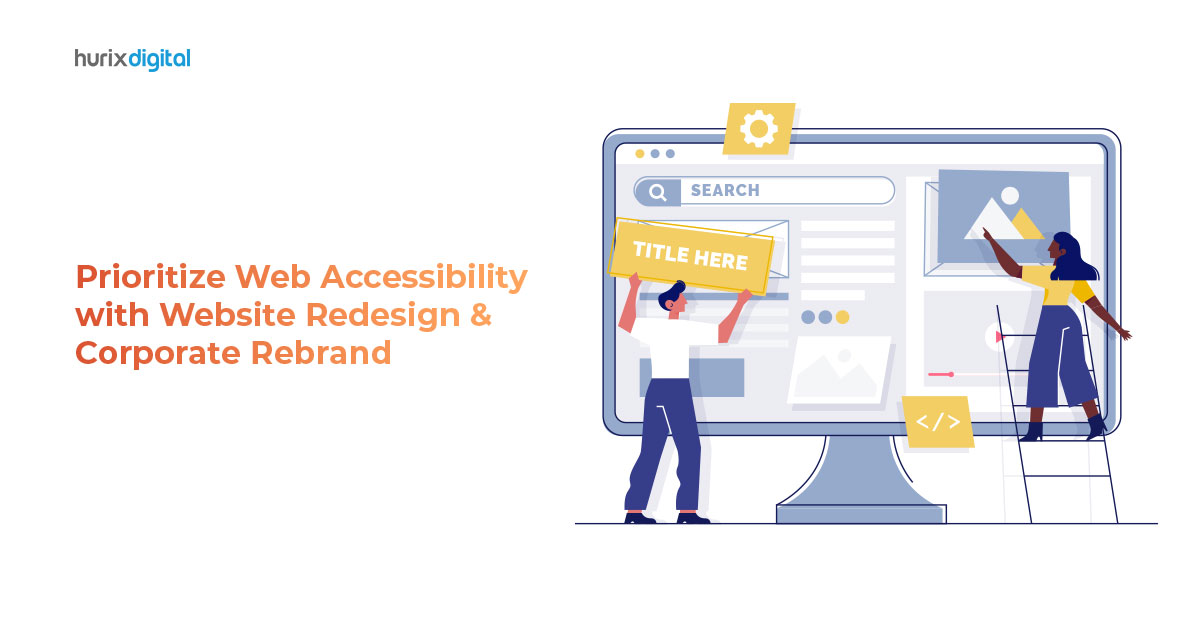
[vc_row][vc_column][vc_column_text] Introduction If your business is considering rebranding or a website overhaul, you may want to ensure its compliance with web accessibility guidelines. But why? Before we delve into the specifics, it’s important to understand the scope of accessibility. Accessibility involves creating infrastructure – including digital infrastructure – that is accessible to everyone, including those with physical, cognitive, conditional, and situational disabilities.  With that defined, web accessibility suddenly encompasses a broad range of people that may be prevented from fully using a website. In this blog, you will learn about the importance of businesses creating accessible websites, WCAG accessibility, and what accessibility professionals can do to help. What is Web Accessibility? In layman’s terms, web accessibility is your website’s ability to be used by everyone without facing issues in consuming content. For example, providing a text-to-speech feature for the information on your website is an accessibility feature that enables those with reading troubles, whether due to visual impairments or low-light environments, to understand the content better. Web accessibility consultants work on various aspects of your website, like Alt-tags, keyboard-based shortcuts, and other accessibility features, to equip your website with the necessary tools to ensure it runs smoothly regardless of who uses it. What are WCAG Accessibility Guidelines? WCAG is the acronym for Web Content Accessibility Guidelines. These guidelines lay down the four pillars/standards of what web content needs to be for it to be accessible equally to everyone. These four pillars are: Perceivability Web content should be perceivable by everyone in some way, regardless of their disabilities. For example, for a visually impaired person, the website should have text-to-speech tools to perceive the content aurally. Operability This pillar helps ensure that the controls on a website are operable by the users, regardless of their motor capabilities. Understandability The third aspect involves making the web content universally understandable by providing translation tools, readable fonts, and infographics. Robustness The web content should be published on websites that follow web standards and are responsive and compatible with a variety of apps, extensions, and devices. Why is Web Accessibility Important? Today, the Internet is a key resource for education, health care, government operations, commerce, and employment. Especially for people with disabilities, the internet must remain accessible and user-friendly to enable them to participate and stay involved in the community. Besides redesigning your website to make it inclusive for people with disabilities, there are several advantages to building an accessible, user-friendly site. Mobile optimization is essential in today’s world. Statista reports that in the last quarter of 2022, the percentage of website traffic that came from mobile phones was just under 60%. Smoother usability is necessary regardless of the quality of the internet connection available. When your website displays too many complex elements that require heavier bandwidths to load, it’s likely that your traffic drops. Since people discover websites through internet searches, improving web accessibility also helps boost your website’s search engine optimization. For example, following a website structure that indexing and crawler algorithms can easily understand helps improve website visibility in search results. Some corporates have begun to view web accessibility improvements as a way to contribute to their corporate social responsibility.  Web accessibility is no longer an option – it’s a necessity. From the perspective of your business, you could capitalize on the expanded audience pool who seek out your products and services by allowing everyone equal opportunity to use your website. How Can Web Accessibility Consultants Optimize Your Website? There are several ways that you can fulfill the accessibility requirements for websites. By partnering with reliable accessibility professionals, you can optimize the following aspects of your digital channels: Alt-Tags Alt-tags are used to describe the images that you post to your website. These descriptions allow screen readers to read an image’s content for people with visual impairments. This aids everyone in understanding the visual content of your website. Tables Accessibility professionals help you add captions to tables and give them “scope” so that the tables have context rather than just being a collection of rows and columns. Keyboard Navigation The design of your website should be friendly for users who only use keyboards for navigation. Avoid adding excessively animated elements and requiring mouse pointers to trigger further action. Provide dropdown menus that can be operated through the keyboard. Default HTML Tags Using default HTML tags for website elements is always more functional. For example, the default tag for a button should not be repurposed into an anchor because it’s not compatible with the software used by people with disabilities to read a website. It can be confusing and generate garbled information. Closed Captions For audio and video elements on your website, closed captions enable your visitors to view the content when they can’t turn the volume up. It’s helpful for people with hearing impairments. ARIA Tag ARIA is the acronym for Accessible Rich Internet Applications. These tags provide better accessibility for people with disabilities by enabling navigation landmarks, error messages, hints, and live content updates. They also provide form descriptions to help people fill them in.  Title Tags Titles and tab titles are a way to describe what the page is about – they make it easier for screen readers to describe a page to the viewer. Wrapping Up Improving the web accessibility of your website is a core exercise that is essential to increase traffic to your website and make it friendly for people who need assistance in consuming content. If you are building your website from scratch or rebranding, consider partnering with accessibility professionals for a seamless experience.[/vc_column_text][/vc_column][/vc_row]

Gokulnath B April 26, 2023 No Comments

5 Most Common Accessibility Errors in Software Design and Development

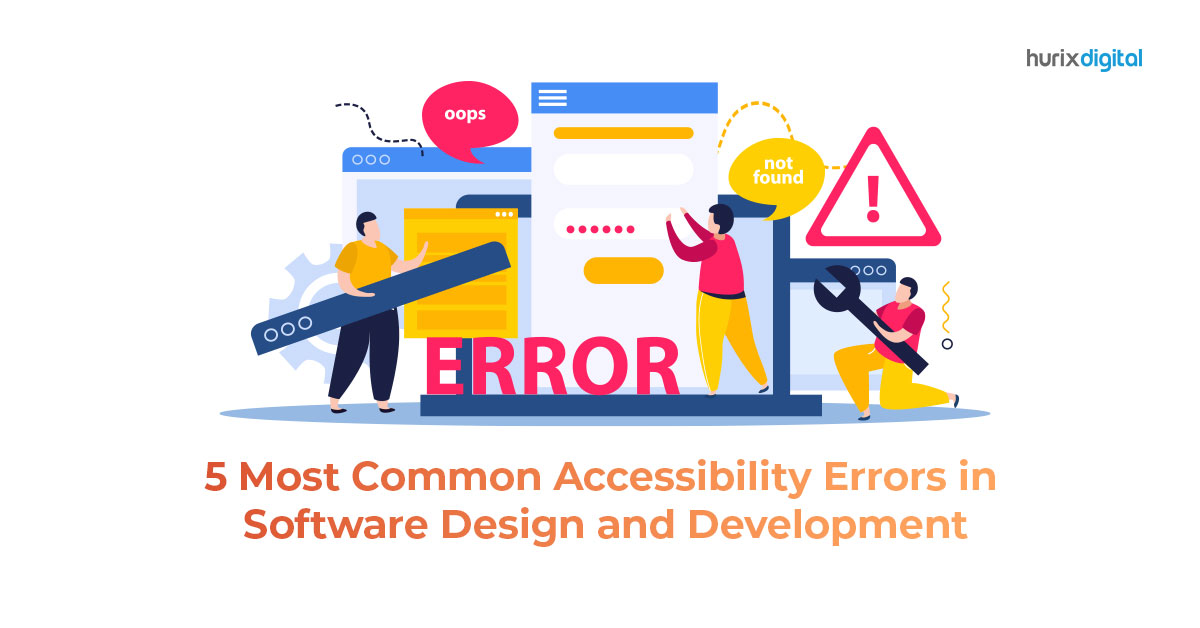
[vc_row][vc_column][vc_column_text]Web accessibility is an important part of software design and development to ensure barrier-free access to digital content for people with disabilities. An analysis of the top 1,000,000 home pages found more than 51 million accessibility errors. This translated to over 51 errors per page. Despite the ever-increasing awareness of the importance of internet accessibility, common mistakes are often made. These mistakes prevent people with disabilities from using software or websites to their full potential.  In this article, we’ll explore five of the most common accessibility mistakes in software design and development and describe how to avoid them. Some of the most common accessibility issues are: Lack of Proper Color Contrast Inadequate Keyboard Navigation Missing Alternative Text for Images Inaccessible Forms Lack of Semantic HTML Top 5 Most Common Accessibility Issues To Avoid And Solve Lack Of Proper Color Contrast It is crucial to consider color contrast for visually impaired users who may have difficulty distinguishing between different colors. Insufficient contrast between text and background colors can make the content hard to read, leading to a poor user experience. To prevent this issue, designers and developers should follow the Web Content Accessibility Guidelines (WCAG) and ensure that there is sufficient contrast between text and background colors. By utilizing web color contrast tools and adhering to WCAG guidelines, content can be made accessible to all users, irrespective of their visual abilities. Inadequate Keyboard Navigation Keyboard navigation is a crucial feature for users with motor impairments or other disabilities that require them to rely on keyboards for navigation. It is important for websites and applications to be designed in a way that allows users to navigate through all interactive elements using only the keyboard. This can be achieved by using the “tab” key to move between elements and the “enter” key to activate buttons or links. Proper keyboard navigation is essential to ensure a smooth and seamless experience for users who are unable to use a mouse or other pointing devices due to their disability. Missing Alternative Text For Images Images are important in web content, but they can be inaccessible to users who are blind or visually impaired. To make images accessible, it is crucial to provide alternative text, also known as alt text, which screen readers can read. Alt text should be descriptive and convey the meaning of the image, serving as equivalent information for users who cannot see the images. By including Alt text for all images on a website or application, accessibility can be greatly improved for users with visual impairments. Inaccessible Forms Forms are widely used in software applications for different purposes, like submitting information or making transactions. However, forms can pose challenges for users with disabilities if they are not designed with accessibility in mind. Issues such as missing or improper form labels, lack of error messages, and difficulties in navigating through form fields can arise. To address these issues, designers, and developers should ensure that forms are properly labeled, provide clear instructions, and are easy to navigate using a keyboard. This includes making sure that form fields are clearly labeled with descriptive text, providing helpful error messages, and ensuring that users can easily move between form fields using only the keyboard. Lack Of Semantic HTML Creating well-structured HTML is also crucial for accessibility, as it provides meaningful information for screen readers and other assistive technologies. By using semantic HTML elements such as headings, lists, and landmarks, web content can become more accessible. Semantic HTML allows users to navigate content more easily and understand the structure and hierarchy of data. It is important for designers and developers to use semantic HTML elements appropriately and avoid using non-semantic elements like div or span for important content. Using semantic HTML elements ensures that the code accurately represents the content and provides context for users with disabilities, enhancing the overall accessibility of the website or application. The Impact Of Web Accessibility On User Experience In addition to avoiding these common accessibility mistakes, incorporating web accessibility solutions into software design and development has several benefits.  Given below are the benefits of web accessibility: Inclusion: Web accessibility ensures barrier-free access to digital content for people with disabilities. It also promotes inclusion and provides equal opportunities for every user.  Usability: User-friendly design and development practices improve the overall usability of software and make it more accessible to all users, including people with disabilities.  User Satisfaction: When digital content is available, it increases user satisfaction because users can easily interact with and understand the content. Expanded User Base: Web accessibility helps reach a larger user base, including people with disabilities, and expands the potential audience of the software. Brand Reputation: Web accessibility enables you to display your commitment to inclusivity. It can enhance brand reputation, showcasing an organization’s values and dedication to user-centric design. Legal Compliance: Web accessibility ensures compliance with legal requirements such as the Web Content Accessibility Guidelines (WCAG), Section 508, and the Americans with Disabilities Act (ADA), reducing the risk of legal issues and penalties. Business Opportunities: Accessible software can tap into the growing market of people with disabilities and their purchasing power, opening up potential business opportunities. Positive User Engagement: Web accessibility fosters a positive user experience, leading to increased user engagement, retention, and loyalty. Final Thoughts Web accessibility is crucial in software design and development. It ensures that people with disabilities can access and use digital content without barriers. By avoiding the aforementioned accessibility errors, the software can be made more inclusive and accessible.  Hurix provides comprehensive accessibility services, including auditing, testing, and remediation of web content and applications to ensure compliance with global accessibility standards such as WCAG, Section 508, and ADA. Our team of experts works closely with designers and developers to identify and fix accessibility bugs and ensure that software is accessible to people with disabilities. Hurix also provides training and guidance on the best accessibility solutions to help organizations maintain accessibility standards in their ongoing software development processes. To learn more about Hurix’s

Hurix April 26, 2023 No Comments

Is Gamified Learning More Effective in the Modern Workplace

[vc_row][vc_column][vc_column_text]Gamified learning or gamification refers to the addition of games in education and training curriculum with the aim to add a fun element to learning and make it more engaging, immersive and motivating. Gamified learning, also known as game-based learning is more than just a game – the fun and entertainment elements have a motive which is to challenge your senses, urge you on to forge your own path and travel at your pace towards defined learning goals. The question that arises is- why games as a path to education and training? The answer lies in the fact that the millennials are a digitally-savvy lot, hooked on to their smartphones connected to the Internet. And online gaming is a huge industry with worldwide revenues predicted to reach $137.9 billion this year (2019). No other form of entertainment has captured popular imagination as gaming. And so, it makes perfect sense for industries of all types to harness the platform of people’s choice to meet their organizational goals. While an online game is just for fun, entertainment and relaxation, gamified learning adds elements such as levels, point scores, rewards and recognition to self-motivate people to keep moving up and grow their learning curve.[/vc_column_text][vc_custom_heading text=”So, is gamified learning more effective in the modern workplace? The answer is yes and here are some reasons why it is so.” font_container=”tag:h2|font_size:18|text_align:left” google_fonts=”font_family:Lato%3A100%2C100italic%2C300%2C300italic%2Cregular%2Citalic%2C700%2C700italic%2C900%2C900italic|font_style:900%20bold%20regular%3A900%3Anormal” css=”.vc_custom_1682485792376{margin-top: 0px !important;margin-bottom: 0px !important;border-top-width: 0px !important;border-bottom-width: 0px !important;padding-top: 0px !important;padding-bottom: 10px !important;}”][vc_column_text] Self-Motivated Learning: There is no better way of learning than self-motivated learning – people learn more when they want to learn, and this is exactly what gamified learning helps to achieve. As mentioned above, gamification includes elements such as levels, points, rewards and recognition. Each level is designed in a way that the learner cannot move to the next until its learning outcomes are achieved. The successful completion of each level brings recognition in the form of points and rewards. Apart from these rewards, there is a sense of achievement, and the satisfaction of a task well done. Having completed one level successfully, learners are naturally motivated to move up the next rung of the ladder and then the next and so learning becomes a continuous process. And in this digital age, when technology is ever-evolving, learning too has to be continuous, and gamified learning helps to achieve just that. Self-Paced Learning: In traditional instructor-led settings, you have learners with mixed abilities, where some show more ability to grasp and retain than the others. It becomes difficult for the instructor to find a middle path such that the lesson is well-received by everyone. Gamified learning is an effective way to provide a level playing field to all learners. The slow learners can keep re-playing at a certain level till they have grasped the concept and then move to the next. Branching is one of the most popular techniques used by game designers. It provides learners a choice between multiple outcomes, and according to the choice they make they move down a certain path which has options for course correction along the way. Gamified learning is therefore hands-on learning which translates into improved outcomes. Context-Specific Learning: Another factor that works in favour of gamified learning and making it more effective in the modern workplace is that it is context-specific. Each game is created around a particular skill set, is to the point, and does meander into a maze of unnecessary information which can distract the Employees can hone specific skills in virtual settings before applying in the real-world scenario. Safe Learning: Taking forward from the above point, one of the main reasons why gamified learning has captured imagination and is today widely used in industries such as defense and healthcare is that it provides learners a safe environment to practice skills which could have dangerous and sometimes life-threating consequences in the real world. For example, medical students can practice in a gamified environment before going to operate in a real life scenario. And it goes without saying that defense training can have severe consequences in case of any false move. Gamified learning helps the defense personnel practice in simulated environment and learn by trial and error, something which they can ill afford to do in real settings. Personalized Learning: Organizations can leverage game-based learning to provide a more personalized learning experience to their workforce in tune with their organizational goals. By conducting a needs analysis, they can identify gaps in learning and then design a gamification strategy that helps to plug these gaps. Team Learning: Gamified learning not only provides a personalized learning experience but is also a great way for team building. Some games are designed for teamwork where one team challenges When done right, it helps to build empathy between team players bringing them together to pool their skills and capabilities and overcome challenges. Thus, it helps to build healthy relationships and foster collaboration, which are very necessary for the modern workplace. Rewarding Learning: Employees perform well when they know that their efforts are duly recognized, and they are being treated fairly. Gamified learning provides them with a clinical report of their performance which is both objective and fair. So, gamification ensures greater transparency, giving employees an opportunity to review their performance and course correct immediately rather than wait till mid-year or year-end appraisals. Timely course correction benefits both the employees and the organization. Related: Top Tips to Design, Develop and Deliver e-Learning Content![/vc_column_text][vc_custom_heading text=”Conclusion:” font_container=”tag:h2|font_size:18|text_align:left” google_fonts=”font_family:Lato%3A100%2C100italic%2C300%2C300italic%2Cregular%2Citalic%2C700%2C700italic%2C900%2C900italic|font_style:900%20bold%20regular%3A900%3Anormal” css=”.vc_custom_1561983520926{margin-top: 0px !important;margin-bottom: 0px !important;border-top-width: 0px !important;border-bottom-width: 0px !important;padding-top: 0px !important;padding-bottom: 10px !important;}”][vc_column_text]Gamified learning is learning by fun; it challenges the way you think; the way you perceive situations and the way you react and act. It allows you to take control over your learning and challenges you to hone your skills and capabilities and overcome roadblocks. Along the way, you also learn skills such as empathy, collaboration, and teamwork, all of which hold you in good stead in the long run. More and more organizations are realizing that gamified learning is more effective in the modern workplace and are incorporating it as an integral element of

Hurix April 26, 2023 No Comments

6 Microlearning Design Techniques for a Great Learning Experience

[vc_row][vc_column][vc_column_text]The millennial learner is, by and large, a disinterested, distracted learner. Studies find that the young generation look at their phones around nine times an hour; however, ask them to look at a training video which is more than 4 minutes and their attention will begin to wane in no time.  So, it is literally impractical to think that they would sit through long hours of training. Related: Mobile Learning : Why Microlearning is more Effective for Impatient Millennials Organizations today have to continuously focus on upgrading their employee skills to help them meet their career aspirations and organizational goals. And to ensure optimum learning outcomes, it is important to provide learning in a format they want and which they can access on the device of their choice. As mobile devices and the Internet take center-stage, one way forward for organizations is to adopt microlearning techniques to provide valuable training in the form of micro-sized nuggets. Microlearning not only helps to capture the attention of the learners but also provides them the information they need at their fingertips, anywhere and at the time they need it the most. Related: 5 Reasons to Integrate Microlearning in Mobile Learning Strategy! Besides addressing the challenges of the limited attention spans, microlearning is also a way to create more personalized content that addresses the unique learning needs of your employees. Each nugget is generally two to three minutes long, yet within this time span, it adequately provides the necessary information that your employee would need to satisfactorily perform a task. Besides, concept-specific microlearning bites also help to reinforce formal learning in classroom teaching sessions. Microlearning is the way forward in training; however, it is important to get it right in order to avoid pitfalls.[/vc_column_text][vc_custom_heading text=”6 Microlearning Techniques That You Can Use to Provide Great Learning Experiences.” font_container=”tag:h2|font_size:18|text_align:left” google_fonts=”font_family:Lato%3A100%2C100italic%2C300%2C300italic%2Cregular%2Citalic%2C700%2C700italic%2C900%2C900italic|font_style:900%20bold%20regular%3A900%3Anormal” css=”.vc_custom_1682485649099{margin-top: 0px !important;margin-bottom: 0px !important;border-top-width: 0px !important;border-bottom-width: 0px !important;padding-top: 0px !important;padding-bottom: 10px !important;}”][vc_column_text]1. Keep it Short:  Given that microlearning is short modules, keep it concise, about 3 to 5 minutes in length, and in this timeframe provide all the necessary information that your learners would find handy to enhance their performance. Your employees should find it convenient to fit these modules in their short breaks. Also, design them for spaced repetition. Keep in mind that the end goal of your microlearning module should be to provide all the necessary information to meet a goal and not information that is so condensed that it overwhelms the learner. 2. Focus on One Idea per Nugget: Again, since the ideal length of each micro bite is around 3 to 5 minutes, to ensure the most impact, focus on one idea per module. And this can be a bit tricky because you will have to choose your content wisely. Before implementing microlearning, it is a good practice to identify knowledge gaps you wish to plug. Focus on one gap at a time and if needed, break it down into sub-modules. Then create each microlearning nugget such that it focusses on one key point and elaborates the idea in a way that it makes a difference. 3. Enable Mobile Access: As said above, microlearning gained traction mainly due to the fact that more and more people now access all information they need on their mobile phones. So, microlearning modules are mainly designed for people on the move, or in other words, for the mobile environment. It is also a good practice to enable offline access to the microlearning courses because even though people generally have access to the Internet on their mobiles, it is not safe to assume they will have it at all times. 4. Use Different Media Formats: No one likes to read a massive amount of content even for just a few minutes. With microlearning, you can make learning a multi-sensory experience and use audio and video to supplement the reading. Using different media formats, you can bring alive the concepts and make learning more engaging and entertaining. Besides, you can also design microlearning lessons that allow the learner to practice concepts in a virtual environment and avoid making costly mistakes in real-time settings. To use multimedia, first focus on the idea you wish to convey and then identify that would best help to tell the story. Place appropriate visuals that are relevant and not images that take away learner’s attention without adding any value. The same rule applies for using audio and video. By presenting information using rich media formats you can keep your audience engaged and motivated. 5. Offer Customization: There is no one-size-fits-all when it comes to learning. One of the greatest benefits that microlearning provides is that it enables you to customize content in tune with your employees’ unique learning needs. Design your microlearning module in a way that it helps your employees learn the skills they want to learn and in a format they are most comfortable with. 6. Keep it Clean: The more clutter-free your microlearning module, both in terms of content and images, the better the learning outcomes. Segregate your content into what is essential and what is nice to know or additional value. Match media elements that you would need to bring alive the text but keep in mind that there is no unnecessary element that shifts focus of the end-learner away from the main subject of your microlearning module. 7. Facilitate Innovation: Since microlearning is best accessed on mobile devices, design your modules in a way that will allow learners to take control over their own learning such that they are not limited to just the information you provide. While a microlearning nugget allows slow-pace learners to revisit the concepts, it should also provide paths to more information to the fast learners who may wish to build upon that knowledge.[/vc_column_text][vc_custom_heading text=”Conclusion:” font_container=”tag:h2|font_size:18|text_align:left” google_fonts=”font_family:Lato%3A100%2C100italic%2C300%2C300italic%2Cregular%2Citalic%2C700%2C700italic%2C900%2C900italic|font_style:900%20bold%20regular%3A900%3Anormal” css=”.vc_custom_1562149458996{margin-top: 0px !important;margin-bottom: 0px !important;border-top-width: 0px !important;border-bottom-width: 0px !important;padding-top: 0px !important;padding-bottom: 10px !important;}”][vc_column_text]In a fast-paced digital world where people are bombarded with information, their attention span becomes limited. For organizations, microlearning is a great way to capture learners’ attention and provide them with

Hurix April 26, 2023 No Comments

7 Best Ways to Deliver Online Learning Courses to Employees

[vc_row][vc_column][vc_column_text]Technological advancements have made the world a global village, with people and organizations now working across geographical boundaries and time zones. In this new business landscape, all business processes have evolved along with the way companies train their employees. Online learning courses are the new buzzword in employee training. And this also holds true for the education sector with universities, colleges and high schools moving their learning courses online to enable learning anywhere and anytime. The rising penetration of the Internet and easy availability of the smartphones have further built the case for online learning courses or eLearning. Market research firm Global Industry Analysts had predicted a few years back that eLearning would reach $107 billion in 2015, and it did. The firm has now projected that it would grow to $325 Billion by 2025. In sync with the changing times, more and more companies are taking the online route to their training. Apart from transcending geographical borders and time zones, online courses also provide learners the opportunity to learn at their own pace. Besides, they also provide them access to the information they need at the time when they need it the most to close a sale or successfully complete the task at hand. So, what is the best way to conduct online learning courses? The answer is through a cloud-based learning management system, popularly known as LMS in corporate circles. As the name suggests, a cloud-based LMS hosts all learning material on the cloud and provides authorized access to learners anywhere, anytime. Besides, it also provides tools for collaboration, making it possible to hold meetings, brainstorm and at the same time, learn in a personalized environment.[/vc_column_text][vc_custom_heading text=”Here are seven advantages of delivering your online learning courses through a cloud-based LMS.” font_container=”tag:h2|font_size:18|text_align:left” google_fonts=”font_family:Lato%3A100%2C100italic%2C300%2C300italic%2Cregular%2Citalic%2C700%2C700italic%2C900%2C900italic|font_style:900%20bold%20regular%3A900%3Anormal” css=”.vc_custom_1682485439137{margin-top: 0px !important;margin-bottom: 0px !important;border-top-width: 0px !important;border-bottom-width: 0px !important;padding-top: 0px !important;padding-bottom: 10px !important;}”][vc_column_text]1.Learning in a Personalized Environment: By hosting your online learning courses on a cloud-based LMS, you can provide your learners a personalized environment, complete with interaction and collaboration with or without the support of an instructor. Further, video conversations can also be facilitated between learners and an external trainer through apps such as WebEx and Skype. 2. Learning at One’s Own Pace: Learners can rewind a particular topic in case they have not understood a concept and then move on to further modules. They can also learn when they want, from the comfort of their own homes or while on the move. 3. Team Learning: A cloud-based LMS also empowers companies to enroll a number of learners to a single course, making team learning possible. Besides, they can also add or remove learners. 4. Creating Online-Learning Communities: The LMS allows educators to create cost-effective and collaborative online communities and scale up to accommodate a larger user base. 5. Effective Monitoring and Follow-Up: Most LMS also incorporate features that allow training managers and administrators to track each learner effectively and also provide feedback for improved learning outcomes. Besides, they can also generate course completion reports. 6. Open Source: While there are several LMS packages available, it is a good idea to choose a Moodle-based LMS, which is an open source LMS, implying that it can be freely downloaded and distributed. This type of LMS is supported by a global community of educators and professionals who are extremely passionate about improving the online learning experience it provides. This means that they constantly scrutinize and update the code for better user experience. Within the Moodle communities, you can find the answer to all your questions. 7. Low Cost: A majority of users of the software have testified high satisfaction rates because of the low costs involved in the implementation of a cloud-based LMS and the ease of use it provides. Also read: 10 Benefits of Moodle based Learning Management System (LMS)[/vc_column_text][vc_column_text]If you are planning to host your online learning courses on an LMS, make sure that it includes the following features, no matter what your business goals are. Here is a list of 10 must have LMS features for your business. User-friendly Interface: It is very important for an LMS to have a user-friendly interface with self-descriptive navigation features. The last thing that you need is to invest time, resources and money in studying how to use an LMS before you can put it to use to supplement your training and learning needs. Ease of Integration: The LMS you choose should be able to integrate with your various business functions within the enterprise such are human resource management, compliance, talent management, workflow management, customer relationship management, payment processing to name a few. Besides, it should also have features to share data across all geographies. Content Management: The LMS should be able to support all latest eLearning standards such as SCORM and Tin Can/xAPI. Besides, it should enable you to upload existing documents and videos, and also share materials and events between courses or learning paths. Ease of Access: The LMS should have a responsive design, which means that the content should be able to adjust to different screen sizes, be it a mobile device or tablet. Also, with more and more people using their smartphones, it is important to ensure that the LMS supports mobile learning, implying that the content should be interactive and delivered in short segments. Besides, it has generally been observed that users also want more social engagement so the LMS should have features that enable communication through discussion boards. Blended Learning Features: Besides providing online features, the LMS should also be able to support offline learning, which means that it should include features for tracking, recording and assessing offline events along with online ones. Assessment and Testing: The LMS should be able to support pre-tests and post-tests as part of the learning process. Besides, it should have other flexible testing and assessment features, for example, automatic and manual marking, storing a learner’s complete assessment portfolio etc. Reporting and Tracking: Apart from assessment and testing, the LMS should also include features to track and record learners’

Hurix April 26, 2023 No Comments

7 Key Considerations for Finding the Best eLearning Solution Provider

[vc_row][vc_column][vc_column_text]As the world goes digital, enterprises and educational institutions are increasingly taking the eLearning route to fulfil their learning and training objectives. While setting up enterprise eLearning, rather than just taking the plunge, it is important to first define the objectives and key metrics that can help you measure tangible outcomes and allocate budget and resources to ensure smooth set-up and implementation.  The next step is to identify the right eLearning company that can help you achieve your goals.[/vc_column_text][vc_custom_heading text=”7 Questions to Ask Yourself Before Choosing an eLearning Company” font_container=”tag:h2|font_size:18|text_align:left” google_fonts=”font_family:Lato%3A100%2C100italic%2C300%2C300italic%2Cregular%2Citalic%2C700%2C700italic%2C900%2C900italic|font_style:900%20bold%20regular%3A900%3Anormal” css=”.vc_custom_1682485330220{margin-top: 0px !important;margin-bottom: 0px !important;border-top-width: 0px !important;border-bottom-width: 0px !important;padding-top: 0px !important;padding-bottom: 10px !important;}”][vc_custom_heading text=”1. Conduct Needs Analysis” font_container=”tag:h2|font_size:18|text_align:left” google_fonts=”font_family:Lato%3A100%2C100italic%2C300%2C300italic%2Cregular%2Citalic%2C700%2C700italic%2C900%2C900italic|font_style:900%20bold%20regular%3A900%3Anormal” css=”.vc_custom_1557929609725{margin-top: 0px !important;margin-bottom: 0px !important;border-top-width: 0px !important;border-bottom-width: 0px !important;padding-top: 0px !important;padding-bottom: 10px !important;}”][vc_column_text]Conduct a needs analysis to understand what you wish to achieve through eLearning. To gain market insights, one can interview end users about the e-course or use an analytics tool. Studying past training outcomes can help in identifying and bridging the gaps in skills or knowledge and make learning more relevant. Your needs analysis should help you address the following questions: What problems, challenges or skill/knowledge gaps does your eLearning seek to overcome? What outcomes do you expect from eLearning? How will your enterprise meet its business goals? [/vc_column_text][vc_custom_heading text=”2. Understand Your Audience:” font_container=”tag:h2|font_size:18|text_align:left” google_fonts=”font_family:Lato%3A100%2C100italic%2C300%2C300italic%2Cregular%2Citalic%2C700%2C700italic%2C900%2C900italic|font_style:900%20bold%20regular%3A900%3Anormal” css=”.vc_custom_1557929618842{margin-top: 0px !important;margin-bottom: 0px !important;border-top-width: 0px !important;border-bottom-width: 0px !important;padding-top: 0px !important;padding-bottom: 10px !important;}”][vc_column_text]Remember there is no one-size-fits-all in eLearning. For example, writing a course in a foreign language to teach the language to a group of beginners may not be the best way to teach. While designing an eLearning course, keep in mind the target audience’s technical capabilities, existing knowledge and skills, and how they will use the new learning outcomes in real-time. By knowing your audience, you can create better eLearning content and ensure better learning outcomes.[/vc_column_text][vc_custom_heading text=”3. Choose the Right Technology and Resources to Implement eLearning:” font_container=”tag:h2|font_size:18|text_align:left” google_fonts=”font_family:Lato%3A100%2C100italic%2C300%2C300italic%2Cregular%2Citalic%2C700%2C700italic%2C900%2C900italic|font_style:900%20bold%20regular%3A900%3Anormal” css=”.vc_custom_1557929628030{margin-top: 0px !important;margin-bottom: 0px !important;border-top-width: 0px !important;border-bottom-width: 0px !important;padding-top: 0px !important;padding-bottom: 10px !important;}”][vc_column_text]Determine whether you have the technology and trained personnel available in-house to host and implement the eLearning courseware. The following questions can help you determine if you have the right technology to support the eLearning course: How many people will access the eLearning course at a time? Do you have the hardware, server and required bandwidth to host the course? What back-up plan and security measures do you have in place? Do you need to install any applications to run the course? Do you have an in-house team to smoothly implement the course? Will the learners access the course on the company’s devices or their own? These questions will help you plan your technology and personnel requirements and determine whether you should outsource some of these functions to eLearning development companies that can function as an extension of your internal team.[/vc_column_text][vc_custom_heading text=”4. No One-Size-Fits-All:” font_container=”tag:h2|font_size:18|text_align:left” google_fonts=”font_family:Lato%3A100%2C100italic%2C300%2C300italic%2Cregular%2Citalic%2C700%2C700italic%2C900%2C900italic|font_style:900%20bold%20regular%3A900%3Anormal” css=”.vc_custom_1557929638441{margin-top: 0px !important;margin-bottom: 0px !important;border-top-width: 0px !important;border-bottom-width: 0px !important;padding-top: 0px !important;padding-bottom: 10px !important;}”][vc_column_text]Remember that an eLearning company with off-the-shelf courses may not provide you a solution that meets your organizational needs. For example, an eLearning company specializing in providing learning programs for higher education may have little experience in providing corporate learning and training solutions. As said above, it is a good idea to choose a service provider with a track record in servicing organizations similar to yours, or those that have the right combination of knowledge, skills, expertise and experience in providing custom solutions across the spectrum.[/vc_column_text][vc_custom_heading text=”5. Skill Set Offered by the eLearning Companies:” font_container=”tag:h2|font_size:18|text_align:left” google_fonts=”font_family:Lato%3A100%2C100italic%2C300%2C300italic%2Cregular%2Citalic%2C700%2C700italic%2C900%2C900italic|font_style:900%20bold%20regular%3A900%3Anormal” css=”.vc_custom_1557929671149{margin-top: 0px !important;margin-bottom: 0px !important;border-top-width: 0px !important;border-bottom-width: 0px !important;padding-top: 0px !important;padding-bottom: 10px !important;}”][vc_column_text]Developing eLearning courses does not simply mean transferring your existing Word docs or PDF files online. More than that, it means transforming your existing course material into visually aesthetic and functionally-rich content that can provide the end-learners with an engaging, immersive and exciting learner experience that leads to the right outcomes. For this, select an eLearning company that has an experienced instructional design team that can transform your existing course material and make it available for online consumption across all platforms, be it laptops, desktops, mobiles or tablets. Also read: Best Ways to Deliver Online Learning Courses to Employees[/vc_column_text][vc_custom_heading text=”6. Quality Assurance:” font_container=”tag:h2|font_size:18|text_align:left” google_fonts=”font_family:Lato%3A100%2C100italic%2C300%2C300italic%2Cregular%2Citalic%2C700%2C700italic%2C900%2C900italic|font_style:900%20bold%20regular%3A900%3Anormal” css=”.vc_custom_1557929680317{margin-top: 0px !important;margin-bottom: 0px !important;border-top-width: 0px !important;border-bottom-width: 0px !important;padding-top: 0px !important;padding-bottom: 10px !important;}”][vc_column_text]The eLearning company you choose should be able to provide you a high-quality solution within the defined timeline, budget and scope of work. Besides, it should have a robust quality assurance process to ensure that the final product you receive is free of errors and technical glitches.[/vc_column_text][vc_custom_heading text=”7. Availability of Resources:” font_container=”tag:h2|font_size:18|text_align:left” google_fonts=”font_family:Lato%3A100%2C100italic%2C300%2C300italic%2Cregular%2Citalic%2C700%2C700italic%2C900%2C900italic|font_style:900%20bold%20regular%3A900%3Anormal” css=”.vc_custom_1557929692548{margin-top: 0px !important;margin-bottom: 0px !important;border-top-width: 0px !important;border-bottom-width: 0px !important;padding-top: 0px !important;padding-bottom: 10px !important;}”][vc_column_text]Ensure that the eLearning company you select has a rich library of resources such as images and templates, and also the necessary licenses to use the e-learning development software.[/vc_column_text][vc_column_text]Find eLearning companies with experience in implementing eLearning courses in organizations like yours, and converse with them about their experiences. Their lessons learned can help you anticipate and plan for possible pitfalls that may occur during the procurement and implementation processes. Here is a checklist for an initial evaluation of an eLearning company: Identify vendors: Conduct an Internet search or solicit information from other users who have similar business goals. Develop evaluation criteria: The evaluation criteria to evaluate an eLearning company should focus on overall requirements, such as: ‘Fit for purpose: Does the eLearning company have an LMS that delivers a feature set that aligns with your business objectives? Architecture: Does the eLearning company meet your requirements in terms of hardware, scalability, security, modularity, and robustness? Interoperability: Does the eLearning company provide an LMS with ease of system integration and standards compliance? Usability: Is the LMS user-friendly? Cost of ownership: What are the costs of development and support? Maintenance: How difficult or simple is the maintenance? Also read: LMS Vendors: How to Select the Right Vendor for your Goals[/vc_column_text][vc_custom_heading text=”Conclusion” font_container=”tag:h2|font_size:18|text_align:left” google_fonts=”font_family:Lato%3A100%2C100italic%2C300%2C300italic%2Cregular%2Citalic%2C700%2C700italic%2C900%2C900italic|font_style:900%20bold%20regular%3A900%3Anormal” css=”.vc_custom_1557925972270{margin-top: 0px !important;margin-bottom: 0px !important;border-top-width: 0px !important;border-bottom-width: 0px !important;padding-top: 0px !important;padding-bottom: 10px !important;}”][vc_column_text]Search the Internet and you will find scores of eLearning companies that can help you transform your existing resources into e-courseware. However, keep in mind, a wrong